
Decoding Digital Ties: Identifying Social Relationships Through Microblog Interactions
Interaction-Based Social Relationship Type Identification in Microblog
This paper introduces a two-step framework for identifying social relationship types in Microblogging services like Sina Weibo. It features a novel generative model called UIRCT (User Interaction-based Relationship-related Community Topic) to discover communities, achieving an average accuracy of 61.2% in classifying complex real-world relationships.
TL;DR
Social networks are not just collections of "followers"—they are mirrors of our complex physical social circles. This paper presents UIRCT, a generative probabilistic framework that analyzes the "who" and the "what" of your Weibo mentions to automatically categorize your friends into Family, Colleagues, Schoolmates, or Interest-based peers without needing manual labels.
Background & Motivation: Moving Beyond Homogeneous Links
Traditional social network analysis often treats every "link" or "follow" as equal. However, your reaction to a post from your boss is fundamentally different from how you interact with a college roommate. While some specialized models can find specific ties like advisor-advisee, they fail in the "wild" environment of Microblogs where everyone is connected for different reasons.
The authors' core insight is simple yet powerful: users who share a specific relationship type with a person tend to form a "Relationship-related Community" whose interactive content (tweets/replies) contains distinct linguistic signatures.
Methodology: The UIRCT Choice
The heart of the paper is the UIRCT (User Interaction-based Relationship-related Community Topic) model. Unlike standard Topic Models (like LDA) that only look at text, UIRCT links three variables: Users (Author/Recipient), Topics, and Communities.
1. The Generative Logic
UIRCT assumes a tweet is born from a three-step lottery:
- Community Selection: A hidden relationship community is chosen based on the participants' likelihood of belonging together.
- User Activeness: Participants are chosen based on their "activeness" within that specific community.
- Topic & Word Generation: Words are generated based on the specific topics associated with that <User, Community> pair.
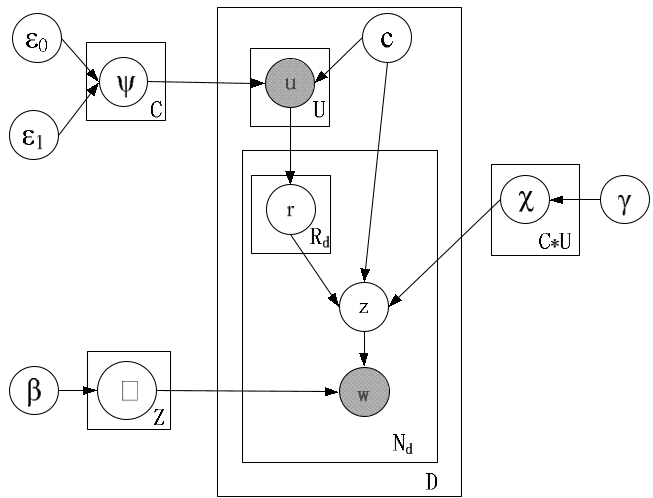 Fig 1: The Probabilistic Graphical representation of UIRCT, showing how latent communities (c) drive participant (p) and topic (z) selection.
2. Community Profiling with Wikipedia
Once the communities are discovered, the model needs to know what to call them. The authors used Wikipedia as an external knowledge base. By calculating the relevance of words to categories like "Education" or "Business" on Wikipedia, they mapped the UIRCT word distributions to human-readable labels like "Schoolmates" or "Colleagues."
Experimental Proof: Mapping Yao Chen’s Network
The authors tested this on real Sina Weibo data, including high-profile celebrities like actress Yao Chen.
Qualitative Success
The model successfully grouped Yao Chen's interactions. For instance, a professor from the Beijing Film Academy was correctly placed in a community dominated by topics like "teacher," "student," and "art," subsequently labeled as Schoolmates.
Quantitative Edge
Compared to baseline models (CUT and CART), UIRCT showed superior performance in:
- Perplexity: Lower perplexity indicates better predictive power for unseen data.
- Fuzzy Modularity: Higher scores prove that the discovered communities have dense, meaningful internal interactions.
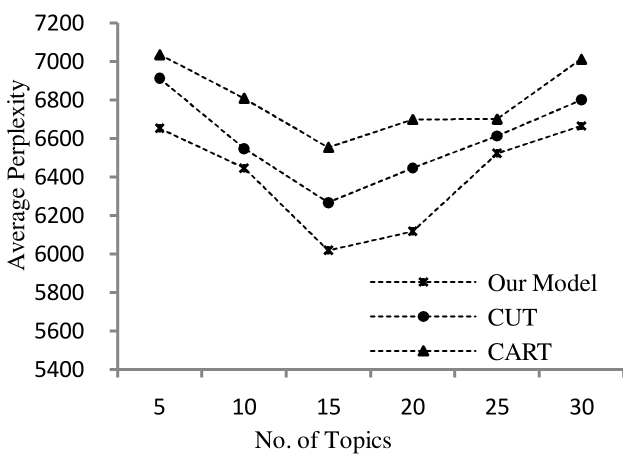 Table 1: Accuracy values across different relationship types. Relationship types like "Colleagues" and "Interests-oriented Friends" reached over 73% accuracy.
Critical Insight & Future Outlook
While the model is highly effective for professional and interest-based ties (73%+ accuracy), it struggled more with Family Members (46.7%). This highlights a fascinating sociolinguistic reality: we talk to our family about everything, making their "topic signature" much noisier and harder to distinguish from close friends.
Takeaway: This research moves us toward a more "human-centric" AI. By understanding the nature of a link, platforms can move beyond simple popularity-based recommendations to relationship-aware services—ensuring you see your sister's baby photos before a random celebrity's lunch.
Future Research Directions
The authors acknowledge that using Wikipedia is just the start. Future iterations could leverage more dynamic ontologies or incorporate temporal patterns (when you talk to people) to further refine the "Family" vs. "Friend" distinction.