
Beyond the Turing Machine: How Topological Potential Drives Collective Intelligence on the Internet
Interaction and Collective Intelligence on the Internet
This paper explores the evolution of Internet computing from traditional Turing machines to a "Collective Intelligence" model. It proposes a Topological Potential approach—combining mathematical topology with physics field theory—to model the uncertain interactions of human-machine systems and the emergence of collective wisdom.
TL;DR
The Internet is no longer just a "big computer"—it is a living ecosystem of uncertain interactions. This paper argues that the classical Turing Machine is insufficient for modern Internet computing because it ignores human participation. Instead, the authors propose a Topological Potential model that treats network nodes like particles in a physical field, successfully quantifying how individual interactions crystallize into Collective Intelligence.
1. The Uncertainty Crisis in Classical Computing
For decades, the Church-Turing Thesis served as the bedrock of computer science: if it’s computable, a Turing Machine can do it. However, the authors point out a fundamental flaw: Turing machines are closed, sequential, and deterministic.
The modern Internet is the opposite. It is defined by:
- Node Uncertainty: Routers, web pages, and users appear and disappear unpredictably.
- Behavioral Uncertainty: Human cognition and social influences cannot be reduced to a fixed "five-tuple" state transition.
- Interactive Complexity: Unlike a program that reads a fixed input tape, the Internet processes an infinite "input stream" where the output of one step changes the environment of the next.
2. Methodology: Modeling Networks as Physical Fields
To bridge the gap between rigid math and fluid social behavior, the authors introduce Cognitive Physics. They treat the network topology as a virtual field.
The Topological Potential Formula
The core idea is that every node exerts an "influence" on its neighbors, much like a gravitational or electric field. The potential at node is calculated as:
- (Node Mass): Represents the inherent property of a user (e.g., activity, knowledge, influence).
- (Logical Distance): Not physical distance, but the number of "jumps" between nodes in the network.
- (Influence Factor): Controls the range of the field. A small implies a short-range interaction (typical for specialized communities).
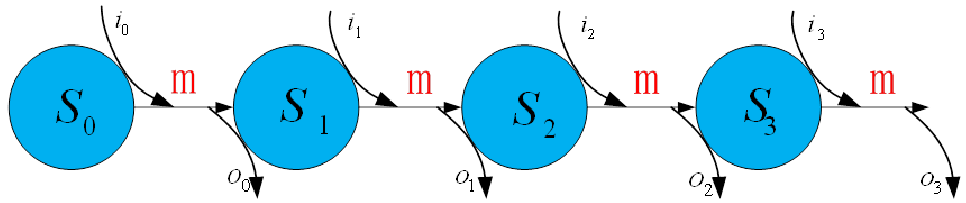 Fig 1: The Multi-Stream Interaction Machine—a model that accounts for external, unpredictable inputs.
3. Evidence of Emergent Intelligence
The paper validates this approach through three fascinating "Collective Intelligence" phenomena:
A. Social Tagging (The Power of the Crowd)
In systems like Flickr and Delicious, users create "folksonomies" (social taxonomies). The authors found that by using the Topological Potential approach, they could cluster tags more effectively than traditional K-means.
- Result: Personalized Information Retrieval (IR) performance reached its peak when the field-based clustering was applied, proving that "node influence" is a better metric than simple vector similarity.
B. Wikipedia: The Correction of Errors
Wikipedia is the ultimate example of collective consensus. While an individual might make a mistake (uncertainty), the interaction of thousands of users acts as a self-correcting field. The definition of "Cloud Computing," for instance, evolved from a simple one-liner to a comprehensive entry through thousands of iterative interactions.
C. Network Literature
Traditional writing is a "one-to-many" broadcast. Internet literature is a "many-to-many" interaction where readers influence the plot in real-time, turning the literary work into a byproduct of collective intelligence rather than a solo endeavor.
 Fig 2: Comparison of Information Retrieval (IR) methods showing the superiority of Topological Potential (right-most columns).
4. Critical Analysis & Future Outlook
Why it matters: This work shifts the focus from "algorithms" to "interactions." It suggests that AI's future isn't just bigger models, but better ways to integrate human feedback loops into the "topological field" of the network.
Limitations: The Gaussian potential function assumes a specific decay rate that might not hold true for all types of social networks (e.g., "viral" information may not follow a standard Gaussian distribution). Additionally, calculating the potential for billions of nodes in real-time presents a massive computational challenge.
Conclusion: As we move further into the era of Cloud Computing and Web 3.0, the "Internet as a Field" metaphor offers a powerful framework for understanding how millions of small, uncertain human actions coalesce into coherent, intelligent structures.