
Beyond Friendship: How Interaction Frequency Governs the Pulse of Social Opinions
Interaction-driven opinion dynamics in online social networks
This paper introduces an interaction-driven model for opinion dynamics in online social networks by extending the classical De Groot-Lehrer framework. It incorporates probabilistic interaction frequencies () between users and proves that such stochastic systems can be accurately approximated by a deterministic model with edge weights scaled by interaction probabilities.
TL;DR
Having a "friend" on a social network is not the same as being influenced by them. This paper addresses a critical gap in social graph theory: the difference between relationship structure and interaction dynamics. By extending the classical De Groot model with probabilistic interactions, the authors provide a mathematical framework to predict how fast opinions converge when communication is sparse—and they offer a computationally efficient "short-cut" to analyze these massive systems using deterministic linear algebra.
Background Positioning: This work bridges the gap between classic sociological models (1970s) and modern distributed consensus theory in multi-agent systems, specifically targeting the scale of Web 2.0 social networks.
The "Friendship" Fallacy
Most models of information diffusion treat a social network as a static graph. If a link exists, information flows. However, empirical studies indicate that the interaction graph—the actual exchange of messages and comments—is often far sparser and structurally different from the relationship graph (the "friend" list).
The core insight of Patterson and Bamieh is that ignoring the frequency of these interactions leads to a massive overestimation of how quickly a network reaches agreement. They argue that to model reality, every edge must be treated as a probabilistic pipe.
Methodology: From Stochastic Chaos to Deterministic Order
The Stochastic Model
The authors define the opinion update process as a stochastic recursion: Where is a Bernoulli random variable. This means communication only happens if the "coin flip" of interaction frequency () comes up heads.
The Spectral "Aha!" Moment
Analyzing the variance of such a system usually requires looking at the autocorrelation matrix , which is . For a network of 10,000 users, this involves a 100-million-element matrix—a computational nightmare.
The authors use Spectral Perturbation Analysis to prove a beautiful result: for large networks, the decay factor of this complex stochastic system is effectively the same as a simple deterministic system where edge weights are just scaled by their interaction probabilities.
 In the figure above, the researchers define the relationship between node degrees and the Laplacian matrix used for consensus.
Experiments: Real-World Social Pulse
The researchers tested their model on two significant datasets:
- Arxiv GR-QC: A collaboration network (4,158 nodes).
- Facebook Monterey Bay: A regional social snapshot (6,115 nodes).
Key Findings
- Interaction is Everything: When interaction probability dropped from 100% to a range of 1%-10%, the "Consensus Time" on Facebook jumped from 111 rounds to over 6,000.
- Validating the Shortcut: The deterministic approximation yielded decay factors (e.g., 0.999834) almost identical to the simulated stochastic results (0.99977).
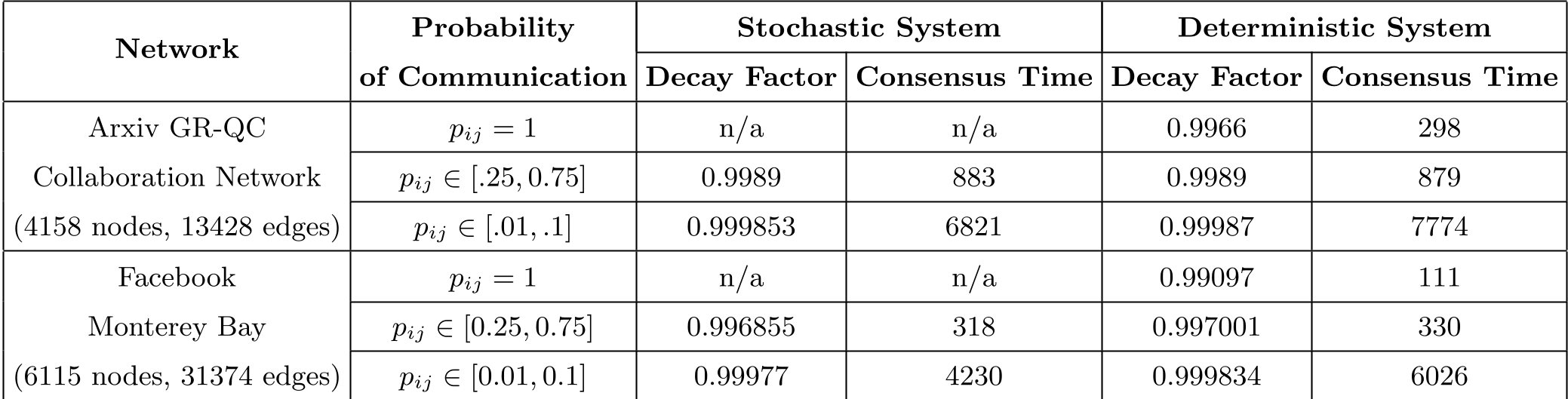 The table demonstrates how various interaction ranges () drastically alter consensus efficiency and how the deterministic model tracks the stochastic one.
Critical Insight & Conclusion
The value of this paper lies in its Strategic Network Modification potential. If you are a marketer or a policy maker, this model tells you that adding links (making friends) is less effective than increasing the frequency of interaction on existing links.
Limitations: The model assumes a fixed interaction probability over time, whereas real-world interactions often come in "bursts." Future work integrating the Friedkin-Johnsen model—where agents have "stubborn" internal beliefs—would add another layer of psychological realism to this robust mathematical foundation.
Takeaway: To understand opinion dynamics, look at the heartbeat (frequency) of the network, not just its skeleton (topology).