
IDML: Bridging Clinical Expertise and Deep Learning for Health Cohort Discovery
Interactive Deep Metric Learning for Healthcare Cohort Discovery
The paper introduces Interactive Deep Metric Learning (IDML), a framework for healthcare cohort discovery. It combines LSTM-based patient journey embeddings with an interactive metric learning process that incorporates expert feedback into clustering tasks across public datasets like MIMIC III and CMS.
TL;DR
Discovering patient cohorts (groups of patients with similar disease trajectories) is vital for policy-making and treatment research. This paper proposes Interactive Deep Metric Learning (IDML), a system that transforms raw Electronic Health Records (EHR) into temporal embeddings via LSTMs and refines clustering results through an iterative, human-in-the-loop feedback mechanism. By allowing experts to refine the distance metric dynamically, IDML achieves superior clustering performance compared to static deep learning models.
Background: The "Similarity" Paradox in Healthcare
In healthcare, "similarity" is not a fixed mathematical property; it is highly context-dependent. A researcher looking at re-admission rates views patient similarity differently than one studying medication reactions.
Previous approaches suffered from two major flaws:
- Handcrafted Features: They failed to capture the temporal "journey" of a patient.
- Static Learning: They required all labels upfront, ignoring the reality that clinicians refine their labels as they see the data clusters.
Methodology: The IDML Framework
The authors solve this by treating a patient's history as a Patient Journey—a sequence of visits, where each visit contains a set of medical codes.
1. Temporal Embedding (The "How")
Instead of simplistic one-hot encoding, they use an LSTM (Long Short-Term Memory) network to process the sequence of visits. This ensures that the order of medical events—not just their occurrence—is encoded into a fixed-length vector representation ().
2. The Interactive Loop
The "Interactive" part of IDML is its secret sauce. Rather than training once, the model follows these steps:
- Propose: Perform clustering based on current embeddings.
- Visualize: Show the clusters to a domain expert.
- Feedback: The expert identifies pairs of patients that should or should not be together (focusing on "borderline" cases).
- Update: The model adjusts the internal weights of the transformation matrix to honor this new feedback.
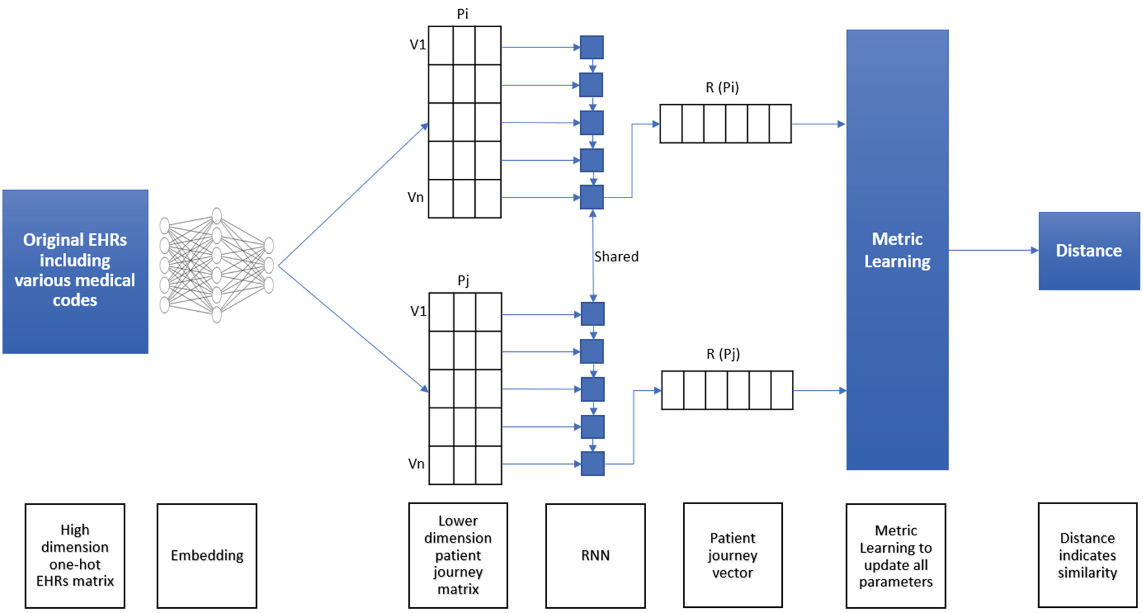 The end-to-end framework: From raw EHR sequences to expert-refined clusters.
Experimental Performance
The model was validated on the MIMIC III and CMS datasets across three cohorts (Diabetes, COPD, Heart Failure).
Key Quantitative Gains:
- Metric Superiority: IDML outperformed basic DML across all benchmarks. On the MIMIC III dataset, the ARI (Adjusted Rand Index) doubled compared to the baseline, suggesting that the expert's feedback is effectively "steering" the deep learning model toward clinically relevant clusters.
- Iterative Improvement: As shown in the performance charts, metrics like NMI and Purity generally improve with each subsequent round of expert interaction.
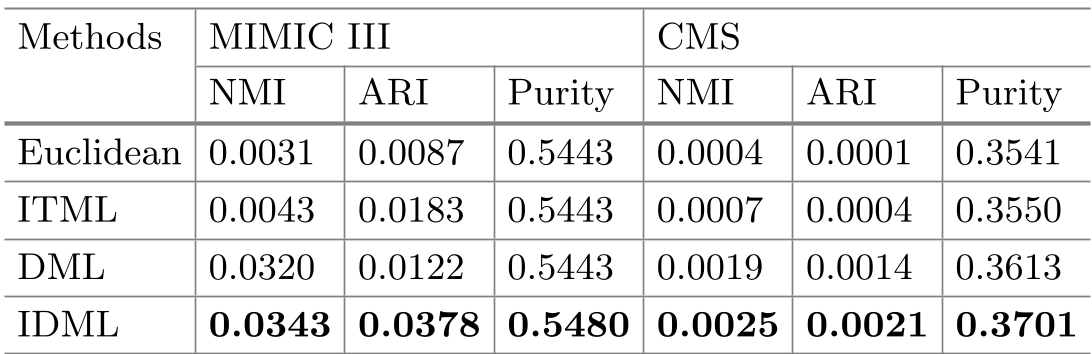 Comparative results showing IDML's consistent lead over Euclidean and ITML methods.
Deep Insight: Why Feedback Matters
The power of IDML lies in its Inductive Bias. By training the RNN on the specific feedback of experts, the model learns which temporal features are "noise" and which are "signals" for a specific analytical purpose. This is particularly effective in healthcare where EHR data is notoriously "noisy" and sparse. The strategy of labeling patients near the cluster boundaries (the "edges") functions as a form of Active Learning, maximizing the information gain from each expert interaction.
Conclusion & Future Outlook
IDML represents a transition from "Black Box" AI to "Collaborative AI." By deploying this tool within the Australian Government Department of Health, the authors have demonstrated that deep learning can be made interpretable and adjustable for policy analysts.
Limitations: The reliance on human experts still poses a bottleneck if scaled to massive, real-time datasets. Future work might explore "Self-Supervised" feedback to reduce the human burden while maintaining the same "concept-aware" sensitivity.