
Beyond the Button: Redefining Interaction in Educational Gaming via Machine Learning
Interactive educational game using machine learning
This paper presents a multimodal interactive educational game based on the story of Aladdin, utilizing Wekinator's machine learning regression and Unity. It replaces traditional button-based controls with a sophisticated set of inputs including face tracking, Leap Motion gestural input, voice commands, and Arduino-based muscle-flexing sensors to foster immersive learning.
TL;DR
This research showcases a novel educational game prototype that replaces the keyboard and mouse with the human body. By leveraging machine learning (Wekinator) and various sensors—Leap Motion, webcams, and Arduino muscle sensors—the project creates a "natural-interaction" version of Aladdin, where smiling, flexing, and speaking drive the narrative. It aims to move away from addictive "button-mashing" toward a more mindful and immersive learning experience.
Background & Positioning
While game graphics have evolved from 2D sprites to photorealistic 3D environments, the way we interact with them has remained largely stagnant for decades. We still push buttons and swipe screens. This paper, presented at IDC '20, positions itself as a bridge between Human-Computer Interaction (HCI) and pedagogy, using Machine Learning (ML) not for data processing, but as a real-time interpreter of human intent.
The Core Problem: The Clicking Barrier
The author argues that traditional inputs are "second nature" but ultimately restrictive. Modern games often encourage a specific type of mindless, repetitive interaction—pressing a button as fast as possible to win. This research highlights two specific pain points:
- Physical Disconnect: The gap between the digital world on the screen and the physical world of the child.
- Addictive Mechanics: The correlation between traditional "violent" input methods (repetitive clicking) and aggression or lack of self-control.
Methodology: The Multimodal "Magic Carpet"
The research utilizes a unique tech stack consisting of Unity, Wekinator (an interactive ML tool), and Open Sound Control (OSC) to create a zero-latency feedback loop.
The Four Pillars of Interaction:
- Leap Motion (Hand Gestures): Controls Aladdin’s magic carpet. A flat palm moves him up; a fist moves him down.
- Face Tracking (Computer Vision): This is perhaps the most "natural" layer. Moving closer to the webcam triggers movement, while a smile is used to collect tokens.
- Voice Control: Simple lexical analysis of "Open" and "Close" commands to bypass obstacles.
- Muscle Flexing (EMG via Arduino): Used for action-oriented tasks like throwing items, but controlled by a software threshold to ensure the action is deliberate.
 Fig 1: The visual aesthetic of the Arabic Town in the Aladdin prototype.
Designing for Non-Addiction
A critical technical detail in this work is the Threshold System. Instead of binary "on/off" button presses, the author uses a scale (e.g., 0 to 1). An action is only triggered when the user reaches a specific mastery/intensity level (like 0.9). This forces the player to slow down, settle their movements, and practice "calm" play.
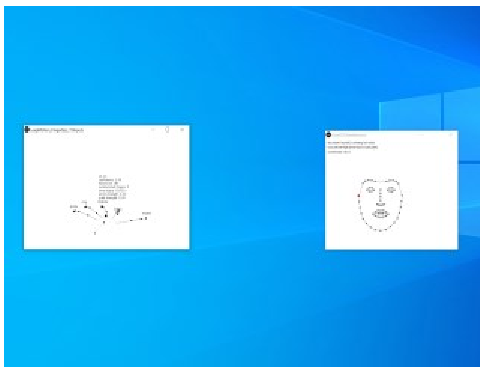 Fig 2: Real-time visualization of Leap Motion and face-tracking inputs on the side screen.
Experiments and Insights
The experiment showed that while using four inputs might seem complex, it successfully engages multiple senses. By displaying the "raw" ML data on small side-screens, children were able to visualize the "cause and effect" of their physiology on the digital world.
Key Results:
- Engagement: Average play session of 8-9 minutes, significantly more focused than typical "clicker" games.
- Cognitive Mapping: Children showed an improved understanding of how specific physical states (like smiling or flexing) correlate to digital outcomes.
- Incentivization: The use of a ranking system based on time and tokens collected added a healthy layer of competition without reverting to addictive input habits.
Critical Analysis & Conclusion
Takeaway
The value of this work lies in its philosophy of "Natural Interaction." It treats Machine Learning as an "artist's tool" to decode the human body, turning every muscle twitch or facial expression into a potential gameplay mechanic.
Limitations
The primary hurdle is hardware accessibility. As the author notes, a regular user is unlikely to own a Leap Motion, an Arduino EMG shield, and a high-quality webcam simultaneously.
Future Work
The next step for this line of research is to consolidate these diverse inputs onto more accessible hardware—perhaps using only a standard smartphone camera to estimate both face gestures and hand poses via MediaPipe or similar frameworks, bringing this deep layer of interaction to the masses.