
Pl@ntNet: Scaling Biodiversity Identification via Social Intelligence and Multi-Organ Fusion
Interactive plant identification based on social image data
This paper introduces Pl@ntNet, a collaborative platform and interactive system for plant identification across 2,258 species. It leverages a unique social network workflow and a multi-organ visual search engine that identifies plants using images of leaves, flowers, bark, fruits, and full plant views.
TL;DR
Pl@ntNet tackles the "taxonomic gap"—the difficulty of identifying plant species—by combining a professional social network with a robust multi-organ visual search engine. Covering over 2,200 species, it moves beyond simple leaf-matching to a holistic system that uses flowers, fruits, and bark to identify plants year-round with high accuracy.
Background: Beyond the Single-Leaf Limitation
Historically, automated plant identification has been a "leaf-centric" field. While leaves are convenient, they disappear in winter (deciduous species) and often look identical across unrelated species (the "laurel" problem). Furthermore, existing datasets suffer from the long-tail problem: a few species have many images, while thousands of others have almost none.
Pl@ntNet's insight is twofold:
- Social Validation: Use a community of 19,000 botanists to filter and label crowdsourced noise.
- Multi-View Logic: If a leaf isn't enough, check the bark or the flower.
Methodology: The Engineering of Botanical Vision
1. The Collaborative Workflow
Instead of just "scraping" the web, Pl@ntNet feeds on a circular ecosystem. Novices provide raw photos; amateurs and experts validate them through a consensus-based voting system. This creates a high-quality, "live" training set that grows every night.
2. Multi-Organ Visual Search Engine
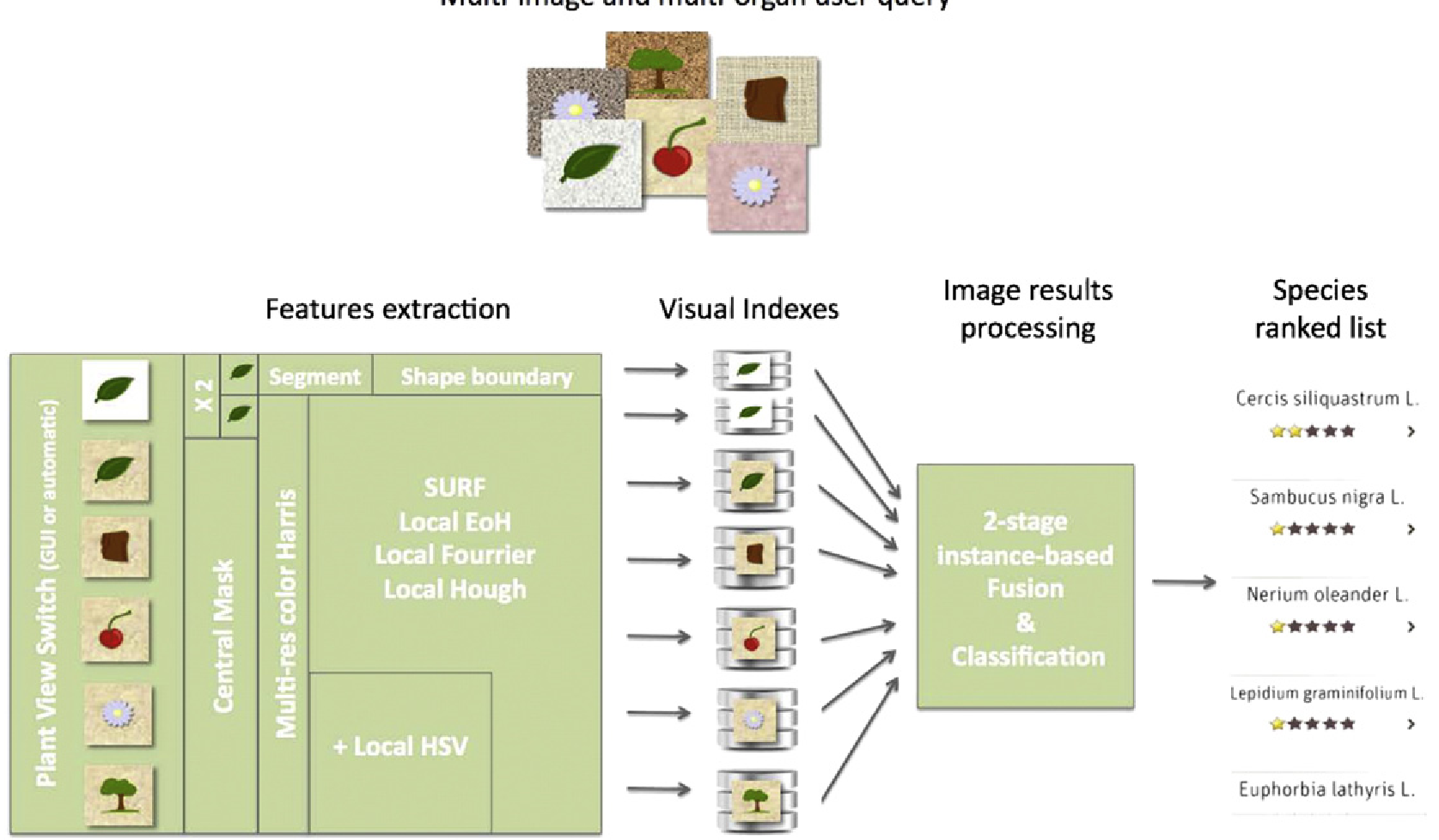
The system treats different plant views as separate search indices to prevent "visual confusion." A flower query is matched against a flower index, not a bark index.
- Feature Extraction: It uses multi-resolution color Harris points to capture the intricate textures of petals and bark.
- Dimension Reduction & Indexing: Using Random Maximum Margin Hashing (RMMH), high-dimensional visual features are compressed into 256-bit binary codes for lightning-fast retrieval across millions of images.
- Decision Fusion: The system calculates a weighted sum of confidence scores across all uploaded views (Leaf + Flower + Bark), giving higher weights to the most "discriminative" organs for that specific query.
Experimental Breakthroughs
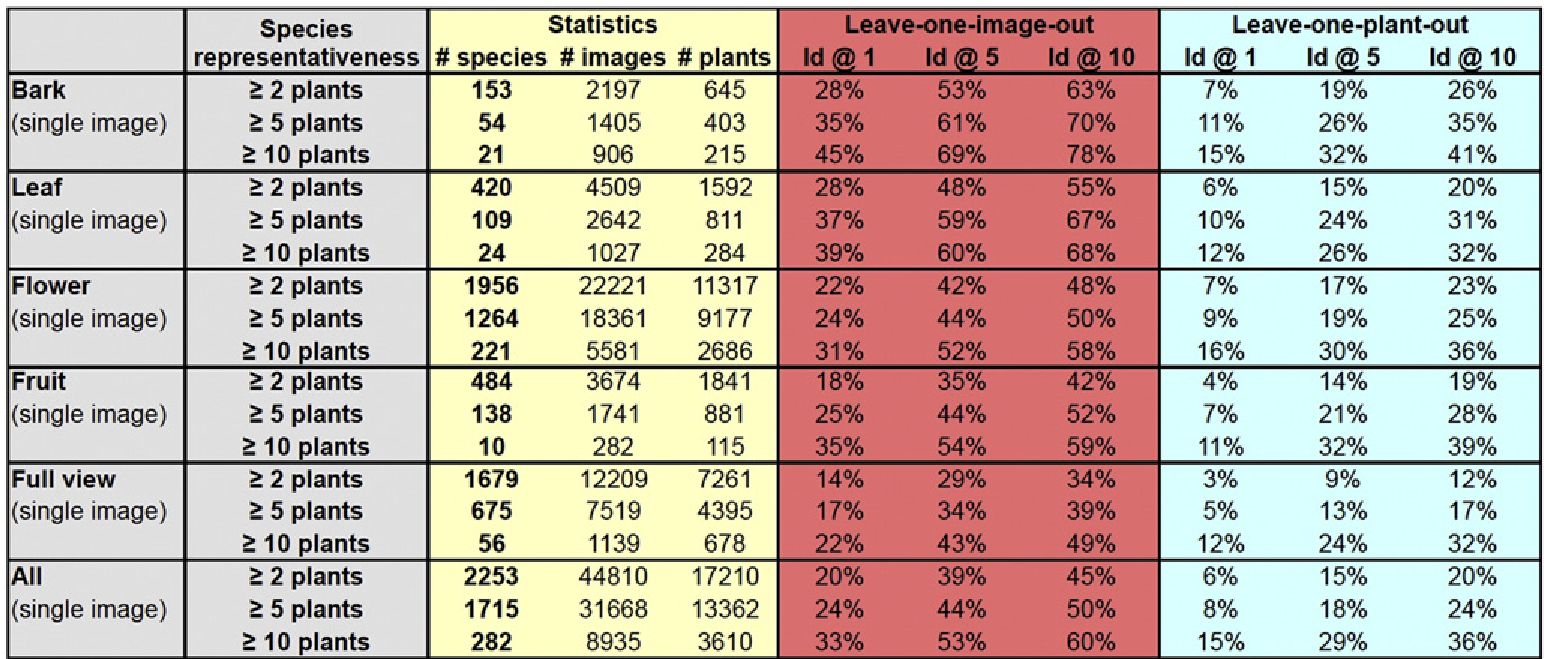
The research demonstrates that "more is more." Identification accuracy (Id@5) for leaves alone might be 15%, but when users provide multiple images of the same plant, efficiency skyrockets.
- The Bark-Leaf Synergy: For trees, the Bark + Leaf combination proved most potent (30% Id@5), effectively acting as a taxonomic filter.
- Human-in-the-loop: User trials showed that while the "brute force" AI is helpful, providing interactive tools (like taxonomic filtering and "more details" buttons) allowed non-experts to reach an 85% identification rate.
Critical Insight: The "Plant-Out" Protocol
A key academic contribution here is the Leave-One-Plant-Out evaluation. Unlike standard "Leave-One-Image-Out" tests (which can cheat by testing on a different photo of the same physical leaf), this protocol ensures the system generalizes to entirely new individuals observed in different lighting and locations.
Conclusion & Future Outlook
Pl@ntNet represents a shift from "AI as a black box" to "AI as a community tool." While raw top-1 accuracy on 2,000+ species remains a challenge for any computer vision system, the integration of social verification and multi-organ fusion makes it the most practical tool for biodiversity conservation available today. Future iterations on mobile (iOS/Android) and the adoption of Deep Learning promise to bridge the taxonomic gap even further.
Takeaway: The future of environmental monitoring isn't just better algorithms—it's the synergy between specialized social networks and multi-view data fusion.