
SocialRank: Decoding Organizational DNA through Ego-Centric Communication Workflows
Interactive poster - SocialRank: An ego- and time-centric workflow for relationship identification
SocialRank is an ego-centric and time-centric workflow system designed to identify social relationships within email corpora. It integrates content-based and activity-based ranking algorithms with advanced visualizations like Multidimensional Scaling (MDS) and temporal network diagrams to streamline the discovery and validation of organizational structures.
TL;DR
SocialRank is a specialized analytical framework designed to transform massive email archives into validated social networks. By combining content-based AI rankers (to find "who reports to whom") with temporal activity analysis (to find communication rhythms), it allows analysts to bypass thousands of irrelevant emails and focus on the "smoking gun" messages that define a relationship.
Background Positioning
In the world of intelligence analysis and litigation support, experts are often buried under a mountain of digital "artifacts"—sent emails, timestamps, and CC lists. Mapping this raw data into a structured social graph is a Herculean task. SocialRank positions itself as a bridge, moving beyond simple graph theory into a multi-dimensional, human-in-the-loop workflow that prioritizes time and ego-networks.
The Problem: The Noise of Digital Communication
Traditional communication graphs show who talks to whom, but they rarely explain why or in what capacity. An analyst trying to uncover a hidden corporate hierarchy (like the Enron structure) faces two major hurdles:
- Entity Resolution: Knowing that "j.smith@corp.com" is effectively "John Smith."
- Relationship Identification: Deciding if John is a manager, a subordinate, or a peer based solely on his interactions.
Previous tools often ignored the temporal dynamics—the fact that relationships evolve, peak, and fade over time.
Methodology: The Dual-Engine Approach
SocialRank uses two distinct "lenses" to analyze data:
1. Content-Based Ranking (The "What")
The system uses a scoring function trained on message content. If a message contains directives, status updates, or approvals, it boosts the probability of a "Manager-Subordinate" relationship. Crucially, it doesn't just rank people; it ranks the messages themselves, guiding the analyst to the most important evidence.
2. Activity-Based Ranking (The "When")
This is the "structural" lens. By creating activity vectors (temporal rhythms of communication), the system uses Metric Multidimensional Scaling (MDS) to map relationships into a 2D space. If two pairs of people communicate with the same frequency and timing as a known manager-subordinate pair, they are visually clustered together, even if the content of their emails is entirely different.
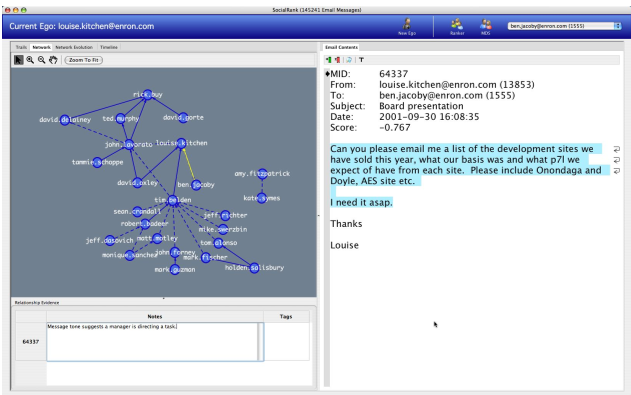 Figure 1: The SocialRank interface showing the integration of the social graph, annotations, and corroborated evidence.
Experiments & Results: Turning Trace into Truth
Using the Enron email corpus as a testbed, SocialRank demonstrated how a structured workflow—Discovery, Validation, Annotation, and Dissemination—dramatically cuts down analysis time.
- The Timeline Viewer: Instead of a flat list of emails, analysts see a temporal distribution. Visual cues highlight "high-rank" messages, reducing the search space from hundreds of emails to a handful of critical ones.
- Network Evolution: The system tracks how a social network grows over time, allowing analysts to see the exact moment a relationship was "validated" by evidence.
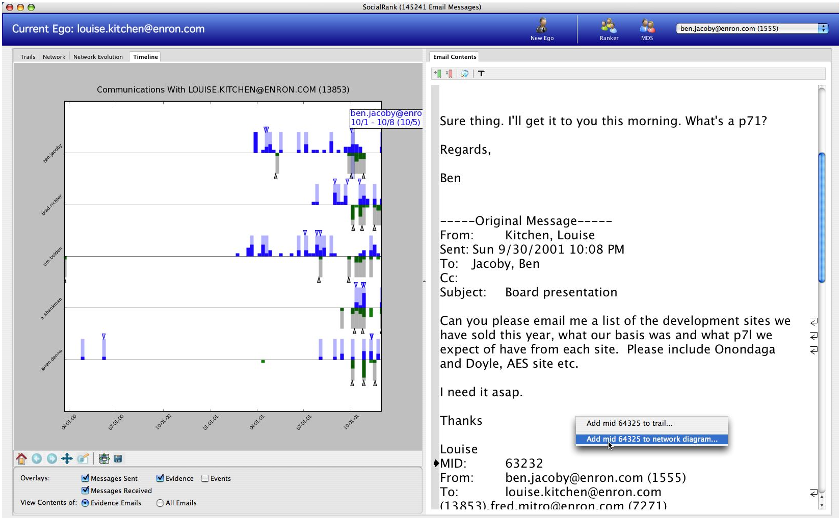 Figure 2: The Egocentric Network Evolution viewer tracks the development of organizational structure alongside temporal evidence.
Critical Insight & Future Outlook
The genius of SocialRank lies in its ego-centric focus. By centering the world on a single "ego" and observing their "alters," it makes the complex problem of global network analysis manageable for a human analyst.
Limitations & Next Steps
The current iteration relies on offline training. The authors identify the need for Incremental Learning, where the system learns the analyst's preferences in real-time. As the analyst labels a relationship as "Personal" or "Professional," the ranker should adjust its weights immediately.
In the modern context, replacing their basic content-rankers with LLMs (Large Language Models) would likely provide a massive leap in nuance, allowing the system to detect subtle power dynamics or sentiment shifts that simple scoring functions might miss.
Conclusion
SocialRank remains a foundational example of how Visual Analytics should work: not just by drawing pretty graphs, but by combining robust machine learning with intuitive, time-aware interfaces to solve high-stakes investigative problems.