
Interactive Recommendations: Leveraging the Wisdom of Social Endorsement Networks
Interactive Recommendations in Social Endorsement Networks
The paper introduces a framework for conducting interactive recommendations within "Social Endorsement Networks" (bipartite graphs of users and endorsed entities like videos or users). It utilizes frequent itemset mining and a custom search engine to recommend cohesive groups of entities that both match a textual tag query and share a significant base of common endorsers (e.g., followers or citations).
TL;DR
In a world of "Likes," "Follows," and "Favs," how do we recommend entities that not only match a user's interest but also carry the weight of social authority? This paper formalizes Social Endorsement Networks and introduces a search engine capable of recommending groups of entities that share common tags and a significant number of common endorsers. By combining frequent itemset mining with a clever redundancy filter, the authors enable interactive, explainable, and highly relevant social discovery.
The Motivation: Why the "Like" Button Matters
Current recommendation systems often act as black boxes. They might suggest a movie because "users like you also watched it," but they rarely explain the underlying commonality. The authors argue that the bridge between a user and an entity is the Endorsement.
The fundamental question is: Why did a specific crowd choose to endorse a particular set of entities? By finding groups of entities endorsed by the same large demographics, we can extract the "characteristic aspects" that appeal to that crowd. This transforms a simple bipartite graph into a rich, searchable corpus of group identities.
Methodology: From Bipartite Graphs to Searchable Groups
The framework follows a four-stage pipeline:
1. Extraction of Popular Groups
The system treats the entities endorsed by a single user as a "transaction." It then employs frequent itemset mining to find groups of entities that appear together across at least endorsers. This captures the collective behavior of millions.
2. Group Tagging and Attribute Aggregation
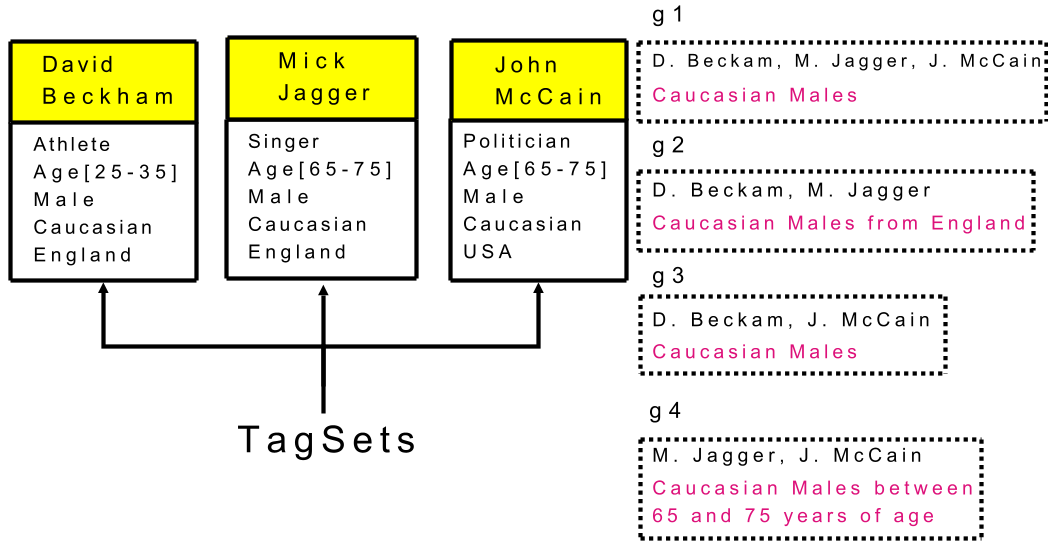
Once a group is identified, what defines it? The authors use an intersection of tags (e.g., from Wikipedia or IMDB profiles). If a whole group of people are all "Pop Singers," "Female," and "from the USA," those tags define why they share a following.
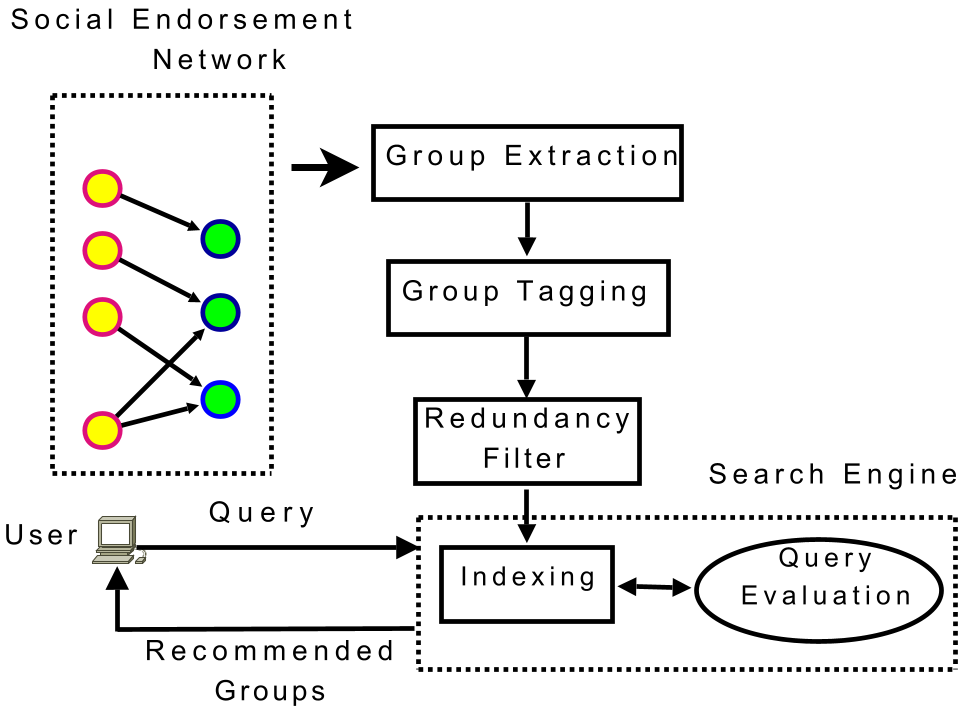
3. Redundancy Filtering (The Secret Sauce)
Mining frequent sets often leads to "explosive" results where many groups are just subsets of others without adding new information. The authors propose the GroupFilter algorithm. It prunes a group if a larger "super-group" exists that contains all its members and carries the same or more descriptive tags.
- Result: In the Twitter dataset, this reduced millions of redundant entries into a compact set of ~56,000 informative groups.
4. Interactive Search Engine
They implement a Top-K search engine using an inverted index. Users submit queries (e.g., "Athlete," "Pop"), and the system returns the largest groups that satisfy the query, sorted by the number of shared followers.
Experiments & SOTA Insights
The researchers tested their framework on two vast datasets: Twitter (6.4M users following top-1000 icons) and DBLP (citation network of authors).
Quantitative Impact
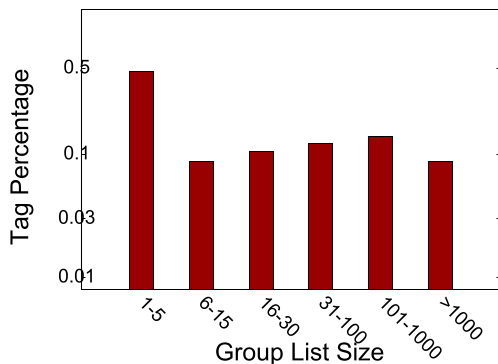
The effectiveness of the GroupFilter is most evident in the DBLP dataset, where the number of groups was significantly compressed, saving massive computational overhead for real-time querying.
Qualitative Performance: Explainability in Action
On Twitter, a query for "Music Artist, Pop, Female, Age [20-30]" returned a group including Britney Spears and Lily Rose Allen, backed by nearly 100,000 shared followers. On DBLP, querying for "Privacy" identified a group of authors who co-wrote seminal papers on distributed object-oriented databases. The recommendation isn't just an item—it's a contextual cluster backed by social proof.
Critical Analysis & Conclusion
Takeaways
- Group-Centricity: Recommending groups rather than single entities provides a "landscape" of a field or genre.
- Explainability: The common tags and endorser count act as a natural justification for the recommendation.
- Efficiency: The use of UBTree and inverted indexes makes this viable even for the 6-million-user scale of 2010 Twitter.
Limitations & Future Work
While the tagging is robust, it relies heavily on external structured data (Wikipedia/IMDB). Future iterations could benefit from LLM-based tag extraction or Vector Embeddings to handle fuzzy tag matching. Additionally, the bipartite model could be extended into a multi-layer graph to include user-user social links ("friendships") alongside user-entity endorsements.
In summary, this paper provides a principled bridge between community discovery and interactive search, proving that the best recommendations often come from the collective "Like" of a crowd.