
CrossCult: Breaking Cultural Silos with Semantic Interconnections and Adaptive Narratives
Interconnecting Objects, Visitors, Sites and (Hi)Stories Across Cultural and Historical Concepts: The CrossCult Project
The CrossCult project presents a semantic-based technological framework aimed at interconnecting digital cultural heritage assets across European borders. It utilizes an extensive knowledge base and mobile applications to provide personalized, context-aware narratives that foster serendipitous learning and reflection.
TL;DR
History is a mesh of interconnected stories, yet our museum experiences are often isolated fragments. The CrossCult project introduces a comprehensive technological platform that uses semantic reasoning, social media profiling, and context-aware recommendations to weave these fragments into personalized, cross-border narratives.
Contextual Positioning
In the landscape of Digital Cultural Heritage (DCH), CrossCult sits at the intersection of Semantic Web technology and Adaptive User Experience. Unlike traditional audio guides, it doesn't just describe an object; it links that object to others across different cities and eras, transforming a "visit" into a "holistic historical journey."
The Problem: The "Silo" Effect and the "Cold Start"
The paper identifies two critical pain points:
- Narrative Fragmentation: History is taught and presented in isolation (by country or site), ignoring the cross-border movement of people and ideas.
- Profiling Barriers: Personalization requires knowing the user, but museum visitors are transient. They won't fill out long surveys (Explicit Profiling), leading to the "Cold Start" problem where the system doesn't know what to recommend initially.
Methodology: The Core Engine
The CrossCult architecture is divided into a sophisticated Front-end for curators and a Back-end for data processing.
1. The Knowledge Base (KB)
The heart of the project is a repository that establishes semantic links. These aren't just "Related Items" tags; they are ontological relationships (e.g., linking a 15th-century painting of a loom to a 20th-century industrial site through the concept of "Handicrafts").
2. Implicit Profiling & Micro-Gaming
To bypass the cold start problem, CrossCult uses:
- Social Media Mining: Extracting personality traits and interests from Facebook/Twitter (with consent).
- Mini-Games: Quick quizzes that reveal a visitor's "cognitive style" (e.g., do they prefer visual data or narratives?).
3. Architecture Overview
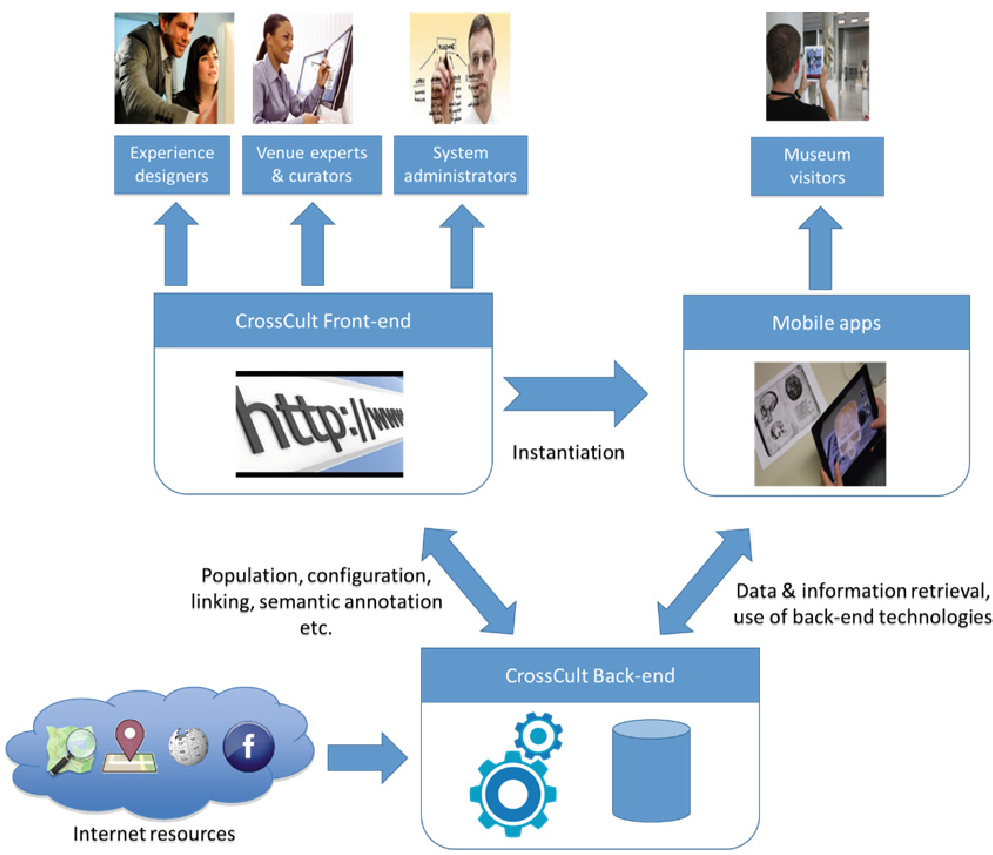 The image illustrates the interaction between experience designers, curators, and the automated app instantiation process.
Dual Performance: Item and Path Recommendations
CrossCult doesn't just recommend an individual statue (Item Recommendation); it constructs a meaningful path.
- Serendipity: It uses "trending topics" from social media to suggest exhibits that are relevant to current news or holidays.
- Crowd-Awareness: Paths are dynamically re-routed based on real-time data to avoid crowded areas, enhancing the Quality of Visitor Experience (QvE).
- Group Dynamics: The system detects if individuals are part of a group (via Bluetooth/NFC) and suggests collaborative educational games.
Critical Insights & Future Outlook
The most innovative aspect of CrossCult is the "Sporadic Social Network." By recommending connections between strangers with similar interests within a venue, the platform turns a solitary museum visit into a social event.
Potential Limitations:
- Implementation Overhead: Curators must invest significant effort into semantic tagging, which may be a bottleneck for smaller institutions.
- Privacy Concerns: Heavy reliance on social media profiling and "interconnecting" people requires extremely robust data ethics frameworks.
Conclusion
CrossCult represents a shift from "information delivery" to "reflection and reinterpretation." By treating history as a graph rather than a list, and by using AI to bridge the gap between digital data and human curiosity, the project paves the way for a more unified European cultural identity.