
InComT: Bridging Social Interests and Community Structure for Efficient Mobile Routing
Message Transmission Scheme Based on the Detection of Interest Community in Mobile Social Networks
The paper introduces InComT (Interest Community based Transmission), a message routing scheme for Mobile Social Networks (MSNs). It leverages a novel interest-based community detection algorithm to optimize "storage-carry-forward" delivery, achieving higher success rates and lower latency compared to classical protocols like Epidemic and Spray and Wait.
TL;DR
In the world of Mobile Social Networks (MSNs), your interests define your movement. The InComT protocol capitalizes on this by grouping users into "Interest Communities." By calculating weighted interest similarities, it routes messages through nodes that are mathematically most likely to encounter the destination, slashing latency and network overhead compared to traditional "flooding" approaches.
Context: The "Storage-Carry-Forward" Dilemma
Mobile Social Networks operate in a world of intermittent connectivity. Since nodes (users) are constantly moving, end-to-end paths are rarely stable. The standard solution is Epidemic Routing—spread the message like a virus to everyone you meet.
The Problem? This causes massive network congestion. While refinements like Spray and Wait limit the number of copies, they lack "intelligence" regarding where the message should go. The authors of this paper argue that social properties—specifically Interests—are the missing link to predictable routing.
Methodology: How InComT Works
The core innovation of InComT is its two-stage community-driven approach.
1. Interest-Based Community Detection
Instead of just looking at who meets whom, InComT looks at why they meet. Each node maintains an Interest Table with weights for different topics.
- Main Interest Matching: When two nodes meet, they first compare their primary interests.
- Cosine Similarity: If their main interests align, they calculate a similarity score () based on their entire interest vector. If it exceeds a threshold (0.5), they are grouped into the same community.
2. The Hybrid Routing Strategy
Routing is split into two distinct phases to maximize efficiency:
- Inter-Community: Messages move between communities using "bridge" nodes (nodes that belong to multiple communities) that are geographically closer to the target.
- Intra-Community: Once the message reaches the target community, it is handed to a relay node that has the highest interest similarity to the final destination node.
Note: The system leverages GPS coordinates for inter-community distance calculation and interest vectors for node selection.
Experimental Performance
The researchers tested InComT against Epidemic, FirstContact, and Spray and Wait using the ONE (Opportunistic Network Environment) simulator.
Key Findings:
- Success Rate: InComT achieves a higher delivery ratio than FirstContact and Spray and Wait. While Epidemic has a slightly higher raw success rate initially, it collapses under high TTL (Time-To-Live) due to buffer overflows—a problem InComT avoids.
- Lowest Latency: InComT consistently shows the lowest average delivery delay. By targeting nodes with similar interests, the "waiting time" for a chance encounter is significantly reduced.
- Resource Efficiency: The overhead ratio is kept low, nearly matching the efficiency of the Spray and Wait algorithm but with much faster delivery times.
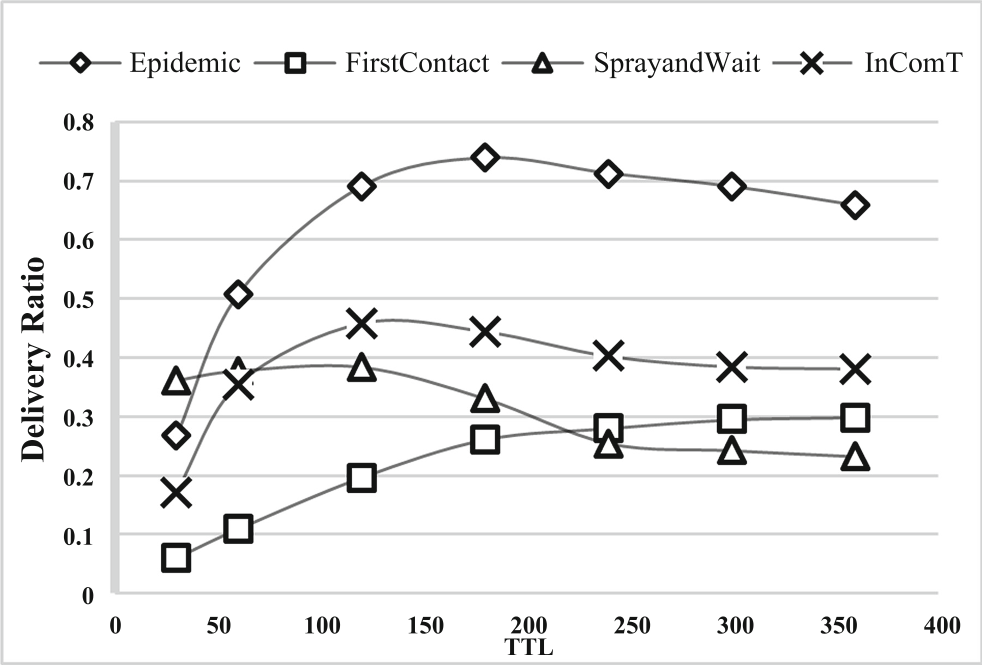 Fig 1: Delivery ratio comparison. Notice how InComT remains robust as TTL increases compared to the congestion-prone Epidemic routing.
Critical Insight: Why This Matters
The brilliance of InComT lies in its Inductive Bias. It assumes that people with similar interests (e.g., colleagues at a workplace or fans at a concert) tend to cluster in the same physical spaces. By mapping digital interests to physical meeting probabilities, the protocol creates a "hidden map" of the network that exists even when nodes aren't currently connected.
Future Outlook & Limitations
While InComT is highly efficient, it currently assumes all nodes are "collaborative" (no malicious nodes). In real-world scenarios, sybil attacks or "selfish" nodes that refuse to carry others' messages could disrupt the interest-based relay. Future iterations would benefit from a trust-based incentive mechanism to ensure reliable forwarding in non-cooperative environments.
Author Perspective: This paper successfully demonstrates that in MSNs, "Social Geometry" is just as important as physical topography. For developers building decentralized social apps or mesh networks, the weighted interest similarity approach offers a clear path toward scalable, low-power communication.