
Interest-Driven Routing: Leveraging Social Semantics for Efficient DTN Delivery
An interest-driven routing algorithm in disruption-tolerant networking based social networks
This paper introduces an Interest-Driven Routing algorithm for Disruption-Tolerant Networking (DTN) based social networks. By grouping nodes with similar interests into communities and employing dual social strength metrics (CSS and PSS), the method achieves superior message delivery and resource efficiency.
TL;DR
In the transient world of Disruption-Tolerant Networking (DTN), physical paths are rare. This paper proposes a routing strategy that shifts the focus from "who meets whom" to "who shares what interests." By grouping nodes into interest-based communities and using specific social strength metrics, the authors achieve a significant boost in delivery rates while keeping network overhead (load and hops) remarkably low.
Problem & Motivation: The Chaos of Opportunistic Connections
Traditional routing in DTNs relies on flooding (Epidemic) or probabilistic encounter history (Prophet). However, these methods treat nodes as random moving particles rather than social entities. In reality, human movement is driven by interests.
Existing community-based algorithms (like BUBBLE Rap) often struggle with "community explosion," where dynamic nodes eventually link everyone together, making the social labels useless. The authors suggest that Interests (e.g., Sports, Military, Education) are a more stable and "lightweight" way to define clusters compared to complex contact-frequency graphs.
Methodology: The Dual-Strength Engine
The core of the paper lies in how it defines "social utility" through two specific lenses:
1. Interest of User (IoU) & Community Detection
Every user has an interest vector . A node is categorized into a community based on its maximal interest value. This makes community detection a simple attribute-matching task rather than a global calculation.
2. CSS vs. PSS: Navigation Logic
To decide whether to hand off a message to a neighbor, the algorithm evaluates:
- Community Social Strength (CSS): How central is the node within the target interest community?
- Perceived Social Strength (PSS): How effective is the node at bridging different communities?
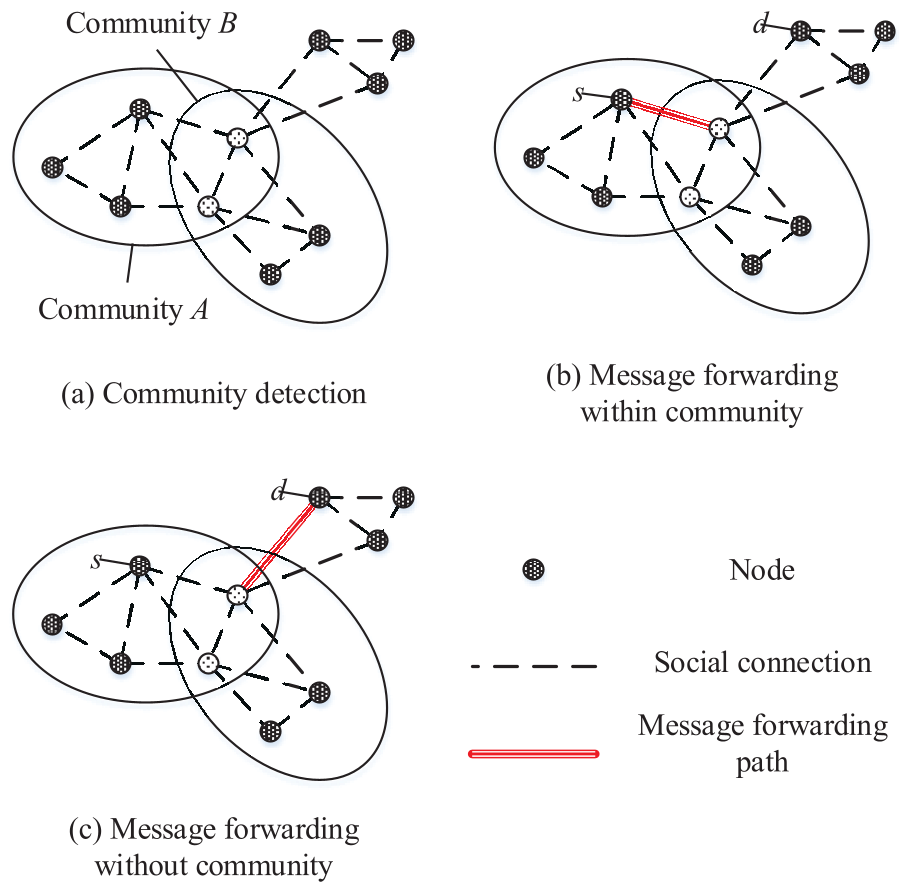
The Strategic Logic (Algorithm 1):
- If a neighbor belongs to the destination's interest community, give them the message.
- If multiple neighbors qualify, pick the one with the highest CSS.
- If no one in the current vicinity belongs to the community, pick the neighbor with the highest PSS to increase the chance of jumping to the right community.
Experiments & Results
Testing was conducted using the ONE (Opportunistic Network Environment) simulator. The authors focused on three key metrics: Delivery Rate, Hop Count, and Network Load.
Impact of Cache Space
As node buffers increase from 10MB to 50MB, the Interest-Driven algorithm consistently maintains a higher delivery rate than Prophet.
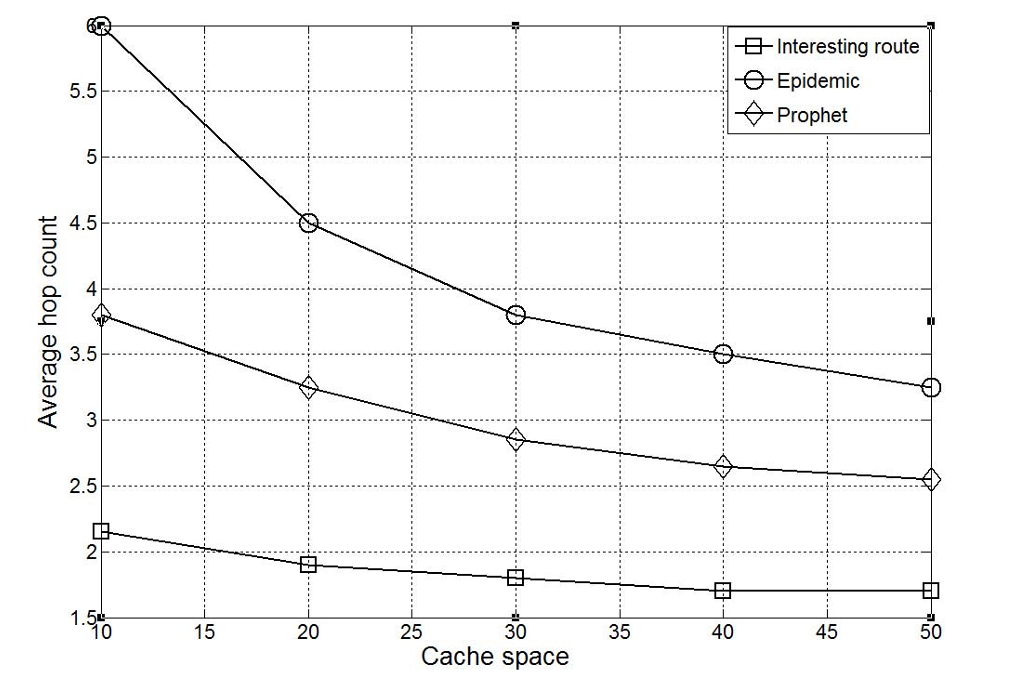 Fig: The Interest-Driven approach requires fewer 'hops' to reach the target, indicating more purposeful routing.
The TTL Challenge
One interesting finding is that increasing Time-to-Live (TTL) for messages actually decreases the delivery rate eventually. Why? Because surviving "zombie" messages clog the cache, preventing new, more relevant messages from being stored. Even under these conditions, the proposed algorithm managed the cache more effectively than the Epidemic baseline.
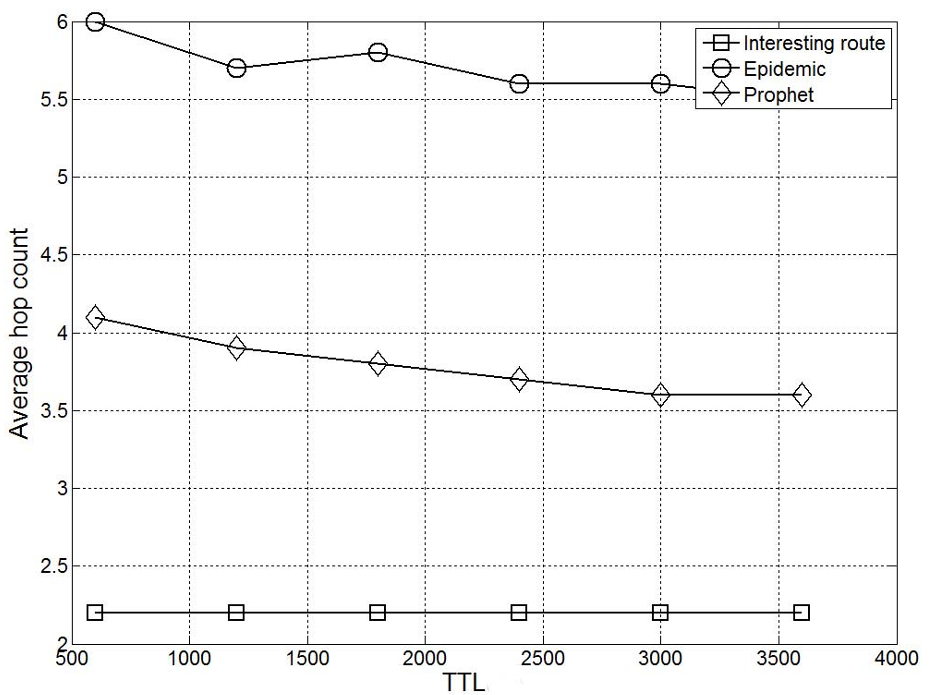 Fig: Network load is significantly lower, reducing the resource drain on mobile devices.
Critical Analysis & Conclusion
Takeaway
The paper successfully demonstrates that semantic similarity (interests) is a powerful proxy for topological proximity. By selecting relays that "care" about the message content, the network naturally routes data toward clusters where the destination is likely to reside.
Limitations & Future Work
While the algorithm is efficient, it assumes that users are willing to share their interest profiles (Privacy concerns) and that interests remain static. Future research could explore privacy-preserving interest matching or dynamic interest evolution to reflect how human preferences shift over time.
Ultimately, this work provides a solid blueprint for building social-aware mobile networks that handle the chaos of intermittent connectivity with human-like intuition.