
Beyond Keywords: Discovering User Interests via Semantically Enriched Social Graphs
An Interests Discovery Approach in Social Networks Based on Semantically Enriched Graphs
The paper introduces a novel interest discovery framework for social network users by constructing Semantically Enriched Graphs (SG) and Semantic Social Graphs (SSG) from informal posts. It utilizes the "Root-Path-Degree" algorithm and Linked Open Data (Freebase) to identify the most representative sub-graphs of user interests, significantly outperforming traditional Bag-of-Words (BOW) classifiers.
TL;DR
This research tackles the challenge of identifying user interests in the "noisy" environment of social media. By moving beyond simple word counts (Bag-of-Words) and leveraging Linked Open Data (LOD), the authors construct Semantic Social Graphs (SSG) that capture implicit relationships between entities. Their "Root-Path-Degree" algorithm identifies core interests with a 79% precision, proving that social context and external knowledge are the keys to understanding short-form text.
The Problem with "Bag-of-Words" in Social Media
Most standard NLP techniques are designed for well-structured, long-form text. However, Social Network Systems (SNS) reflect what the authors call Lingual Characteristics of Posts (LCP): they are short, informal, and riddled with grammatical errors.
If a user posts "Jordan Arabic," a traditional classifier might struggle. Is it the country? The basketball player? The language? Standard frequency-based methods (BOW) provide high recall but abysmal precision because they treat every word as an isolated unit, failing to catch the implicit semantic relations that human readers naturally understand.
Methodology: Building the Semantic Social Graph (SSG)
The authors propose a pipeline that transforms raw posts into a rich, structured graph.
1. Entity Extraction and Enrichment
Instead of just looking at words, the system extracts Noun Phrases and Named Entities. These are then mapped to Freebase (a massive LOD repository) to retrieve synonyms and related concepts. This "disambiguates" the text—connecting "Amman" to "Jordan" even if "Jordan" isn't explicitly mentioned in the same post.
2. The Semantic Social Graph (SSG)
A unique contribution is the inclusion of Social Context. The graph isn't just built from the user's posts; it includes comments from friends. This creates a "Semantic Social Graph," where edges represent semantic relations weighted by their frequency in the knowledge base.
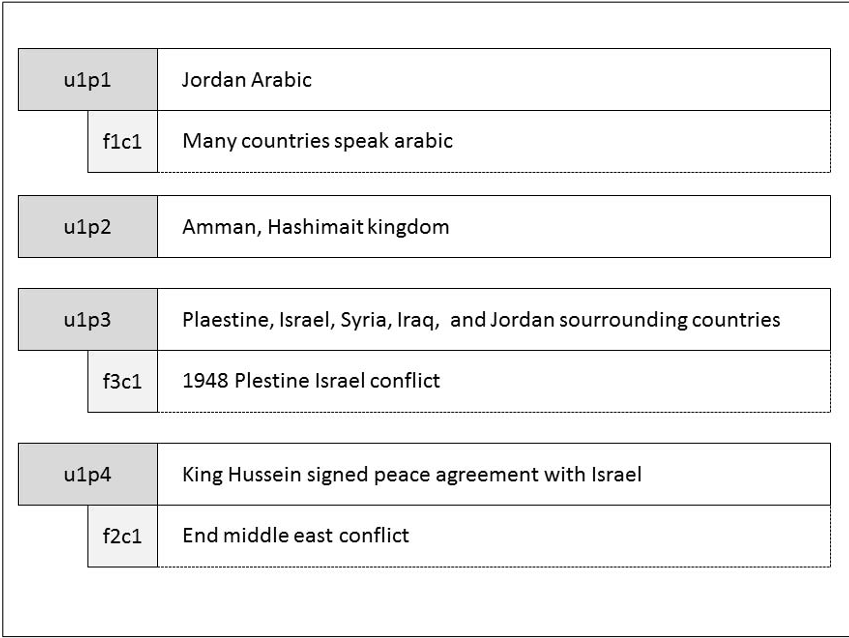
3. The Root-Path-Degree Algorithm
To find the actual "interest" among the noise, the authors developed the Root-Path-Degree algorithm:
- Step 1: Use Betweenness Centrality to find the "Root" (the most semantically connected entity).
- Step 2: Calculate a weight for every other node based on its
out-degree * number of paths to the root. - Step 3: Prune nodes with zero weight to reveal a clean sub-graph representing a core interest.
Experimental Evidence
The study evaluated 687 Facebook users against a manually annotated gold standard.
| Method | Precision | Recall | F-Measure |
|---|---|---|---|
| Semantic Social Graph (SSG) | 79% | 75% | 77% |
| Semantic Graph (SG - No social) | 68% | 63% | 65% |
| Naive Bayes (BOW) | 63% | 50% | 55% |
The results are striking: including social data (SSG) improves the F-Measure by 12% over the standard Semantic Graph and by 22% over Naive Bayes.
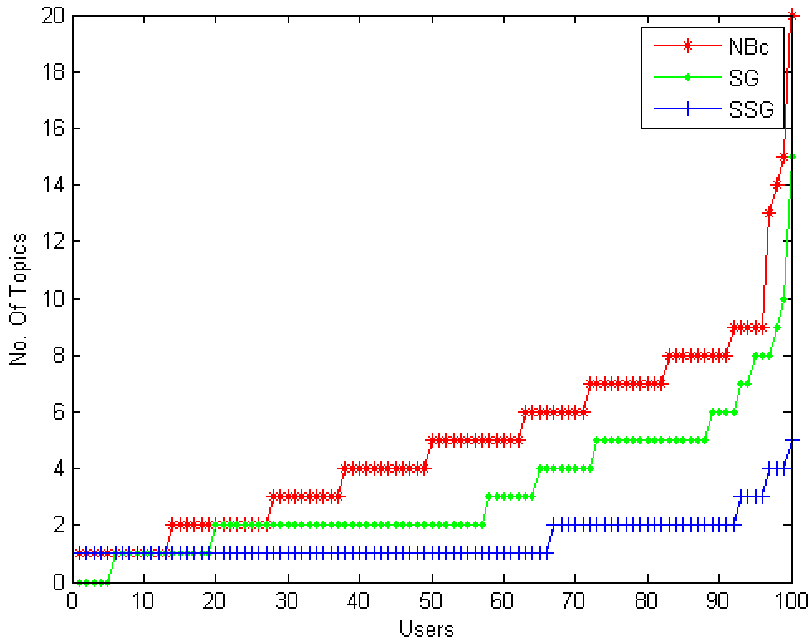 Figure 4: SSG excels at "focusing" user interests. While Naive Bayes scatters users across many topics, SSG maps 70% of users to a single, accurate interest sub-graph.
Critical Insight: Why This Works
The success of this approach lies in its Inductive Bias. By assuming that a user’s interests form a connected cluster in a global knowledge graph, the authors can "fill in the blanks" left by the brevity of social media. The Root-Path-Degree algorithm acts as a sophisticated filter that ignores transient mentions and focuses on deep-rooted semantic pillars.
Conclusion & Future Outlook
This paper demonstrates that for short-form text, context is king. By integrating external ontologies and social interactions, we can model user interests with high fidelity.
Future Directions:
- Multilingual Support: Extending the graph to handle code-switching and multiple languages.
- Temporal Dynamics: How do these sub-graphs evolve over months or years?
- Modern GNNs: Replacing the heuristic pruning with Graph Neural Networks for even more robust interest detection.