
SIOC: Breaking the Silos for a Social Semantic Web
Interlinking the Social Web with Semantics
The paper introduces SIOC (Semantically Interlinked Online Communities), an ontology designed to integrate the Social Web by providing a common RDF-based semantic layer. It enables cross-platform interoperability for blogs, forums, and wikis, effectively forming a "Social Semantic Web" through standardized metadata.
TL;DR
Social media sites are traditionally "data islands." The SIOC (Semantically Interlinked Online Communities) framework acts as a bridge, utilizing Semantic Web technologies to create a unified, machine-readable layer across the Social Web. It enables users to aggregate their content, port their data, and discover knowledge without being restricted by platform boundaries.
Background: The Island Problem
In the mid-2000s, the "Web 2.0" explosion led to a fragmented landscape. Your blog lived on WordPress, your professional discussions on mailing lists, and your photos on Flickr. These "stovepipes" prevented the "wisdom of the crowd" from being fully realized because data couldn't flow between them. The authors argue that the Semantic Web—long viewed as an academic endeavor—is the perfect solution to provide the interoperability these "Social Silos" desperately need.
The Core Mechanism: What is SIOC?
SIOC is much more than a simple metadata format; it is a mature ontology that maps the social reality of the internet into a graph of linked data.
The Ontology Structure
The SIOC model is built on high-level abstractions to ensure it remains future-proof:
- sioc:Space: Where data resides (e.g., a website).
- sioc:Container: Groupings of items (e.g., a Forum or a Mailing List).
- sioc:Item: The actual user-generated content (e.g., a Post or a Wiki article).
By using these generic classes, SIOC can describe virtually any social interaction. It doesn't work in isolation; it integrates with FOAF (Friend-of-a-Friend) for identity and SKOS (Simple Knowledge Organization System) for topics.
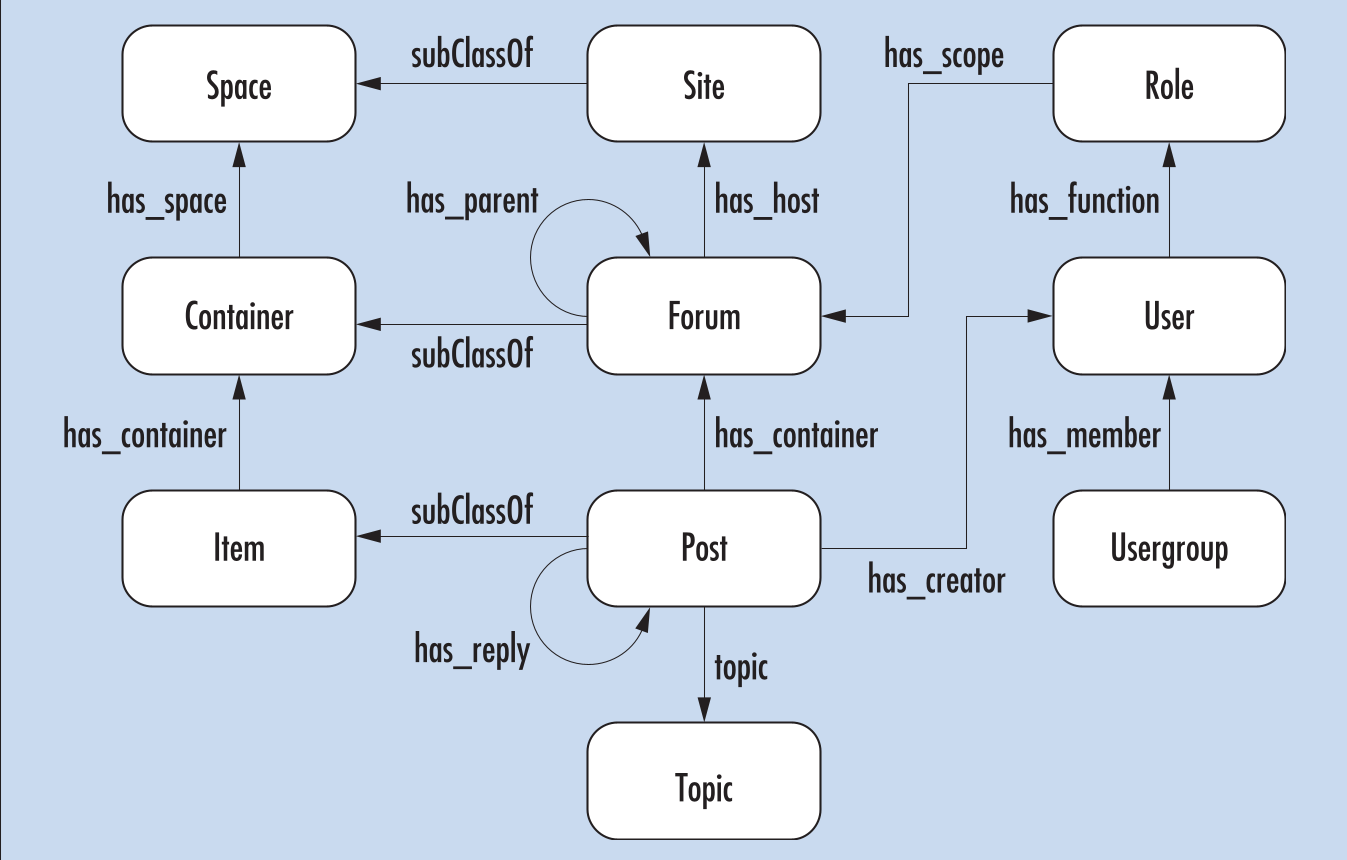 Figure: The main classes and properties in the SIOC ontology, creating a standardized language for online communities.
Methodology: The SIOC Food Chain
How does this theoretical model become reality? The paper describes a "food chain" of data:
- Producers: Exporting data from WordPress, Drupal, or APIs.
- Collectors: Crawlers and indexers (like Sindice) that gather RDF data.
- Consumers: Applications like the SIOC Explorer that aggregate this data for users.
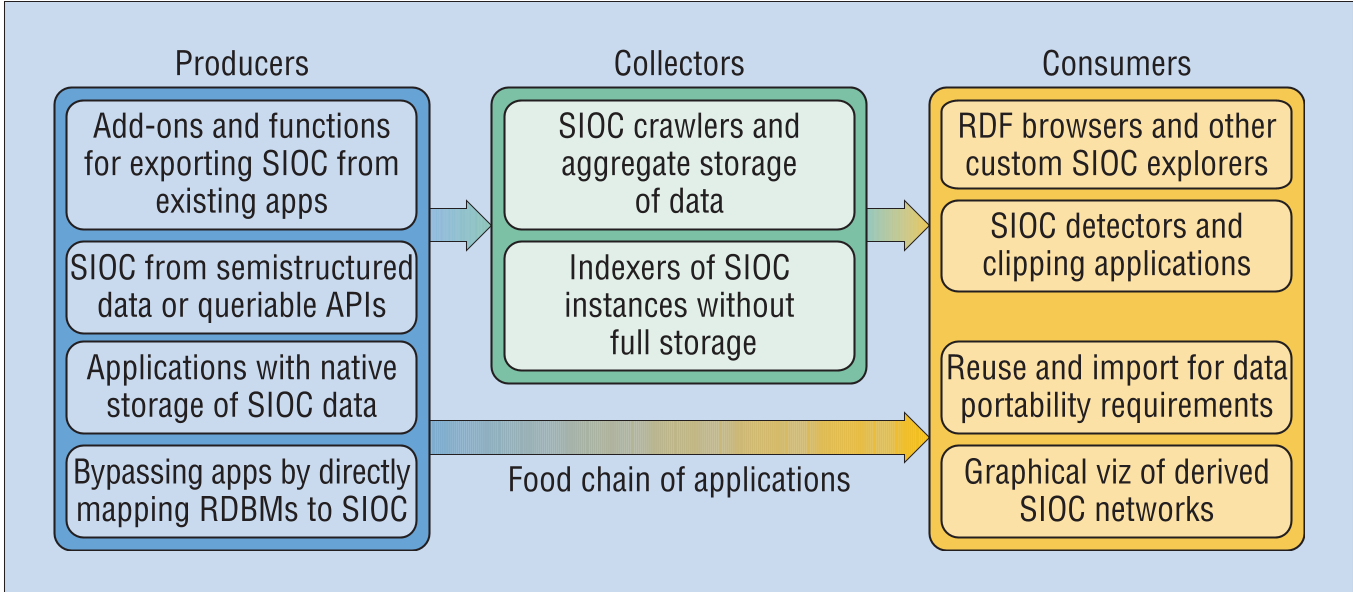 Figure: The SIOC data lifecycle—from production in CMS plugins to consumption in semantic browsers.
Revolutionary Applications: Object-Centered Sociality
One of the most profound insights of the paper is object-centered sociality. This theory posits that people aren't just connected directly (Person A knows Person B); they are connected through the objects they interact with.
If Alice and Bob both tag a specific paper or comment on the same technical forum, they have a social bond. SIOC allows us to visualize these "content circles," enabling reputation portability. Imagine moving your "influence" or "reputation" from a specialized tech forum to a job search platform because the underlying data is linked via SIOC.
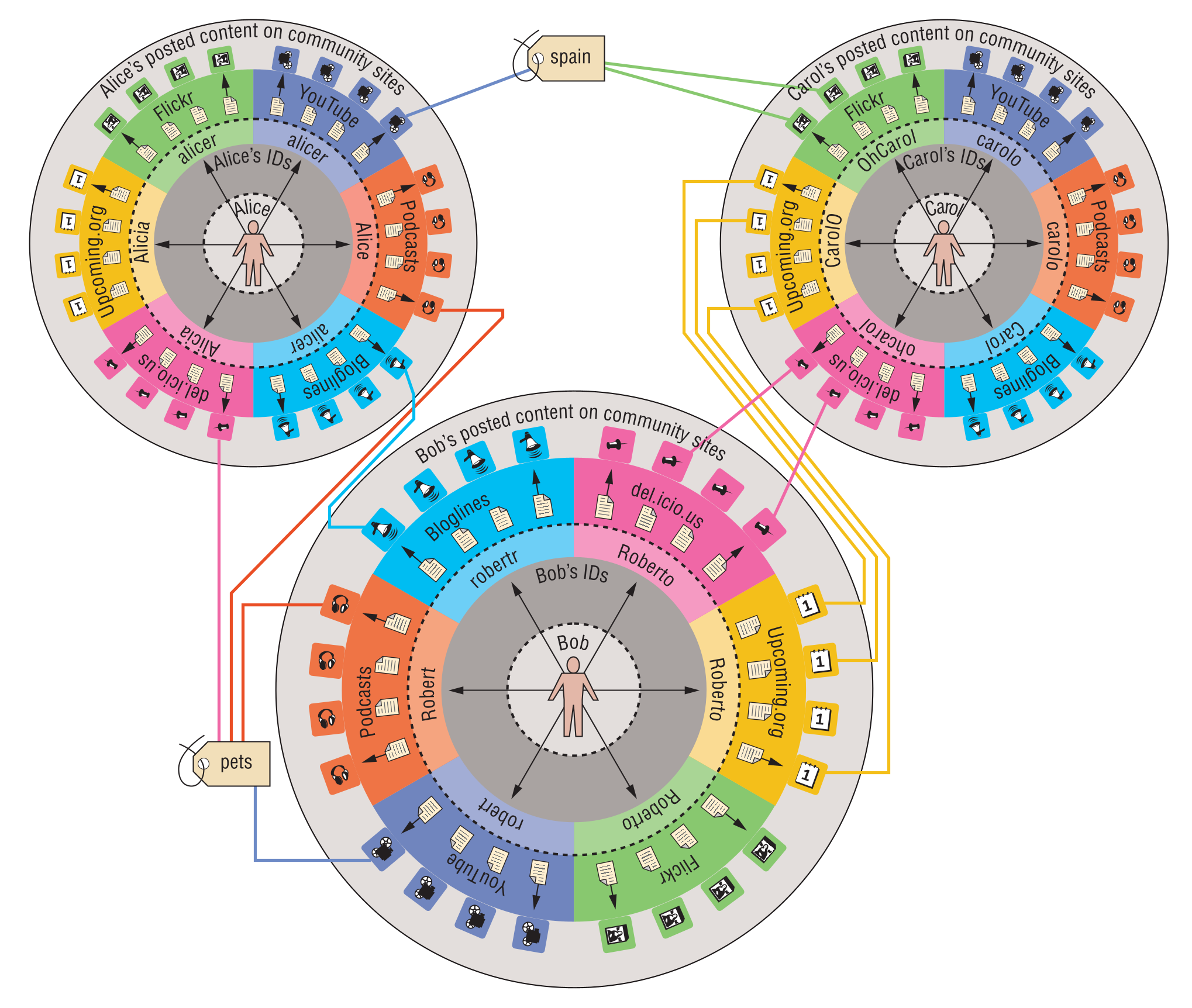 Figure: How users are connected via interlinked objects and metadata.
Deep Insight: Beyond Just Social Web
The reach of SIOC extends into CWE (Collaborative Work Environments) and E-Science.
- In Corporations: It breaks down internal silos between project management tools and document repositories.
- In Science: Projects like "Bio-zen" use SIOC to interlink scientific discourse across publications, making research more discoverable.
Critical Analysis & Conclusion
While SIOC provided a robust technical foundation for a unified social web, its success relied heavily on the willingness of platforms to export their data—a challenge in an era of "walled gardens."
Summary Takeaway
SIOC remains a masterclass in ontology design. By focusing on a "minimal consensus" rather than complex axiomatization, it achieved real-world scale. It serves as a precursor to modern decentralized protocols, reminding us that for the web to be truly social, it must first be open and semantically rich.
Limitations
- Privacy: Centralizing a user's total social footprint raises significant privacy concerns.
- Incentives: Major social networks often resist interoperability to protect their market dominance.