
Beyond the Cockpit: Why Automation is a Social Fabric, Not Just a Software Update
International Journal of Human - Computer Studies
This paper presents a sociomaterial ethnographic study of an automatic speed regulation system installed on five passenger ferries to improve maritime energy efficiency. It introduces the "imbrication" theory to explain how human and material agency intertwine in actual work practice, moving beyond traditional cognitivist models of Human-Automation Interaction (HAI).
TL;DR
Automation is often marketed as a "plug-and-play" replacement for fallible human cognition. However, this study in the maritime sector proves that once technology hits the deck, it enters a complex "imbrication" with human agency. Using an ethnographic study of five ferries, the authors show that a system’s success depends less on its "Level of Automation" and more on how it is socially woven into the daily routines of the crew.
The "Abracadabra" Myth: Why Prior Work Falls Short
For decades, Human-Automation Interaction (HAI) has been dominated by the Level of Automation (LOA) paradigm. This view treats humans and machines as separate components: "If I automate Stage X, the human does Y." Critics call this the "Abracadabra Dream"—the belief that you can simply plug a functional allocation method into a system and expect a perfect social outcome.
The reality is messier. Automated systems often face:
- Deskilling and Trust Issues: Professionals feel "out-of-the-loop."
- The Substitution Myth: The false idea that technology can replace a task without changing the entire nature of the work.
- Black-Box Logic: When a system’s reasoning is opaque, experts (like ship masters) will simply disengage it to maintain accountability.
Methodology: The Sociomaterial Perspective
The researchers moved out of the lab and onto the bridge. Over a year, they observed how two ships handled the same Automatic Speed Pilot. They viewed this through the lens of Imbrication—the way human and material agencies overlap and interlock over time like roof tiles.
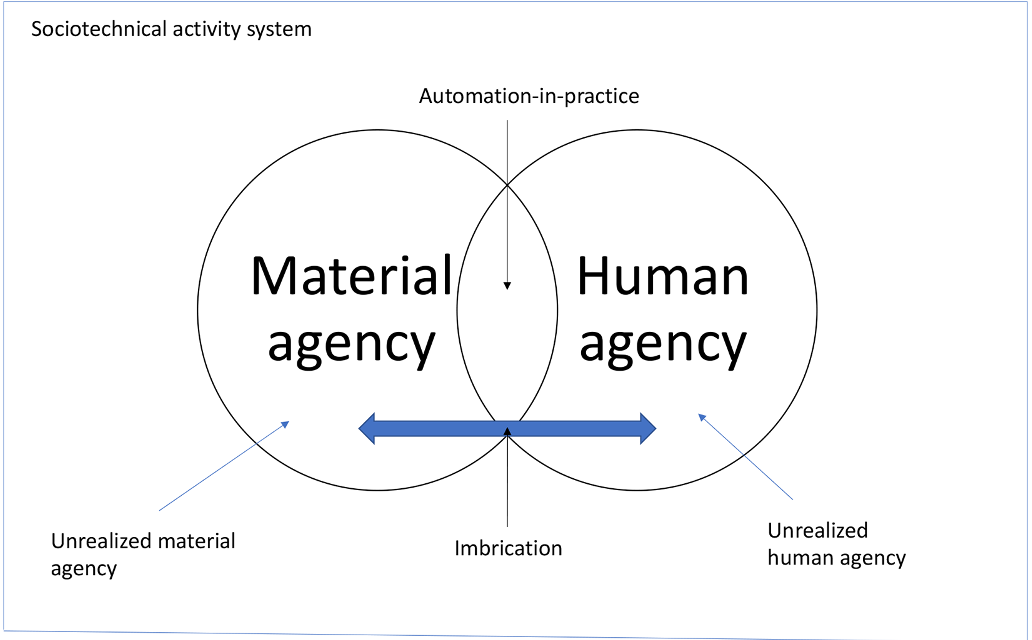
In this model, "Function" isn't built into the code; it’s a social construction. A button is only an "energy-saving feature" if the crew perceives it as such and incorporates it into their navigational culture.
A Tale of Two Ships
The study highlights two radically different paths taken by crews using the exact same hardware:
Ship 1: The "Hacker" Approach (Imbrication via Reconstruction)
The crew on Ship 1 didn't like how the speed pilot’s algorithm jittered the engines. Instead of just complaining, the Chief Engineer and the Master collaborated to rebuild the system. They influenced the designers to allow a "Constant Power" mode.
- Outcome: The technology was adapted to human expertise. Human agency regained control, and the "Material Agency" of the system was permanently altered to fit the crew's mental model.
Ship 2: The "Suspicious Supervisor" (Imbrication via Adaptation)
On Ship 2, the bridge and engine room didn't talk as much. The bridge used the system but monitored it constantly with deep skepticism.
- Outcome: Because the system was a "black box," it created social friction. The engineers felt the bridge was "disconnecting their experience" and delegating decisions to a computer that didn't understand the physical vibrations of the ship.

Deep Insights: The Physics of "Trust"
The core of this work is the realization that Responsibility cannot be delegated. Even if the machine steers the ship, the Master is held liable. Therefore, if the machine behaves in ways that don't match the officer's "situated, embodied, and holistic thinking," the officer will (and should) kill the process.
The "Material Agency" of the speed pilot (its ability to calculate 0.1nm speed intervals) is only powerful if it aligns with the "Human Agency" (the desire for a smooth ride and punctual arrival). When these two agencies are misaligned, the result is "vibrations"—both physical in the engine room and social in the boardroom.
Conclusion and Future Outlook
This paper is a vital reminder for AI and Robotics designers: Technology-in-practice is emergent.
- For Designers: Stop focusing solely on "Levels of Automation." Start designing for "Interdependency."
- For Managers: Realize that training isn't just about "how to use the tool," but how the tool changes the "fabric of social practices."
- Limitation: The study is maritime-specific; however, the sociomaterial logic applies to any field—from AI-assisted surgery to autonomous trucking—where professional identity and high-stakes responsibility collide.
Ultimately, the "irony of automation" remains: the more we automate, the more crucial the remaining human contribution becomes.