
Gamified Crowdsourcing: Transforming Work into Play
International Journal of Human - Computer Studies
This paper provides a comprehensive systematic literature review of 110 studies to conceptualize the intersection of gamification and crowdsourcing. It proposes an integrated framework for "Gamified Crowdsourcing Systems" and identifies distinct patterns in motivational design across four archetypes: crowdprocessing, crowdsolving, crowdrating, and crowdcreating.
TL;DR
Gamification has evolved from a buzzword into a critical architectural component for crowdsourcing platforms. By reviewing 110 research papers, this study reveals that while points and leaderboards are the "bread and butter" of the industry, the true potential lies in matching specific game mechanics (like storytelling or virtual teams) to the complexity of the task. The result? Higher participation, better quality, and a potential replacement for traditional monetary incentives.
The Core Motivation: From Profit-Seekers to Players
Crowdsourcing depends on a motivated "crowd." Historically, this was achieved via micro-payments (e.g., Amazon Mechanical Turk). However, the "Homo Economicus" model is brittle—it invites cheating and lacks long-term engagement. The authors suggest a shift toward "Homo Ludens" (The Playing Man), using gamification as a motivational affordance to trigger intrinsic joy rather than just financial gain.
The Taxonomy of Gamified Tasks
Not all crowdsourcing is created equal. The paper identifies four archetypes that dictate how gamification should be designed:
- Crowdprocessing: Large quantities of homogeneous tasks (e.g., tagging images).
- Crowdsolving: Finding heterogeneous solutions to complex problems (e.g., Foldit).
- Crowdrating: Collaborative assessment or "wisdom of the crowd" (e.g., voting).
- Crowdcreating: Creating emergent artifacts (e.g., Wikipedia).
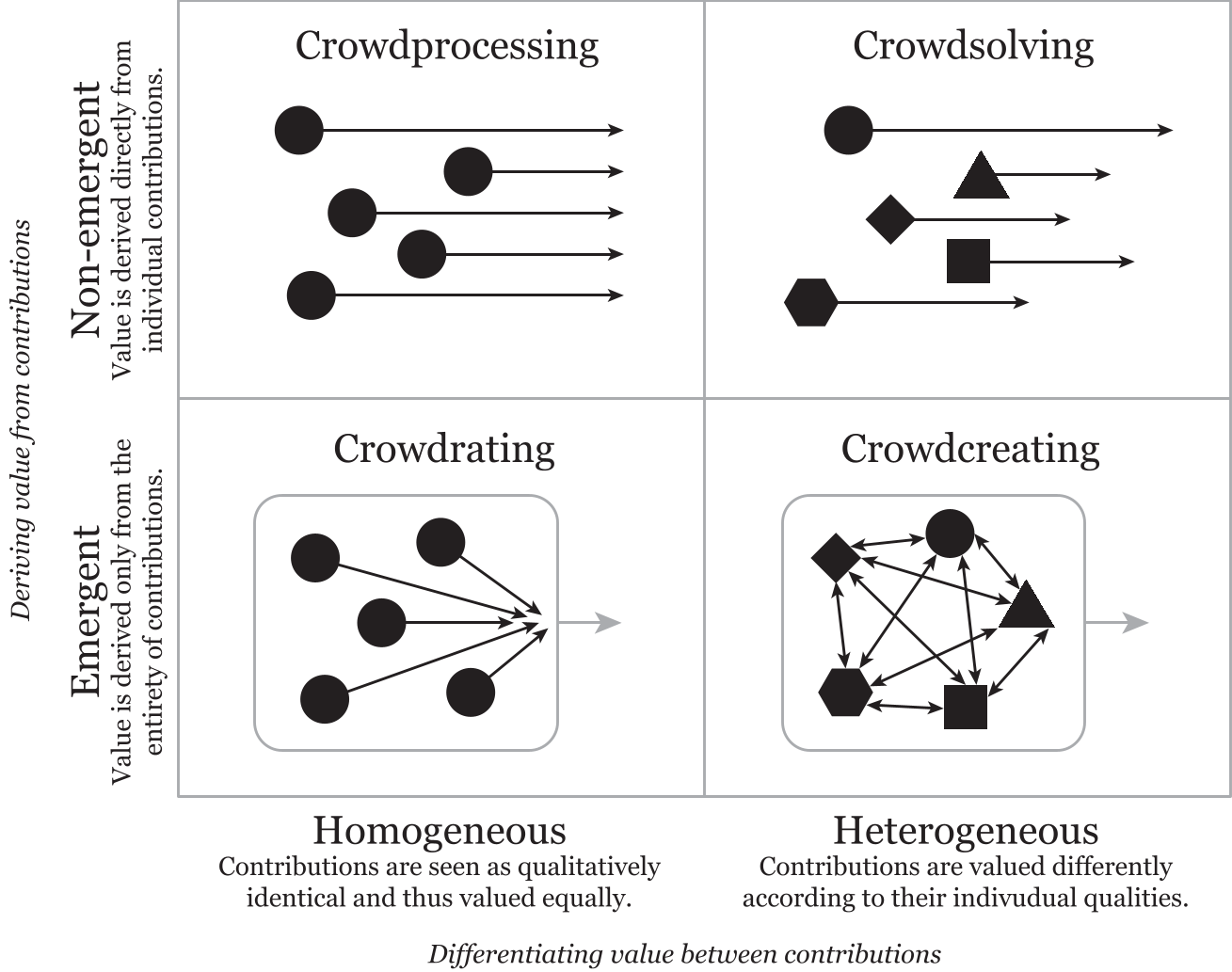 The design of incentives must change depending on whether the task outcome is emergent or non-emergent.
Methodology: The Integrated Framework
The researchers propose a holistic framework to analyze these systems. It isn't just about the "points"; it’s about the loop between Affordances (Design), Psychological Outcomes (Motivation, Fun), and Behavioral Outcomes (Quality, Retention).
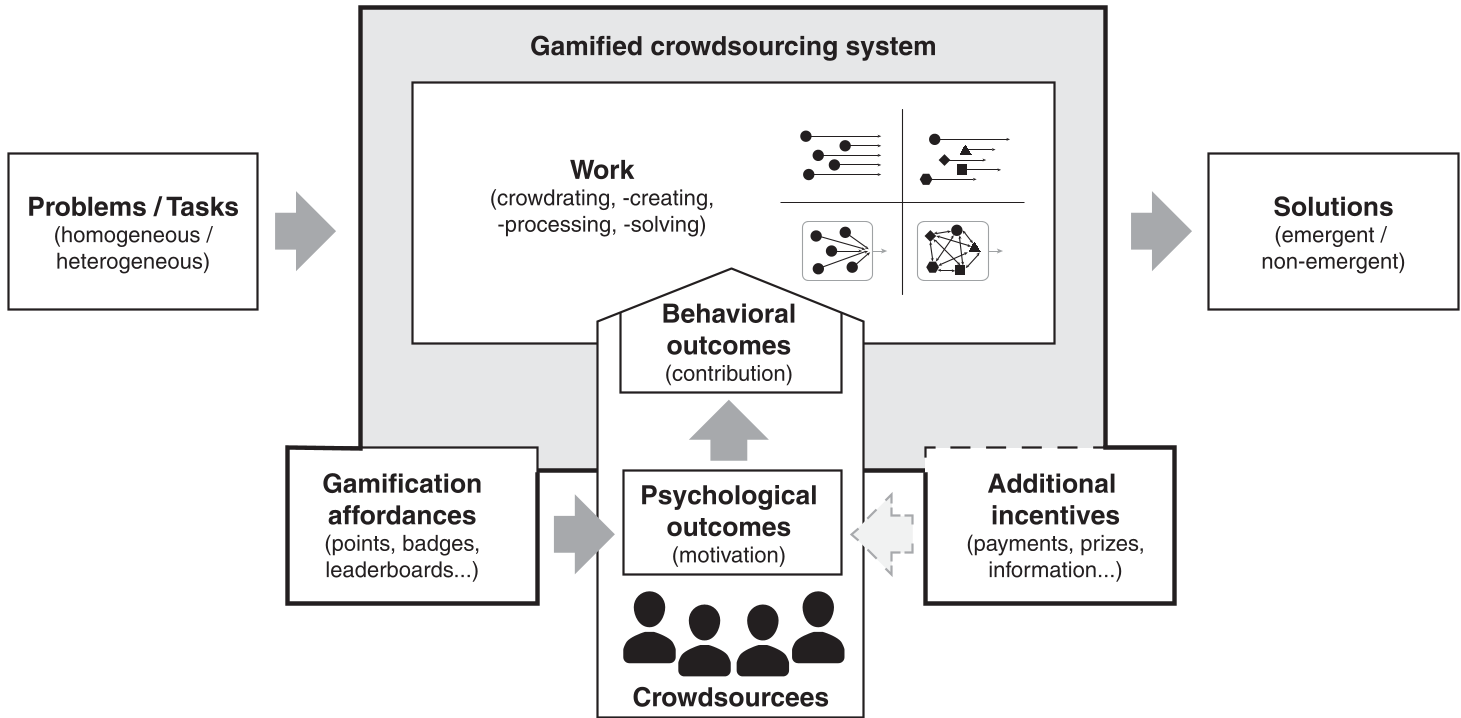
The "Point" of Points
- Simplicity Wins for Monotony: For simple tasks (Crowdprocessing), basic PBL (Points, Badges, Leaderboards) sets are highly cost-effective.
- Complexity Demands Narrative: For creative tasks (Crowdcreating), the review suggests "richer" gamification. Using Storytelling and Avatars transforms the perception of "work" into "play," which is essential for sustaining effort in difficult tasks.
Key Results & Evidence
The data is overwhelmingly positive:
- Quantitative Boost: 26 studies confirmed an increase in the volume of contributions.
- Quality Control: 13 studies found that gamification (especially when rewarding "agreement" with other users) reduces "spam" and increases accuracy.
- The Age Factor: Interesting demographic nuances emerged—competition-based designs are hit-or-miss with older populations, whereas collaborative designs tend to perform better across a wider age spectrum.
 Empirical results across different study types show a dominant trend of positive outcomes.
Limitations & The Future Agenda
While the field is growing, the authors warn of several "traps":
- The Novelty Effect: Does gamification work only because it's new? Most studies were shorter than 4 weeks. We need longitudinal data.
- Publication Bias: With 90% positive results, there is a risk that "failed" gamification experiments aren't being published.
- The Social Dimension: Future systems should move away from pure individual competition toward Cooperative Gamification (e.g., virtual teams), which is currently under-researched but vital for collective artifact creation.
Conclusion
For developers and researchers, the message is clear: Stop adding points randomly. Instead, analyze the "Task Complexity" and "Value Emergence" of your platform first. If you want a crowd to build something beautiful and complex, give them a world and a story, not just a leaderboard.