
Tribefinder: Decoding Digital Subcultures through Deep Learning and Honest Signals
International Journal of Information Management
This paper introduces Tribefinder, an automated system that identifies "virtual tribes" (E-tribes) on Twitter by combining word embeddings and LSTM deep learning models. It succeeds in categorizing users into macro-categories like Lifestyle or Recreation with an accuracy of up to 81.2%.
TL;DR
Marketing focuses on who consumers are; tribal marketing focuses on who they belong to. This paper unveils Tribefinder, an AI tool that scans Twitter data to automatically categorize users into "virtual tribes"—subcultures linked by shared passions rather than demographics. By leveraging LSTM neural networks and Social Network Analysis (SNA), the researchers have created a way to turn chaotic social media noise into actionable consumer segments.
Decoding the "Virtual Tribe"
In the postmodern era, consumers don't just buy products; they join communities. A "tribe" is a network of heterogeneous people linked by a shared emotion or passion. While traditional marketing splits people by age or income, tribal marketing recognizes that a 20-year-old artist and a 50-year-old executive might both belong to the same "Vegan" or "Tech Nerd" tribe.
The Problem: Until now, identifying these tribes required manual interviews or focus groups. In the fast-moving world of Twitter, these methods are obsolete. We need a way to detect tribal membership through the "honest signals" of language and interaction.
Methodology: How Tribefinder Works
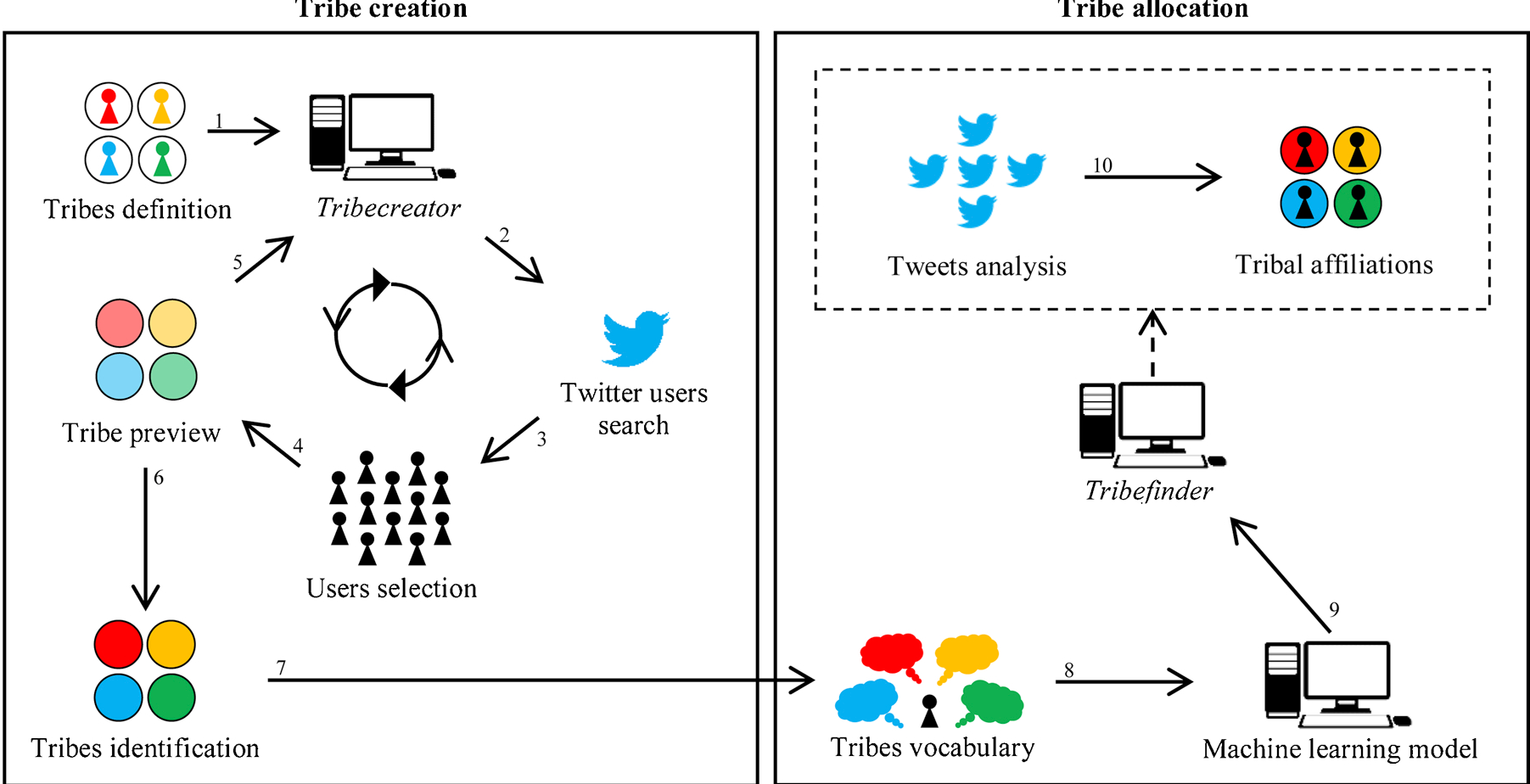
The system operates through a sophisticated pipeline involving human-in-the-loop training and deep learning.
1. Tribecreation (The Seed)
The system starts with Tribecreation. A researcher inputs core keywords (e.g., "plant-based" for Vegans). The system then crawls Twitter to find "tribal leaders"—users who influential within that specific discourse.
2. Deep Learning for Tribeallocation
Once leaders are identified, their tweets are used to train an LSTM (Long Short-Term Memory) model.
- Word Embeddings: Words are converted into high-dimensional vectors, capturing semantic nuances.
- Structural Context: The model looks for recurring textual patterns that act as a "tribal vocabulary."
Experimental Insight: Tribes are Quantifiably Different
The authors tested the system on macro-categories: Alternative Realities (e.g., Nerds, Treehuggers), Lifestyle (e.g., Vegan, Fitness), and Recreation (e.g., Travel, Fashion).
The results proved that tribes aren't just cultural labels; they have distinct Social Dynamics:
- The "Fatherlanders" (Patriots): Showed the lowest sentiment and highest emotionality—they are passionate but often defensive or negative.
- The "Nerds": Exhibited the highest Language Complexity, introducing more variety and innovation into the discourse.
- The "Fitness" Tribe: Highly optimistic (high sentiment) and served as "brokers" (high betweenness centrality), connecting different social groups.
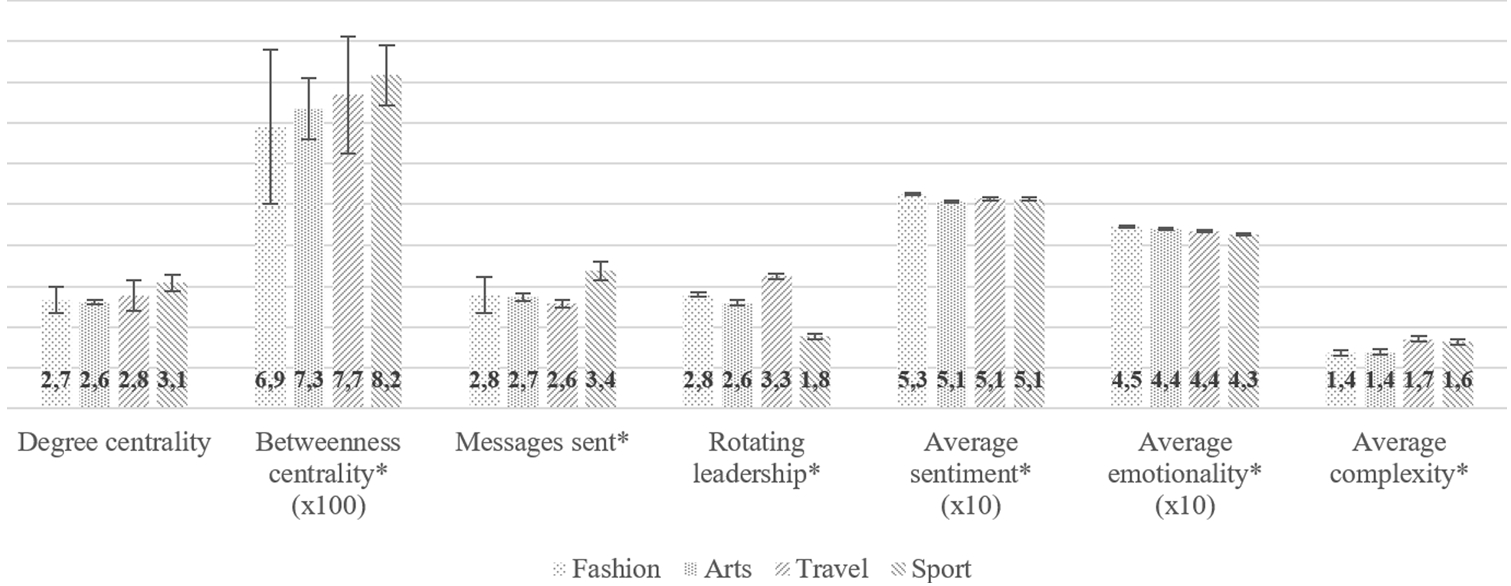 The figure above demonstrates how different tribes score on metrics like Rotating Leadership and Complexity.
Why This Matters for Brand Strategy
A brand like Gucci or Dior isn't just selling clothes; it's interacting with the "Fashion Tribe." However, the paper reveals a fascinating nuance: the behavior of the fashion tribe changes depending on the brand they discuss.
- Dior was found to have the highest positive sentiment.
- Chanel and Dior prompted more heterogeneous, diverse conversations.
- Gucci (at the time of the study) had a "flatter" discourse with lower complexity.
Critical Perspective: Beyond the Algorithm
While Tribefinder is a breakthrough in Social Media Mining, it has limitations:
- Platform Specificity: Currently tuned for Twitter's short-text format.
- Temporal Drift: Tribal vocabularies evolve; a "nerd" in 2018 uses different slang than one in 2026.
- The "Lurker" Problem: The system only categorizes active users. The "silent majority" of a tribe remains invisible.
Conclusion
Tribefinder represents a shift from Demographic Marketing to Psychographic AI. By understanding the "honest signals" of virtual tribes, firms can stop blasting generic ads and start participating in the meaningful "rituals" of their core communities. As the authors suggest, the future of marketing isn't about finding customers; it's about finding tribes.