
Beyond Keywords: Decoding Depression through User Intention and Social Influence
International Journal of Information Management
The paper introduces a comprehensive big data analytics framework to detect user-level depression on social networks using a multi-dimensional feature approach. Beyond standard linguistics, it integrates unique user intention modeling and social influence analysis, achieving a high recall of 86.84% using Random Forest on a massive Facebook dataset.
Executive Summary
TL;DR: This research moves beyond simple keyword matching to detect depression. By combining Big Five personality traits, Speech Act theory (User Intention), and Social Influence analysis, the authors developed a scalable framework on Apache Spark that leverages "pragmatic" features to identify at-risk users on Facebook with high recall.
Academic Context: This work bridges the gap between traditional clinical psychology and modern Big Data analytics. It shifts the paradigm from simple sentiment analysis to a multi-modal behavioral model that considers the user's social ecosystem.
The "Linguistic Blind Spot" in Prior Work
Most existing SOTA models for depression detection focus on Syntactic (grammar) and Semantic (meaning) features. While effective, they miss the Pragmatics: the actual intention behind a post. For example, two users might use the same "sad" words, but one is seeking help (Directive) while the other is merely describing a movie (Assertive).
Furthermore, humans are social animals. Prior work often ignored the "Mood Contagion" effect—the phenomenon where a user’s mental state is influenced by their social circle. The authors argue that a user’s risk of depression is not just an isolated variable but a function of their network position and their friends' mental health.
Methodology: The Core Innovations
1. User Intention Modeling (The "Why")
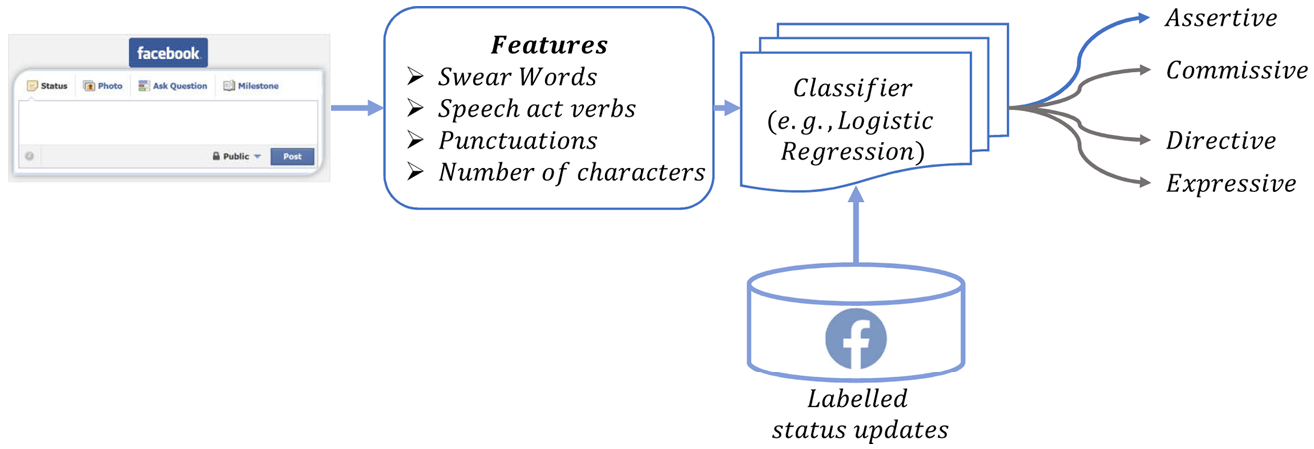
The framework utilizes Speech Act Theory to categorize status updates into four primary categories:
- Assertives: Committing to the truth (e.g., "I feel tired today").
- Commissives: Commitments to future action (e.g., "I will go out").
- Directives: Attempts to get others to do something.
- Expressives: Psychological states (e.g., "Thank you so much").
2. Social Influence (The "Who")
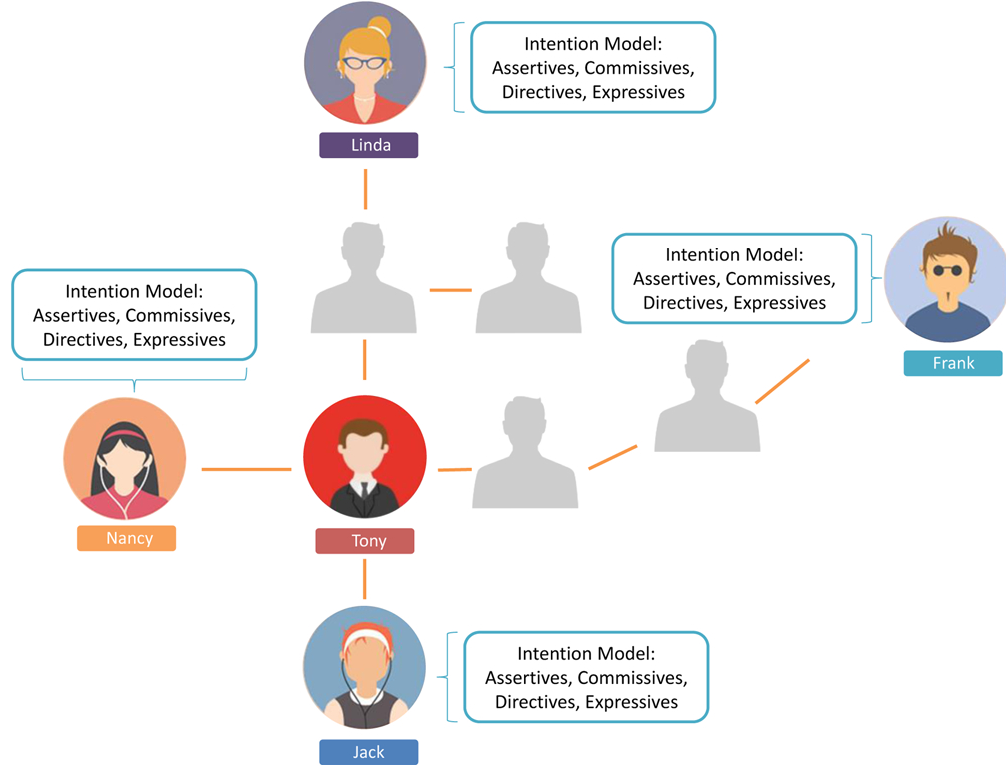
The paper introduces two ways to calculate how friends "infect" a user with depressive states:
- Shortest Path-based: Assigns weights based on network distance. Closer friends have a higher "Influence Score."
- Intention-based Similarity: Uses Euclidean distance between intention distributions. If you and your depressed friend share similar "speech act" patterns, the influence weight increases.
Experimental Insights
The study utilized the myPersonality dataset, which contains 22 million Facebook records.
Key Findings:
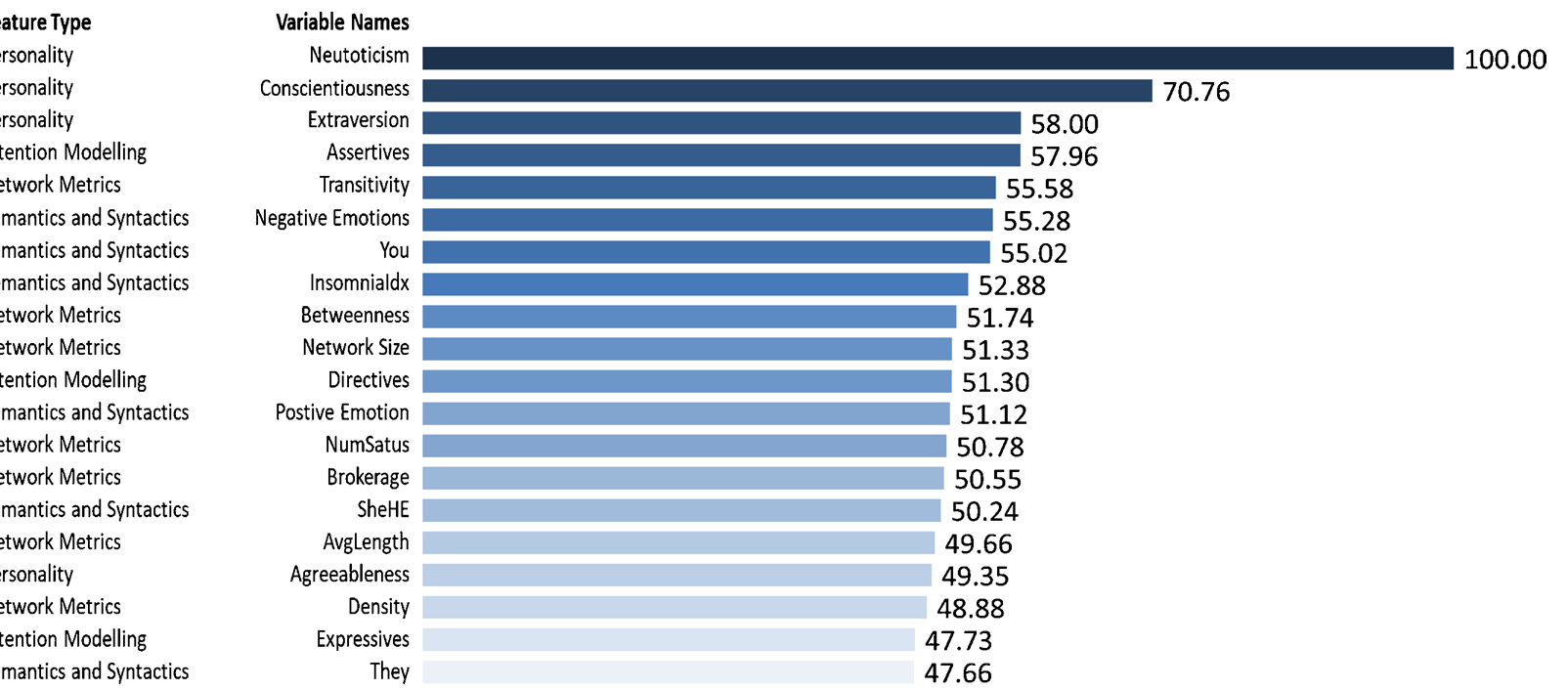
- The Power of Personality: Neuroticism, Extraversion, and Conscientiousness remain the strongest predictors (Top 3).
- Intent Matters: "Assertive" speech acts ranked 4th in importance, even higher than negative emotion scores.
- Model Performance: Random Forest emerged as the winner for identifying depressed users (Recall: 86.84%), proving that ensemble methods are robust for sparse social data.
Critical Analysis & Conclusion
Takeaway: The inclusion of "Social Influence" (FS4) and "Intention Modeling" (FS6) consistently outperformed models using only LIWC-based linguistic features. This proves that mental health isn't just about what you say, but how you interact and who you are near.
Limitations:
- Single Intention: The model assumes one post has one intent, whereas real-world speech is often multi-faceted.
- Language Barrier: The current intention classifier is optimized for English, limiting its global applicability without retraining.
Future Outlook: The next step is moving toward Expert Systems for clinicians, where these scores serve as a "Digital Vital Sign" to supplement traditional therapy and intervention.