
Digital Footprints of Global Mobility: Why Your Skype Contacts Predict Your Next Move
Explaining International Migration in the Skype Network: The Role of Social Network Features
The paper investigates international human migration patterns using login events and social network structure from the Skype network (15 million sampled users). By combining social features like international call ratios and link distributions with socio-economic data, the authors develop regression models to explain net migration rates at both the country and bilateral levels.
TL;DR
Researchers from the University of Tartu and Microsoft analyzed 15 million anonymized Skype users to track international migration. They discovered that the structure of our digital social networks—who we call and where our contacts live—is a drastically better predictor of migration than traditional factors like geographical distance or national GDP.
Background: The Limits of Official Statistics
For decades, demographers have relied on government registries to track human migration. These datasets are notoriously "late" and often inconsistent between countries. In a world characterized by hyper-mobility, waiting a year for a census report is an eternity. This paper positions the Skype network as a "living laboratory" to observe human movement in near real-time, focusing on "why" people move by looking at their social ties.
Problem & Motivation: Beyond the Gravity Model
The traditional "Gravity Model" of migration suggests that people move based on the size of the destination's economy and its geographical proximity. However, this fails to account for the Social Capital—the networks of friends and family that lower the barrier to moving. The authors argue that by looking at communication metadata (calls, messages, and contact lists), they can find the "hidden" signals of migration that institutional data misses.
Methodology: Mapping the Digital Migrant
The study defines a migrant as an individual who shifts their primary login location for at least five consecutive months. This filters out short-term tourists and business travelers.
The researchers combined several data sources:
- DS0 (Login Data): 500 million data points tracking monthly locations.
- DS1 (Social Graph): The complete network of "contacts" as of 2011.
- External Data: World Bank socio-economic indicators (GDP, Internet adoption, etc.).
The Core Insight
They focused on "Openness" (fraction of international links) and "Communication Intensity." If a country has a high percentage of international calls, it suggests a high population of either expats calling home or residents preparing to leave.
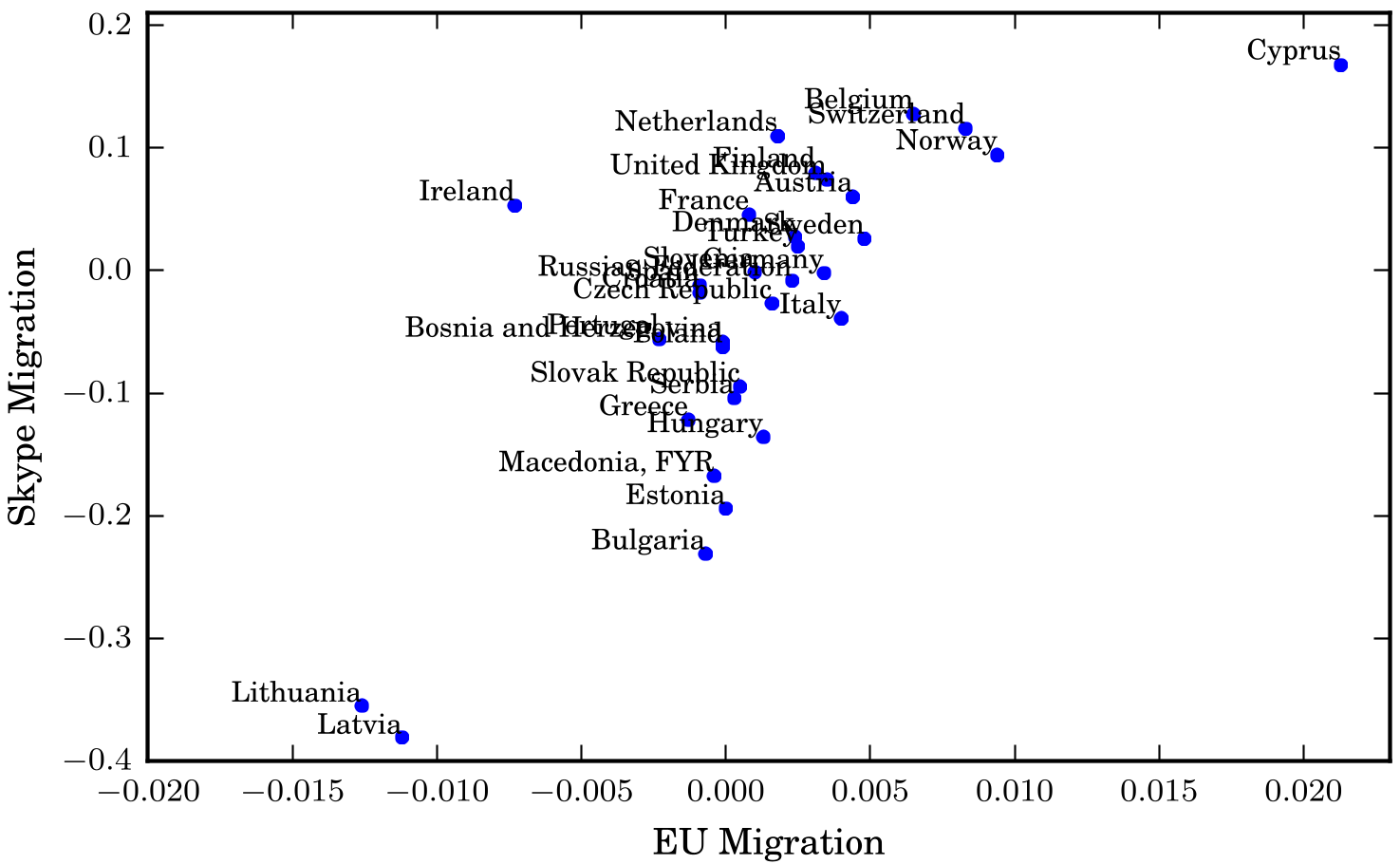 Figure 1: Comparison between official EUstat migration rates and Skype's observed net migration, showing high alignment (0.75 correlation) within Europe.
Experiments & Results: Social vs. Geography
The study utilized Random Forest regression to see which features were the most "informative."
| Features | R² (Accuracy) |
|---|---|
| Social Features Only (Links, Calls) | 0.83 |
| Geography + GDP | 0.19 |
| Geography + GDP + Trade | 0.49 |
As shown in the table above, the "Social Only" model achieved an R² of 0.83, nearly as high as the full model (0.84). In contrast, the traditional "Geography + GDP" model was significantly weaker (0.19). This proves that social closeness is far more relevant than physical distance in determining where people migrate.
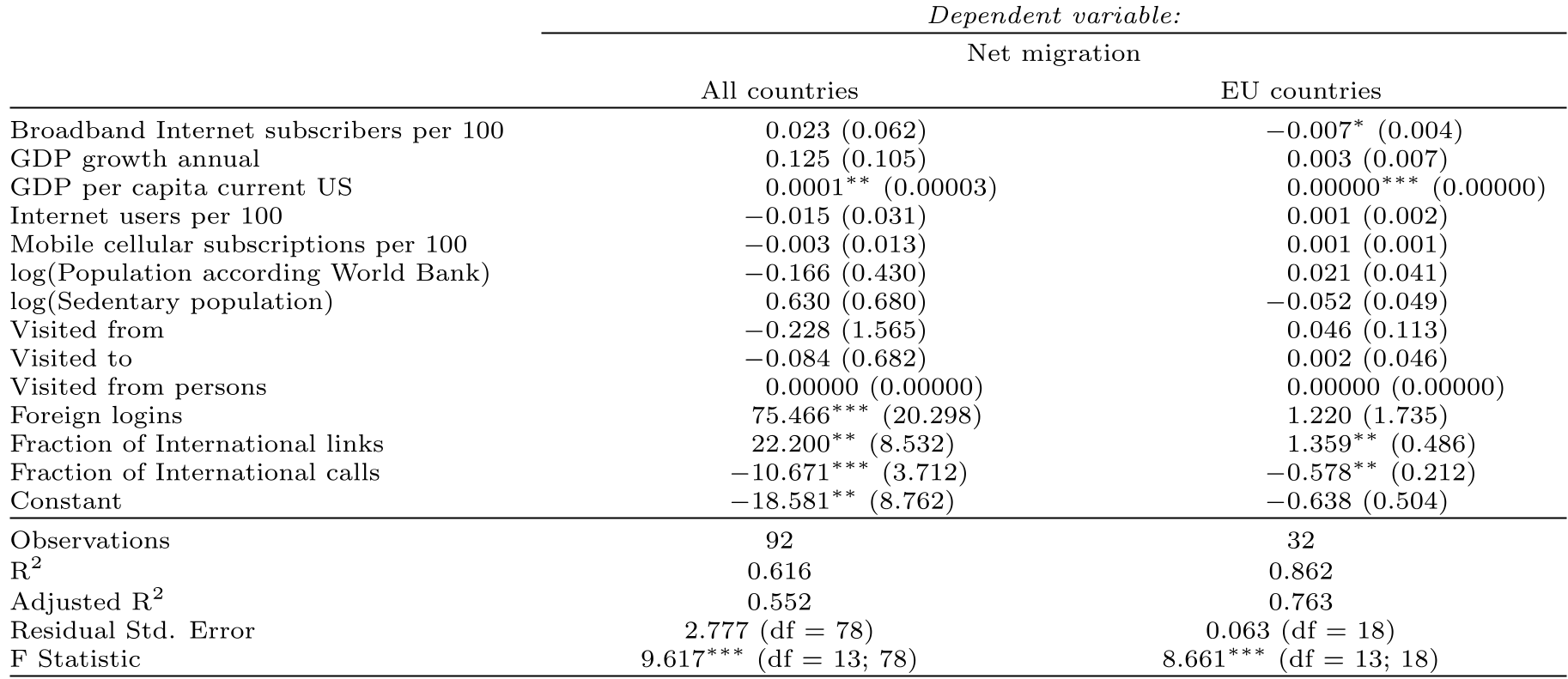 Table 3: Regression results showing that 'Foreign Logins' and 'Fraction of International Links' have high statistical significance (p < 0.01) in explaining migration.
Critical Insight: The "Call Back" Effect
One of the strongest signals found was Foreign Logins—when users from Country A log in from Country B regularly. This doesn't just represent the migrants themselves, but the sustained social link they maintain with their home country. The study found that as net migration increases, the volume of international communication increases proportionally, creating a "feedback loop" that encourages further migration from the same social circles.
Conclusion & Future Outlook
This work demonstrates that social network features are not just "extras"—they are the primary sensors for human mobility in the 21st century.
Limitations: The study acknowledges "adoption bias" (Skype is more popular in certain demographics) and the lack of fine-grained city-level data. The Future: As AI and Graph Neural Networks evolve, researchers could potentially predict migration "waves" before they happen by monitoring sudden shifts in international communication density, providing vital lead time for humanitarian and urban planning.