
Facebook vs. WeChat: How International Users Navigate the Digital Great Wall
International Users’ Experience of Social Media: A Comparison Between Facebook and WeChat
This paper presents a comparative study of international users' behaviors and experiences on Facebook versus WeChat within the Chinese context. By surveying 98 international participants, the study identifies that while Facebook excels as a news and content-sharing platform, WeChat functions as an indispensable all-in-one communication and utility tool for residents in China.
TL;DR
What happens when international users are "forced" into a different digital ecosystem? This study explores the behavioral dichotomy of international residents in China using both Facebook and WeChat. It finds that while Facebook remains the preferred hub for news and self-expression, WeChat has become an inescapable "utility powerhouse" for daily survival, dominating in communication and localized services despite persistent privacy concerns.
Background Positioning
In the spectrum of Social Networking Sites (SNS), Facebook represents the classic Western model of "Socializing + Information," while WeChat embodies the Eastern "Super App" model. This paper, published in the context of Human-Computer Interaction (HCI), serves as a crucial case study for product globalization and cultural adaptability in the UX design field.
The Motivation: A Conflict of Habit and Necessity
The researchers were driven by a unique tension: International users in China often bring a "Facebook habit" but are met with the "WeChat necessity." The study aims to dissect this transition across three dimensions:
- Satisfaction: Which features actually feel better to use?
- Trust: Do users actually trust these platforms with their data?
- Usage: How does the environment (e.g., the "Great Firewall") dictate time spent?
Methodology: Quantitative Rigor Meets Qualitative Insight
The study surveyed 98 participants from diverse nationalities (USA, Germany, France, etc.) using standardized SUS and SEQ metrics. By focusing exclusively on users who maintain accounts on both platforms, the authors isolated the platform differences from general internet usage habits.
Feature-Level Satisfaction
The data revealed a stark functional split. WeChat is the undisputed king of direct interaction, while Facebook dominates the "feed."
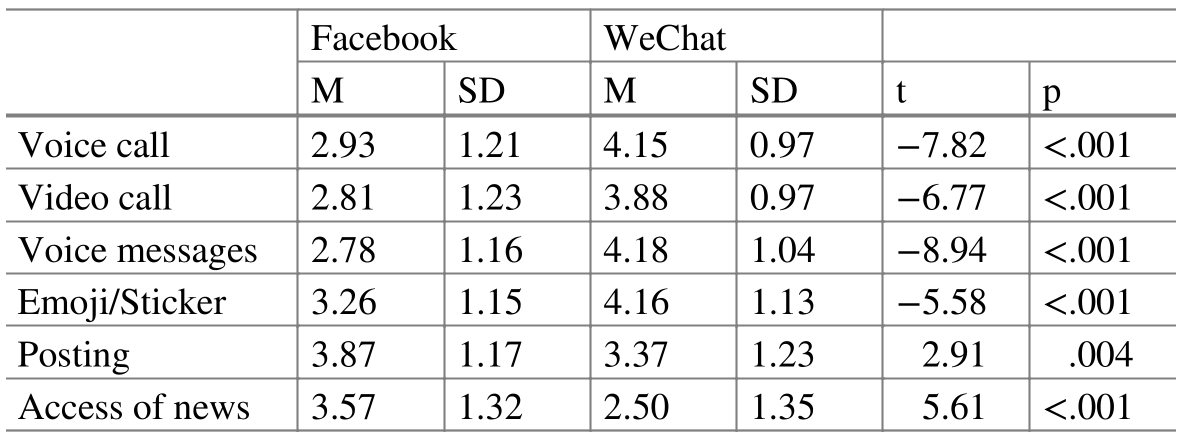
The table above highlights that WeChat scores significantly higher (p < .001) in Voice/Video calls and Stickers, whereas Facebook wins in news accessibility.
Key Insights: Why the Difference?
1. The Communication Powerhouse
WeChat's higher satisfaction in voice and video is not just about technology; it’s about convenience. For international users in China, WeChat serves as the primary gateway to school, work, and local communities. The integration of "WeChat Pay" and "Mini Programs" further solidifies it as a tool for "doing" rather than just "viewing."
2. The Trust Paradox
Surprisingly, there was no significant difference in the low levels of trust for both platforms. Participants expressed skepticism regarding data security and fraud on both WeChat and Facebook.
- The WeChat Concern: Government monitoring and lack of English interface for advanced features.
- The Facebook Concern: Reliability of news and general data security.
3. Usage Distribution: The 3-Hour Mark
The results for "Extent of Use" were dramatic. The physical presence in China acts as a massive "Inductive Bias" for WeChat usage.
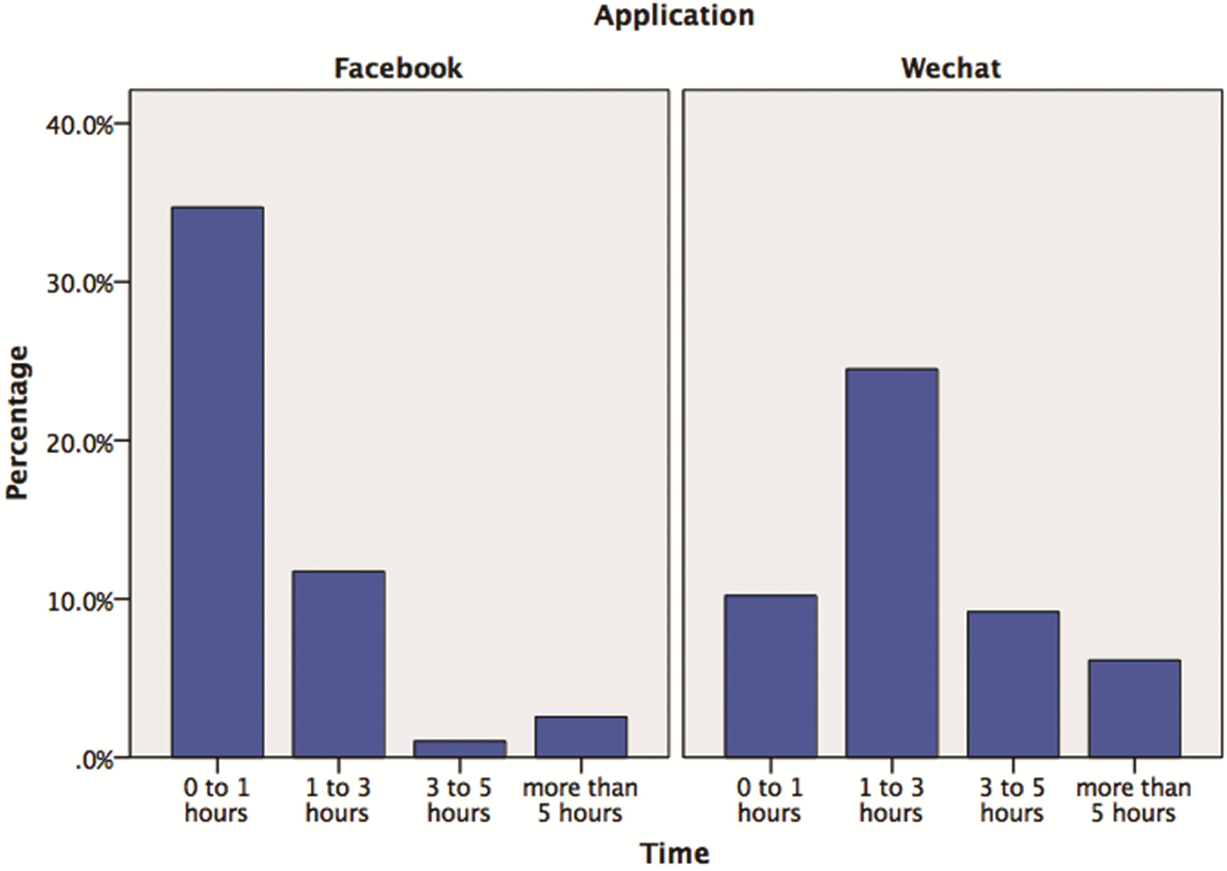
As shown, 32% of participants are "heavy users" of WeChat (3+ hours), while Facebook usage is relegated to short bursts, often hindered by the need for VPNs and a lack of local relevance.
Critical Analysis & Conclusion
Takeaway for Designers
Globalization is not just about translating strings. The study highlights that language barriers in advanced features (like WeChat's secondary services) actively prevent international users from fully adopting the ecosystem. Designers must prioritize "Language-Independent Utility."
Limitations
The study's sample (N=98) is relatively small and confined to international users within China. To see the true strength of these platforms, a control group of users outside China—where Facebook is not blocked—would be necessary to decouple "choice" from "necessity."
Final Thought
WeChat has successfully pivoted from a social app to a social infrastructure. While Facebook remains a choice for "identity," WeChat has become a requirement for "utility." For Western apps to compete in the East (and vice-versa), they must decide whether they want to be a source of entertainment or a tool for survival.
Reference: Huang, H., et al. "International Users’ Experience of Social Media: A Comparison Between Facebook and WeChat." Department of Industrial Engineering, Tsinghua University.