
Bridging the Digital Literacy Gap: Adapting NLP Taggers for the Wild West of Internet German
Internet Corpora: A Challenge for Linguistic Processing
This paper addresses the performance degradation of Part-of-Speech (POS) taggers when applied to non-standard German Internet texts (Twitter, chats, forums). The authors propose "easy-to-implement" adaptation methods, including small-scale manual annotation and text normalization, to bridge the gap between newspaper-trained models and Computer-Mediated Communication (CMC).
TL;DR
Language on the internet is "broken" by design—filled with typos, emoticons, and creative grammar. This paper tackles the drastic drop in POS tagging accuracy (from 96% to as low as 69%) when standard tools meet German Twitter and chat data. By using targeted manual annotations and normalization, the authors demonstrate that we don't need "Big Data" to fix the problem; a "Smart Data" approach can bring performance back to near-human levels.
The "Newspaper Bias" in NLP
Most Natural Language Processing (NLP) tools are "civilized" creatures. They were raised on a diet of Wall Street Journal excerpts or, in the German case, the Tiger and Negra corpora—formal, edited, and perfectly punctuated newspaper texts.
When these models encounter the "Wild West" of Computer-Mediated Communication (CMC), they hallucinate:
- Lexical Shifts: Words like sooooo or grrr aren't in the dictionary.
- Structural Chaos: Lowercase nouns (common in German chats) lead taggers to mistake subjects for verbs.
- New Species: Emoticons (
;-)) and action words (*seufz*) simply don't exist in the training set.
Methodology: Small Tweaks, Big Gains
The authors tested whether we could "teach" old taggers new tricks without spending thousands of hours on manual labor.
1. The Strategy: Silver vs. Gold
They compared Experiment 1 (The Silver Approach), which used "consensus" tagging from existing tools to create more training data, against Experiment 2 (The Gold Approach), which involved a small but high-quality set of manually annotated internet posts.
2. The Architecture of Adaptation
The project focused on the TnT Tagger, extending the standard STTS tagset to include categories for internet-specific phenomena.
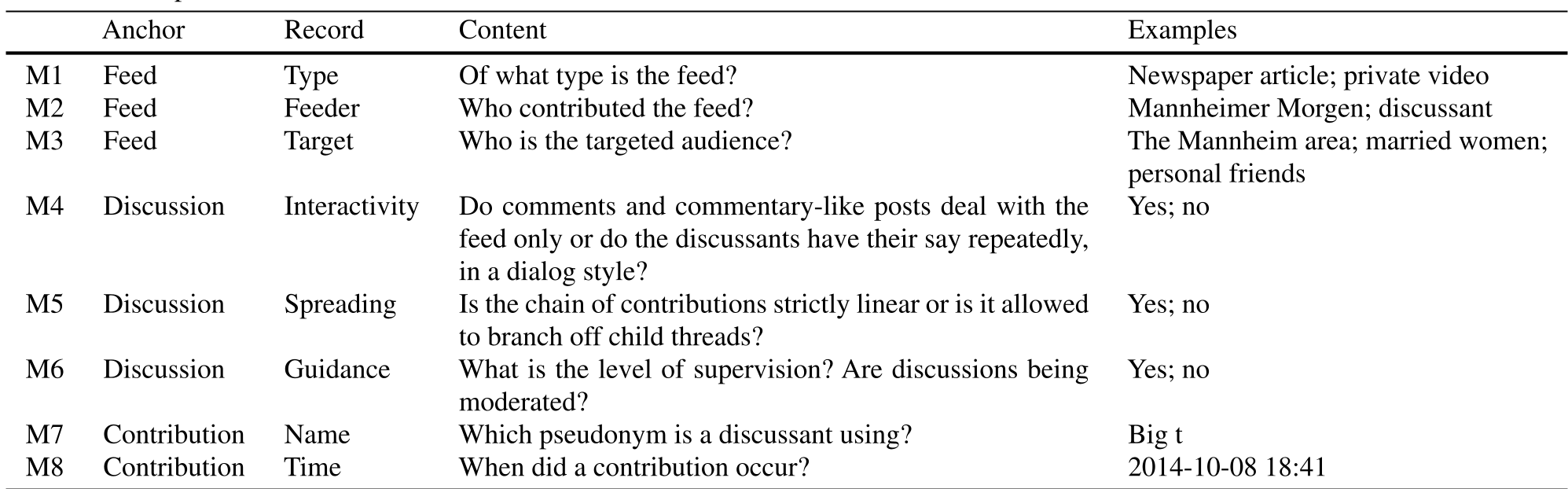 The researchers didn't just scrape the web; they stratified data by interactivity and target audience to capture the full spectrum of German CMC.
Experiments and Results: Quality over Quantity
The results provide a masterclass in the value of human-in-the-loop AI.
- The Failure of Baseline: A standard tagger (Tiger) dropped to 69.1% accuracy on chat data.
- The Power of Manual Labels: Adding a tiny sliver of manual Internet data (+gold) boosted performance to 83.2%.
- The Normalization Secret: By simply correcting "nudeln" (lowercase) to "Nudeln" (uppercase), accuracy leaped.
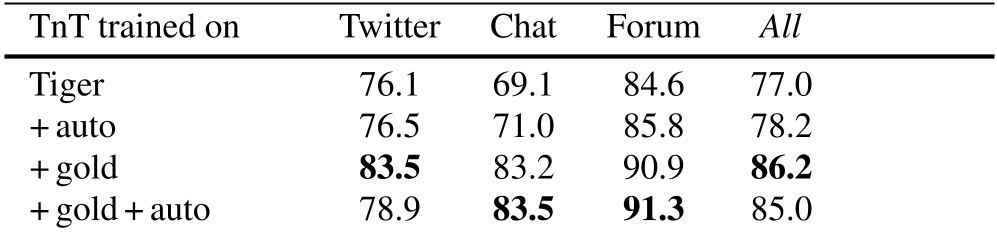 Notice how +gold consistently outperforms +auto across Twitter, Chat, and Forum datasets.
The "Specific Model" Advantage
The authors also found that a tagger specifically "raised" on Twitter performs better on Twitter than a general "Internet Tagger." By using language models to predict the text type first, they could automatically route sentences to the most appropriate specialized tagger.
Critical Analysis & Conclusion
Takeaway
The study proves that Domain Adaptation doesn't always require millions of new parameters. For linguistic analysis, understanding the genre—whether it's a cooking forum or a live chat—is as important as the language itself.
Limitations
- Manual Effort: While 100 hours of annotation is "low cost" for a research lab, it's still a hurdle for real-time applications.
- Normalization Bottleneck: The most successful results relied on manual normalization. Automated normalization is the "Holy Grail" of this pipeline but remains significantly difficult due to the ambiguity of slang.
Future Outlook
As we move toward 2026, the techniques pioneered here—mixing specialized sub-models with "smart" small-scale annotation—provide a roadmap for processing historical manuscripts, regional dialects, and the ever-evolving slang of the next generation of social platforms.
 The final push: combining text-type specific training with normalization achieves the highest gains, especially in "messy" environments like Chat (+31.4% improvement).