
Breaking the Echo Chamber: How Online News Reconnects a Fragmented Public
Contribution of Internet news use to reducing the influence of selective online exposure on political diversity
This study investigates how Internet news consumption influences the relationship between selective online interaction and political diversity in individuals' offline social networks. Utilizing data from the US Citizenship, Involvement, Democracy (CID) survey, it demonstrates that while selective online exposure typically reduces network heterogeneity, high levels of Internet news use act as a critical moderator to mitigate this "echo chamber" effect.
TL;DR
Is the Internet making us more close-minded? While "selective exposure"—the tendency to only interact with like-minded individuals—does indeed shrink our political horizons, this study reveals a powerful antidote: Internet News Use. Even if you prefer talking to people who agree with you, active news consumption provides the "cognitive gear" to handle disagreement, effectively buffering the negative impact of digital echo chambers on your real-world social diversity.
The Motivation: Dissonance vs. Diversity
Since the dawn of the digital age, scholars like Cass Sunstein have warned of a "segment-making" society where we retreat into niches. The logic is rooted in Cognitive Dissonance Theory: biological discomfort with conflicting ideas leads us to use the Internet's high level of control to filter out "noise" (opposing views).
The author, Najin Jun, noticed a gap in this pessimistic narrative. Most research looks at what we choose to see, but ignores how different digital behaviors—specifically news consumption vs. social interaction—interact to shape our actual lives among neighbors and coworkers.
Methodology: Beyond the "Discussion Circle"
Unlike many studies that only look at who you talk politics with, this research looks at Social Network Heterogeneity. This includes the people you didn't necessarily choose:
- Close Friends: High influence, often homogeneous.
- Neighbors: Geographically imposed, potential for diversity.
- Coworkers: Procedurally imposed, critical for exposure to "difference."
The study uses a hierarchical regression model to see if the "news habit" changes the slope of the "selectivity-diversity" relationship.
 Figure 1: Conceptual visualization of how Internet news use acts as a moderator between online behavior and offline diversity.
Core Findings: The Moderation Effect
The data reveals two crucial steps in the digital influence chain:
- The Negative Impact: There is a clear, statistically significant negative relationship between selective online interaction and the diversity of one's social network. If you only use the web to find "your tribe," your real-world network shrinks.
- The News Subsidy: This is the "Eureka" moment of the paper. For people who rarely read online news, social diversity drops sharply as they become more selective online. However, for high-news users, the drop is significantly flatter.
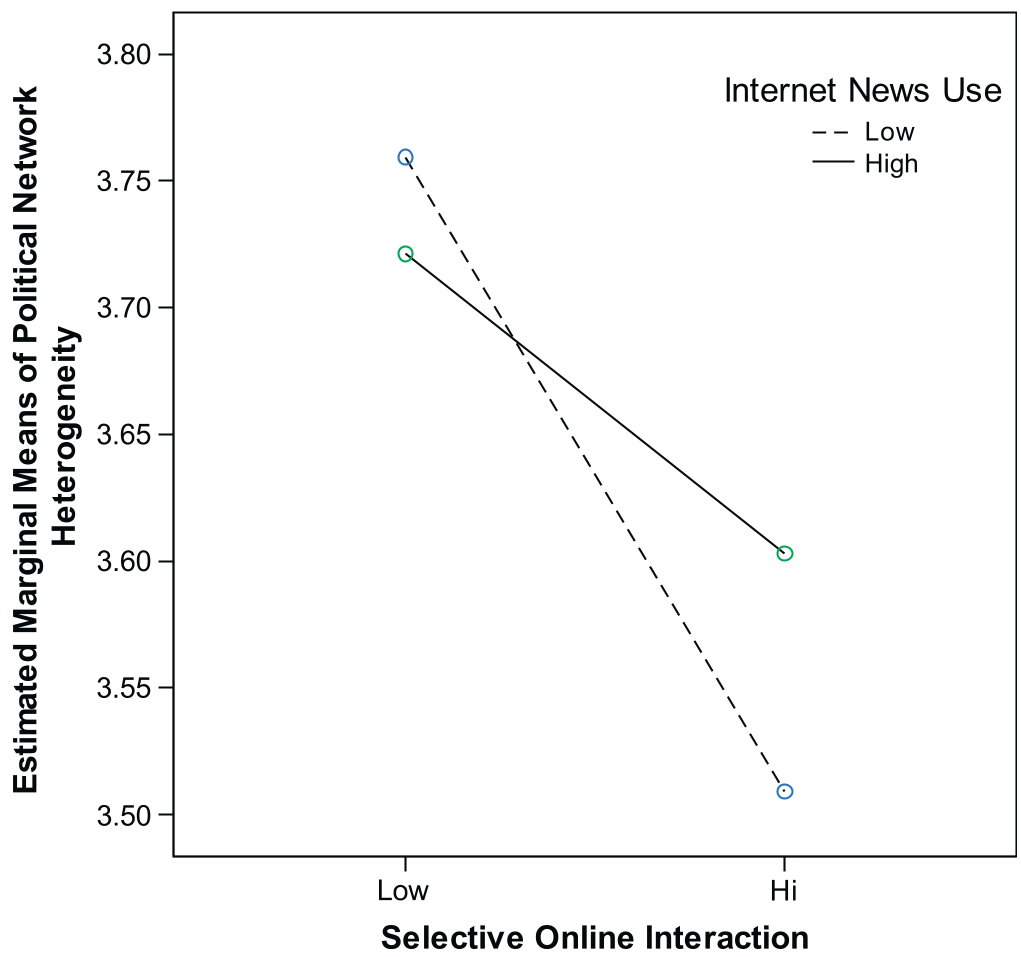 Figure 2: The interaction plot shows that while high selectivity (right side of the X-axis) usually lowers diversity, the "High Internet News" group (top line) maintains much higher marginal means of diversity.
Why does this happen?
The study suggests three "Hows":
- Traversability: The structural nature of news (links/tags) forces "accidental" exposure to other views.
- Argument Repertoire: News users learn the reasons behind the other side's arguments, even if they don't agree. This makes them more "boring-tolerant" or "conflict-resilient" in real-life encounters.
- Defensive Confidence: Knowledgeable users feel less threatened by opposing views, so they don't feel the need to avoid "different" neighbors or coworkers.
Critical Analysis & Conclusion
The Takeaway: Selective exposure is real, but it isn't a death sentence for democracy. The "Internet News" ecosystem provides a vital infrastructure for inadvertent exposure.
Limitations:
- The data is from 2005 (CID Survey). In the age of 2026 algorithms and AI-curated feeds, "traversability" might be lower than it was in the era of traditional hyperlinks.
- The study relies on self-reported "usefulness" of the Internet rather than raw traffic data.
Future Outlook: This paper challenges the "Limited Effects" model of media. It suggests that news doesn't just reinforce what we think; it shapes how we handle what others think. As we move into an era of hyper-personalization, maintaining a "shared news floor" is perhaps more important for social cohesion than the specific content of the news itself.