
TakNet: Unveiling the Socio-Technical Dynamics of Rural Wireless Mesh Networks
Understanding Internet Usage and Network Locality in a Rural Community Wireless Mesh Network
The paper presents a socio-technical measurement study of "TakNet," a Rural Community Wireless Mesh Network (CWMN) in northern Thailand. It combines three months of network traffic analysis with on-site social interviews to characterize Internet usage patterns and spatial locality in underserved regions.
TL;DR
Researchers from the University of Cambridge and AIT Thailand conducted a deep-dive study into TakNet, a community-owned wireless mesh network in rural Thailand. By blending 90 days of network traces with face-to-face interviews, the study reveals how mobile app "misbehavior" distorts network load and confirms that rural users exhibit a surprising degree of network locality—interacting significantly with the neighbors sitting right next to them.
Background: Crossing the Digital Divide
In isolated villages like Thai Samakhee, the "for-profit" ISP model fails. With a population of just 300, there is no "economy of scale." Community Wireless Mesh Networks (CWMN) offer a solution by amortizing the cost of a single ADSL link across multiple households. However, managing these networks requires more than just hardware; it requires an understanding of the unique behavioral patterns of the users.
The "Ghost in the Machine": When Apps Misbehave
One of the paper's most striking revelations is the distortion of content popularity. In typical urban settings, web traffic follows a Zipf Distribution (a few sites get most of the hits). In TakNet, the distribution was heavily skewed.
The culprit? Misinformed Knowledge.
85% of the interviewed villagers installed an app called "CM Battery," believing it would accelerate their WiFi speed. In reality, the app generated an enormous volume of automated HTTP requests to ksmobile.com, wasting precious bandwidth and creating network anomalies.
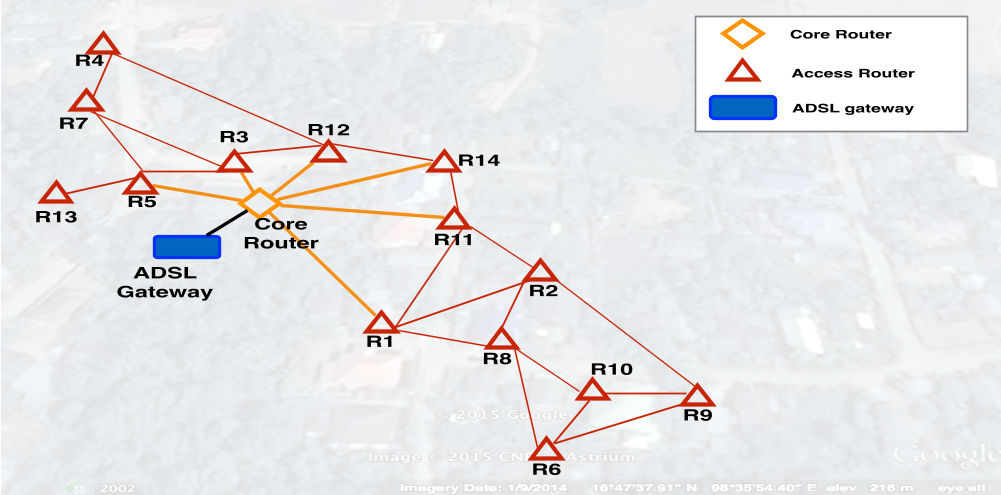 Figure 1: The architecture of TakNet, utilizing a central core router to bridge the gateway to 14 access routers.
Methodology: Detecting Anomaly through Fairness
To separate human intent from autonomous app behavior, the authors used Jain’s Fairness Index.
- The Logic: If a domain (like Google) is popular because everyone likes it, the FAIRNESS index is high (traffic is distributed across all routers).
- The Anomaly: If a domain (like
baidu.comorksmobile.com) shows massive traffic but originates from only one or two routers with sub-2-second interarrival times, it is flagged as application-driven misbehavior.
By filtering these "suspicious domains," the researchers were able to recover a realistic Zipf parameter (), revealing that the "tail" of the distribution actually contained high-value educational content like dek-d.com that was previously buried by app noise.
Network Locality: The Digital Village Square
Is the Internet only for reaching the outside world? Not in rural Thailand. Using a "sliding window" analysis on the Line messaging app (the region's dominant IM service), the researchers discovered that 10-20% of all messages were exchanged locally within the village.
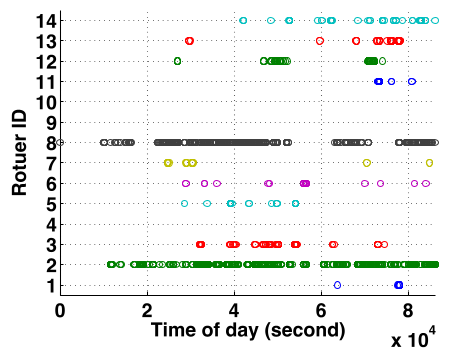 Capturing local pairs: When two matching HTTP requests fall within a 5-second window, they likely represent a local conversation.
This finding is lower than the 50% locality seen in some African studies, but high enough to justify Service Caching. Instead of fetching every message from a remote server in Bangkok or Seattle, the network could theoretically "cache" local interactions to save bandwidth.
Critical Analysis & Takeaways
The study highlights a critical gap in universal network design:
- Context Over Frequency: Traditional caching (keeping the most "popular" items) fails in rural areas because "popular" often means "malware" or "ad-heavy apps." Caching must be context-aware, prioritizing education and local news.
- Sustainability is Socio-Technical: The biggest threat to the network wasn't hardware failure, but "manual instability"—villagers turning off routers to save on the $1/month electricity bill.
- The Mobile Shift: Unlike previous studies focused on PCs, 60% of rural Thai users are mobile-first. This changes everything from the type of traffic (short IM bursts) to the type of "maintenance" (clearning out junk apps).
In conclusion, TakNet demonstrates that for rural connectivity to survive, it must be self-adaptive to the human and technical quirks of the community it serves.