
Passing Together: Decoding Social Dynamics in Collaborative VR
Interpersonal Affordances and Social Dynamics in Collaborative Immersive Virtual Environments: Passing Together Through Apertures
This study investigates "interpersonal affordances" by examining how dyads coordinate behavior to pass through apertures of varying widths in both real-world and distributed Immersive Virtual Environments (IVEs). The research utilizes commodity-level VR hardware (HTC Vive) and full-body self-avatars to measure critical behavioral thresholds for joint action.
TL;DR
How close would you get to a stranger while walking through a narrow door? Does it change if you are both represented by digital avatars? This research discovers that while social dynamics (like gender) govern our personal space in the real world, we become significantly more "cautious" and demand more space in Virtual Reality—even when physical collisions aren't possible.
The "Invisible Bubble": Why Joint Action is Hard to Map
In the real world, we navigate tight spaces with others using a mix of affordances (body-scaled possibilities for action) and proxemics (the social "bubbles" we maintain). Previous SOTA work by Davis et al. established that dyads often tolerate tighter spaces than individuals. However, the move to Immersive Virtual Environments (IVEs) introduces a variable that the real world cannot: a mismatch between our physical identity and our digital representation.
Methodology: Poles, Avatars, and Gender Swaps
The researchers tracked pairs of participants as they approached a doorway-like aperture (two poles).
- Experiment 1 (Real World): 48 subjects in M-M, F-F, and M-F pairings.
- Experiment 2 (IVE): 112 subjects using HTC Vives and inverse kinematics for full-body avatars. Crucially, they tested gender-swapped avatars (e.g., male participants using female avatars).
The team measured four specific behavioral transitions:
- SFA: Single File with Adjustment (turning and tucking).
- SF: Single File (one waits).
- ADJ: Adjustment (shoulder rotation while side-by-side).
- CLR: Clearing (passing side-by-side without effort).
 Fig 1: From left to right: Adjustment, Clearing, and Single File behaviors in the virtual environment.
Key Finding 1: The "Gentleman" Effect in the Real World
In the physical experiment, Male-Female pairings gave each other the most room, with an adjustment threshold of 1.23 (meaning they turned their shoulders even when the gap was 23% wider than their combined bodies). Interestingly, Male-Male pairs were the "stubborn" group, often refusing to go single-file until the gap was extremely narrow.
Key Finding 2: The VR "Caution" Gap
The most striking discovery was the inflation of thresholds in VR. Contrary to the authors' hypothesis that a lack of haptic feedback would make people "overlap" their avatars, participants were actually more afraid of colliding in VR.
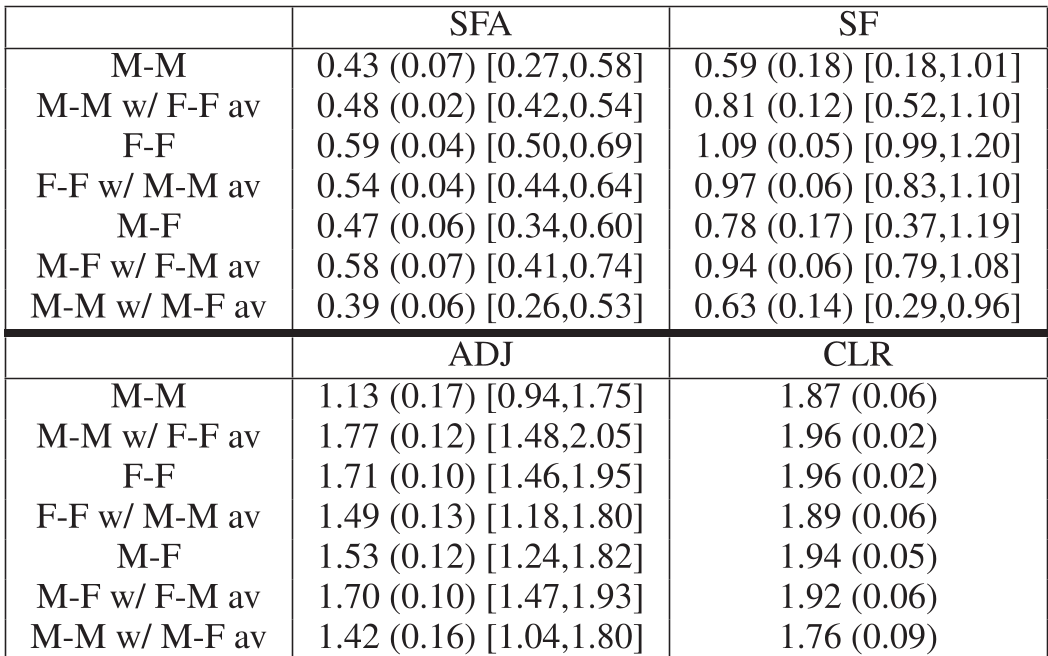 Table 1: Critical thresholds across all behaviors in Exp 2. Note the higher values compared to real-world baselines.
- Real World ADJ Threshold: ~0.99
- Virtual World ADJ Threshold: ~1.57 (A ~58% increase in required space!)
Why the Difference? (The Academic Insight)
Why do we demand more space in VR? The authors point to uncertainty. In the IVE, users are less sure of their "digital skin." Without the subtle visual and haptic cues of the real world, and with the limited field-of-view of HMDs, participants adopt a "play it safe" strategy.
The study also found that avatar gender overshadowed the participant's actual gender in some social contexts, but the nuances of real-world gender dynamics (like the M-F "chivalry" or M-M "competition") didn't translate perfectly to current commodity VR setups.
Conclusion & Future Outlook
This work provides a baseline for "Interpersonal Affordances." It suggests that for VR to feel as natural as a real-world office or social gathering, we need more than just "tracked controllers."
- Calibrated Self-Avatars: Users need a phase to "feel" their digital dimensions to reduce uncertainty.
- Social Fidelity: Future IVEs must account for the fact that social norms (proxemics) are currently "stretched" in the digital realm.
While we can "pass together" in VR, we aren't yet doing it with the same fluid intuition we use on a busy city sidewalk.