
Interpersonal Informatics: Making the Invisible Social "Infection" Visible
Interpersonal informatics: making social influence visible
This paper formalizes the field of Interpersonal Informatics (IPI), a subclass of computing tools that allow social groups to collect, aggregate, and share personally relevant data. It extends Personal Informatics by making "hyperdyadic spread"—the subtle social influences from friends and friends-of-friends—visible and actionable for users.
TL;DR
Why do you suddenly start eating more junk food at work? It’s likely not just your willpower; it’s your social network. This paper introduces Interpersonal Informatics (IPI), a domain that expands personal tracking (like Fitbit) into a social ecosystem. By aggregating data across your "tribe," IPI tools reveal how your friends—and even people you don't know—silently shape your health, mood, and habits.
Backgound: Beyond the Self
In the world of HCI (Human-Computer Interaction), we've spent a decade perfecting Personal Informatics (tracking your own steps, sleep, and heart rate). But we live in a vacuum. This paper, published at CHI '11, argues that to understand the user, we must look at the "Hyperdyadic Spread" of influence.
The Problem: The Transparency Paradox
We know from social science that if your friends smoke, you are more likely to smoke. If your friends are happy, you are likely happy. However, these influences are the result of thousands of microscopic impressions. They are effectively invisible.
The Gap: Current tools show us what we do (the timeline of a single user), but they don't show us why we do it (the combined timelines of our social network).
Methodology: Mapping the "Tribe"
The authors define IPI as the intersection of Personal Informatics and Social-Mobile Ubiquitous Computing.
1. The Core Infrastructure
The system relies on three pillars:
- Sensing: Mobile phones and wireless devices (scales, monitors) collect the data.
- Aggregation: Data is pooled not just from immediate friends, but up to three degrees of separation.
- Visualization: Comparison interfaces that contrast "Me" vs. "My Subgroups" (e.g., seeing that your office's average BMI is higher than your family's).
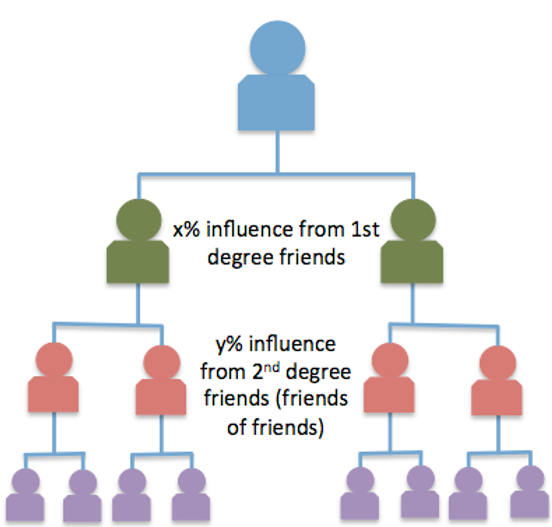 Figure: Transitioning from a single user's timeline to a network-aggregated view.
2. The Concept of Hyperdyadic Spread
The authors lean heavily on the "Three Degrees of Influence" rule. Influence flows from a friend to a friend's friend, and so on, decreasing in strength but still remaining measurable until the third level.
 Figure: Visualizing how influence propagates through nodes in a social graph.
Challenges: The Human and Technical Friction
Realizing IPI isn't just a matter of coding; it faces significant socio-technical hurdles:
- Privacy vs. Utility: If you track alcohol consumption or debt, are you willing to share it? The authors suggest using anonymous averages or delta-sharing (sharing that you lost 2 lbs, rather than your actual weight) to mitigate this.
- Data Quality and Self-Censorship: People tend to present an idealized version of themselves online. If the data is "curated" rather than "sensed," the IPI system becomes a hall of mirrors rather than a window to reality.
- Computational Scale: Analyzing the "influence map" for millions of users, where each node's behavior is a function of its neighbors, requires massive backend infrastructure.
Critical Insight: The Future of "Social" Software
The true value of this paper is its shift in perspective. Instead of using social networks for competition (leaderboards) or support (encouraging comments), it uses them for diagnostics.
Key Takeaways:
- Awareness is the first step to change: Just as seeing a calorie count changes how you eat, seeing your office's "sedentary score" changes how you view your own desk time.
- Disaggregation is key: We aren't influenced by "everyone" equally. Comparison between work, family, and hobby groups is where the real insights lie.
Conclusion
Interpersonal Informatics represents a maturation of the Quantified Self movement. It acknowledges that human behavior is not an individual choice, but a networked phenomenon. By making these invisible ties visible, we gain the agency to consciously choose which "tribe" we want to follow.