
Strategizing Social Entry: How Newcomers Can Maximize Social Capital in Evolving Networks
Interpersonal Ties and the Social Link Recommendation Problem
This paper investigates the dynamic social link recommendation problem, focusing on how a newcomer can strategically enter an evolving social network to maximize their social capital. The researchers propose a two-stage framework: first, identifying the optimal weighted link prediction model (e.g., WRA or WRWR) to simulate network evolution, and second, applying edge establishment strategies like Max Closeness Centrality to optimize the newcomer's positional advantage.
TL;DR
Entering a new social network isn't just about making friends; it's a strategic optimization problem. This paper formalizes the "Dynamic Social Link Recommendation Problem," demonstrating that by using weighted link prediction to model how a network grows, a newcomer can choose specific "central" individuals to link with to maximize their own long-term influence (Closeness Centrality).
Background Positioning
In the landscape of Social Network Analysis (SNA), link prediction is usually a passive task—predicting what will happen. This work shifts the perspective to an active, agent-centric view. It occupies a niche between Link Prediction and Network Building, treating the newcomer as a strategic actor looking for the highest "Return on Investment" (ROI) for their limited social resources.
Problem & Motivation: The Newcomer's Dilemma
Most social networks are dynamic; they grow, prune, and reorganize. When a newcomer enters (e.g., a new employee in a company or a new user on a platform), they have limited "slots" to build initial connections.
The authors identify a critical gap: Prior work focuses on the network's overall growth, but not on the newcomer's positional advantage. If you only have five people you can meet, who should they be to ensure that six months from now, you are at the heart of the information flow?
Methodology: The Two-Stage Framework
The paper proposes a rigorous framework to solve this.
Stage 1: Network Evolution Modeling
To recommend links, we first need to know how the network behaves. The authors compared weighted local indices (like Resource Allocation - WRA) and global indices (like Random Walk with Restart - WRWR).
- Local Intuition: Similar nodes are more likely to connect (WCN, WAA).
- Global Intuition: The overall topology, including paths of length , dictates future ties (WKatzi, SimRank).
 The implementation uses a steady-state vector approach for Random Walks, ensuring that the model captures the long-term "importance" of nodes relative to one another.
Stage 2: Passive Edge Establishment
Once the "best-fit" evolution model is found, the newcomer applies a strategy. The researchers tested several "Passive" strategies (where the newcomer makes links once upon entry and then lets the network evolve):
- MaxDegreeCentrality: Link to the "celebrities."
- MaxClosenessCentrality: Link to the "shortcuts" who are closest to everyone else.
- MaxBetweennessCentrality: Link to the "bridge-builders."
Experiments & Results: What Actually Works?
The results varied significantly by network type (Political vs. Social Media):
- WRA (Resource Allocation) proved superior for political networks, likely because political ties are often driven by specific shared resources or local alignments.
- WRWR (Random Walk with Restart) dominated social media networks, where information cascades and global reach are more prevalent.
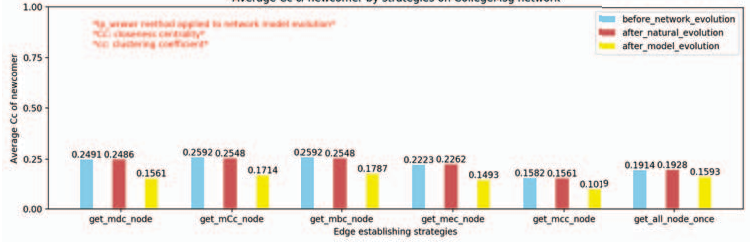 In the CollegeMsg dataset (social media), the "MaxClosenessCentrality" and "MaxBetweennessCentrality" strategies significantly outperformed the control group (AllNodeOnce), proving that strategic tie-making leads to a measurably better position.
The Clustering Effect
The researchers found that the newcomer gains higher Closeness Centrality in "clustered" networks. If the community is tightly knit, a single well-placed tie acts as a massive "on-ramp" to the entire social group.
Critical Analysis & Conclusion
Takeaways
- Context Matters: You cannot use the same link prediction model for a political organization as you do for a Facebook forum.
- Strategic Targeting: Connecting to "central" players isn't just vanity; it's the most efficient way to reduce your "distance" to all other nodes in the future.
Limitations
The study assumes a "Passive" Strategy—the newcomer connects once and then waits. In reality, networking is iterative. Future research should explore "Active" Strategies, where the newcomer dynamically adjusts their ties as the network evolves.
Future Outlook
This work lays the foundation for AI-driven "social career coaches" or "market entry tools" that could tell a brand exactly which influencers to partner with to become "central" to a target demographic in the shortest time possible.