
Intersectional HCI: Beyond the "Rhetorical Cipher" of the Universal User
Intersectional HCI: Engaging Identity through Gender, Race, and Class
The paper introduces "Intersectional HCI," a framework derived from Black feminist theory to analyze how overlapping identity markers like gender, race, and class influence technology use. Through a meta-review of 140 CHI papers (1982-2016), the authors establish the current state of identity representation in the field and provide a roadmap for more inclusive research.
TL;DR
Is the "user" in your research a real person or just a placeholder? This seminal paper by Schlesinger et al. introduces Intersectional HCI, a framework that challenges the field to stop looking at identity markers like gender, race, and class in isolation. By auditing 34 years of CHI history, they reveal a startling lack of diversity and nuance in how we represent identity, offering five critical recommendations to build more equitable technology.
The "User" Problem: A Rhetorical Cipher
For decades, HCI has revolved around the concept of "the user." However, as the authors argue, this term often acts as a rhetorical cipher—an abstract character used to justify design decisions rather than a reflection of complex human reality.
The core motivation for this work is the realization that when we design for a "universal user," we implicitly design for the dominant group (often white, Western, cisgender, and middle-class). Those at the intersections—such as low-income women of color—find their experiences erased because previous SOTA methods tended to analyze one identity facet at a time, ignoring how they collide and compound.
Methodology: Auditing 34 Years of CHI
The researchers conducted a massive meta-review, searching the ACM Digital Library for papers published between 1982 and 2016. Using over 50 keywords (e.g., transgender, poverty, African American), they narrowed down 13,999 publications to a core corpus of 140 manuscripts that explicitly engaged with identity.
They applied three intersectional lenses defined by Leslie McCall:
- Anticategorical: Deconstructing categories as flawed/incomplete.
- Intercategorical: Using categories "provisionally" to document inequality.
- Intracategorical: Focusing on a specific group (e.g., homeless mothers) to show internal heterogeneity.
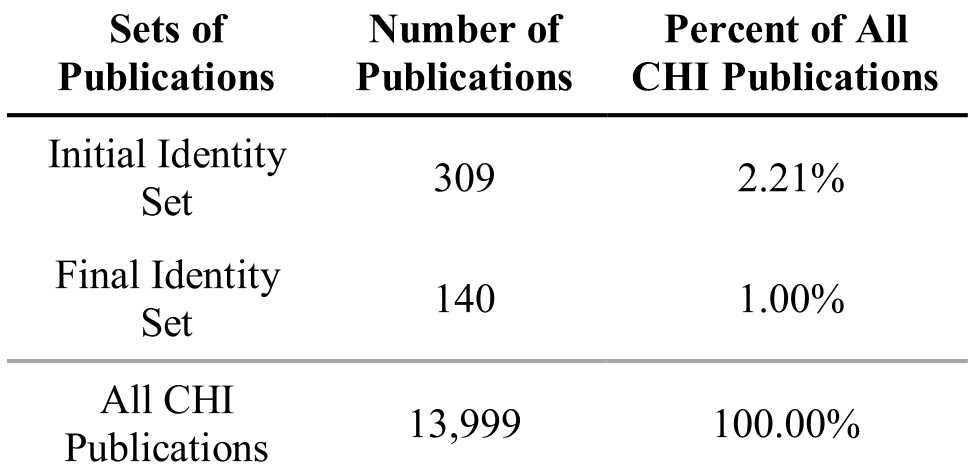
Key Findings: The Great Imbalance
The results of the audit were revealing and, in some ways, indicting of the field's historical blind spots:
- Gender Dominance: Gender was the most researched category (70% focus), but it was often treated as a simple binary (Male/Female).
- Race Omission: Research on race and ethnicity lagged significantly behind (only 12% focus). Many keywords like Latinx, First Nations, or Middle Eastern returned zero results in the final corpus.
- The Intersection Gap: Only 3 out of 140 papers significantly addressed the intersection of gender, race, and class simultaneously.
- Contextual Vacuum: Nearly half of the papers did not report the region or nationality of their participants, assuming a "universal" (usually U.S.-centric) context.
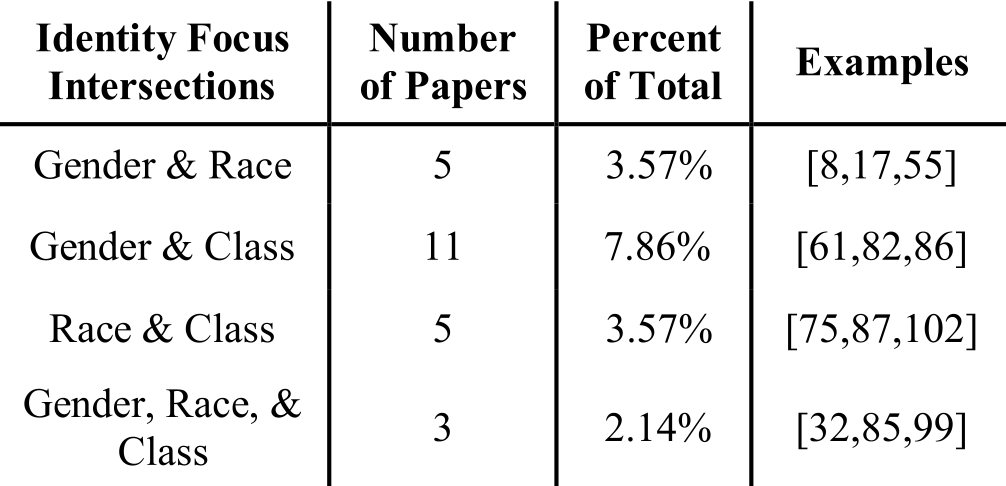
Why Conventional Analysis Fails
The authors point out a common pitfall: researchers often report gender differences in statistical results (e.g., "men used the app more than women") without providing any theoretical or contextual motivation for why that difference exists. This is "identity-as-variable" research, and it lacks the depth required to solve real-world systemic issues.
Intersectional HCI asks "Why?"—Why does a low-SES environment change technology acceptance in rural China vs. rural India? Why do trans individuals manage privacy differently on Facebook?
5 Recommendations for the Future of HCI
Schlesinger et al. conclude with a call to action for all HCI researchers:
- Report Context: Don't assume "normal." State clearly where and in what culture your study exists.
- Report Demographics: Be explicit about who your participants are.
- Acknowledge Limitations: If your study only includes one group (e.g., all men), explain why and what is missing.
- Author Disclosure: Normalize "Researcher Stance" sections where authors explain their own background and potential biases.
- Embrace Complexity: Stop flattening identities into binaries. Look for the "Multiplicative" effect of overlapping identities.
Critical Insight
This paper isn't just a critique; it's a foundational shift in how we think about human-computer interaction. By moving away from the "rhetorical cipher" and toward a nuanced, intersectional understanding of the user, HCI can finally move from being "user-friendly" to being truly "inclusive." The gap in race-related research in the CHI proceedings is a particularly loud silence that current researchers must work to fill.
Written by the Senior Academic Tech Editor.