
Intertwined Viral Marketing: Why Your Product Strategy Fails in a Multi-Product World
Intertwined viral marketing in social networks
This paper introduces the Intertwined Influence Maximization (TIM) problem, addressing how to maximize a target product's impact when multiple competing, complementary, or independent products are promoted simultaneously. The authors propose TIER (interTwined Influence EstimatoR), a unified greedy framework leveraging a novel Intertwined Linear Threshold (TLT) diffusion model to navigate these complex product relationships.
TL;DR
Marketing doesn't happen in a vacuum. Most Influence Maximization (IM) research assumes your product is the only one in the social network. This paper shatters that illusion by introducing Intertwined Influence Maximization (TIM). It provides a framework to handle competing, complementary, and independent products simultaneously, proving that utilizing knowledge of other products' strategies can boost your reach by over 50%.
Beyond One-Product Isolation
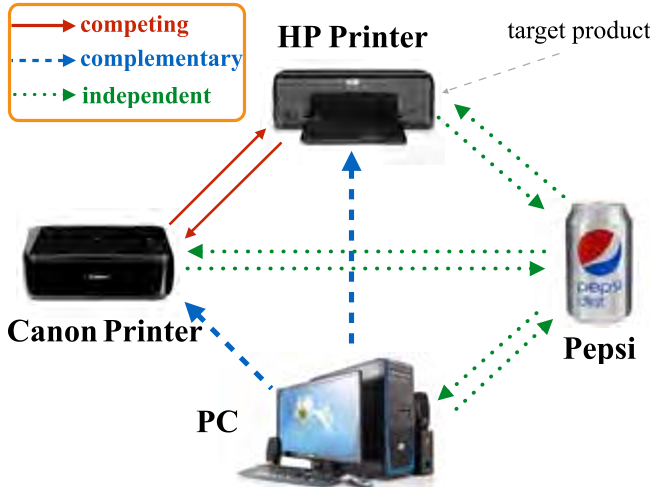
In the real world, if you buy a PC (complementary), you're more likely to buy a printer. If you buy a Canon printer (competing), you're less likely to buy an HP. Traditional algorithms like LT-Greedy or PageRank treat every user as a blank slate, ignoring these intertwined relationships.
The authors identify two critical versions of this problem:
- C-TIM (Conditional): You know your competitors' moves (e.g., they launched last week).
- J-TIM (Joint): Everyone is launching at once, and marketing strategies are confidential "black boxes."
Methodology: The TLT Model and Threshold Dynamics
The core innovation is the Intertwined Linear Threshold (TLT) model. In a standard LT model, a user becomes active for product if the sum of influences from their neighbors exceeds a fixed threshold .
In the TLT model, the threshold is no longer static. It shifts dynamically:
- Competing Products: Increase the threshold (harder to activate).
- Complementary Products: Decrease the threshold (easier to activate).
- Independent Products: No change.
Solving the "Game" of J-TIM
When strategies are unknown, the paper treats the social network as a game-theoretic arena. The J-TIER algorithm uses a round-wise greedy approach: in each step, your "agent" infers what the most selfish move for your competitors would be, and then selects a seed user that maximizes your reach given that inferred competitive landscape.
Experimental Proof: Knowledge is Power
The authors tested TIER on four architectures, including Facebook and Epinions.
Key Findings:
- The Complementary Advantage: Many methods only focus on competitors. However, the study shows that accounting for complementary products (like PCs for Printers) provides a massive lift. In the Epinions dataset, J-TIER was 17.3% better than models that ignored complementary effects.
- Greedy Approximations: For the C-TIM variant, the authors proved that the influence function remains submodular and monotone, guaranteeing a approximation of the optimal result.
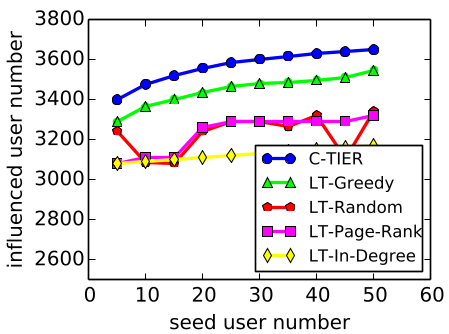 (Shown above: In the Facebook network, C-TIER consistently outperforms standard LT-Greedy as seed size increases.)
Critical Insight & Future Outlook
The biggest takeaway here is the Threshold Updating Coefficient. It quantifies "market friction" and "market synergy." While this paper assumes these coefficients are known from market research, the next frontier will be learning these coefficients directly from historical diffusion data using deep learning.
Limitations: The model assumes that the most recent activation has the dominant effect on the threshold. In reality, the cumulative "fatigue" or "loyalty" from multiple past purchases likely influences user behavior in more complex, non-linear ways.
Conclusion
TIM and the TIER framework shift the conversation from "who is the most central person?" to "who is the most influential person given the current market clutter?" For brands, this means your influencer strategy shouldn't just look at follower counts, but at how those followers have already been "primed" by your allies and competitors.