
Demystifying Crowdsourcing: Scaling Language and Multimedia Research with Human Computation
An Introduction to Crowdsourcing for Language and Multimedia Technology Research
The paper provides a comprehensive introduction to crowdsourcing for Language and Multimedia Technology research, detailing a framework for rapid, low-cost dataset construction using platforms like Amazon Mechanical Turk (AMT). It covers the transition from simple labeling tasks to complex "creative" assignments, exemplified by the MediaEval 2011 Rich Speech Retrieval (RSR) project.
TL;DR
In the world of AI, data is the new oil, but manual labeling is the expensive refinery. This paper presents a foundational guide on using crowdsourcing (specifically Amazon Mechanical Turk) to build datasets for language and multimedia research. By breaking tasks into micro-units and managing human effort, researchers can achieve "SOTA" results at a fraction of the cost and time of traditional methods.
Background: The Data Bottleneck
Whether it is Machine Translation, Speech Recognition, or Image Classifiers, the hunger for high-quality manual transcription and labeling is insatiable. Historically, researchers were limited by the staff they could hire locally. Crowdsourcing shifts this paradigm by treating human intelligence as a scalable, on-demand utility.
The Mechanics of a Crowdsourcing System
The paper defines crowdsourcing as a form of Human Computation. To run a successful project, a researcher must solve four critical challenges:
- Recruitment: How to find workers with the right skills (e.g., bilingual for translation).
- Contribution: Designing micro-tasks that are simple yet effective.
- Integration: Methods to merge multiple worker inputs into a single "ground truth."
- Evaluation: Determining who to pay and who to block.
The Power of Reputation
The "Requester" is as much under scrutiny as the "Worker." A researcher's reputation for fair pay and clear tasks determines their ability to attract top-tier talent. This mutual accountability is the "Inductive Bias" that keeps the ecosystem stable.
Designing the Perfect "HIT" (Human Intelligence Task)
The methodology focuses on an iterative design cycle. Before launching 10,000 tasks, one must run a pilot.
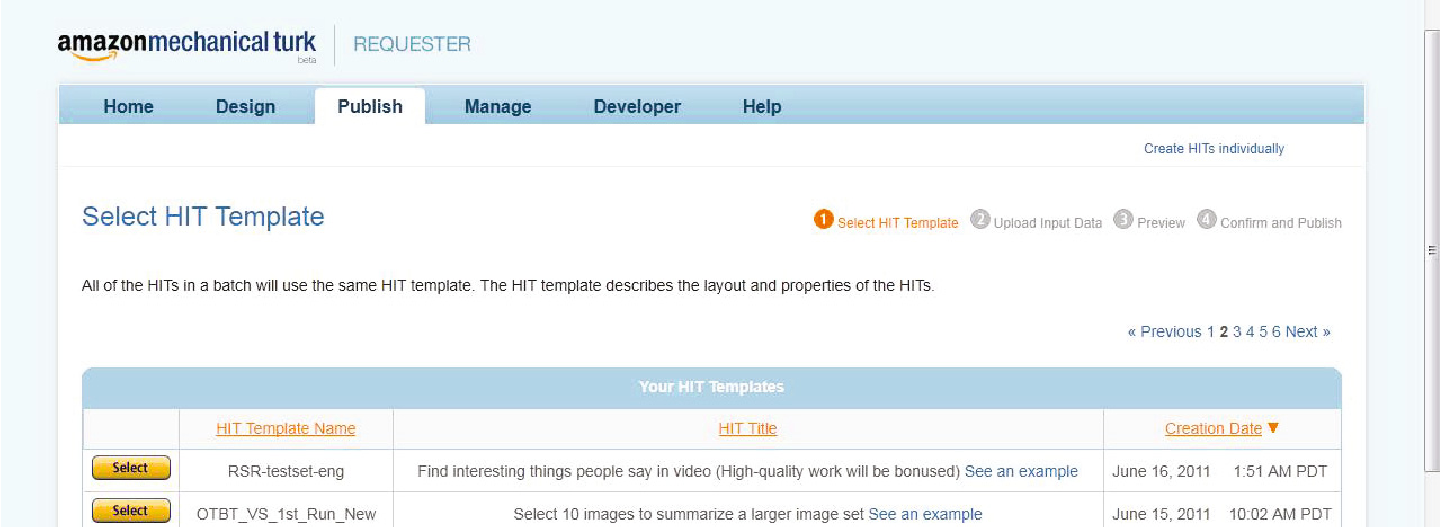 Figure: The range of HIT designs available in Amazon Mechanical Turk, highlighting the flexibility of task presentation.
Protecting Against "Spam"
A significant contribution of this work is the discussion on Honey Pots. These are "golden questions" with known answers hidden within a task batch. If a worker fails these, it’s a clear signal of low-quality work or automated script usage (spam), allowing requesters to reject the entire batch.
Case Study: MediaEval 2011 Rich Speech Retrieval
The author demonstrates the efficacy of this approach through the RSR task. Unlike simple labeling, this required workers to find specific "speech acts" like warnings or promises in long video files.
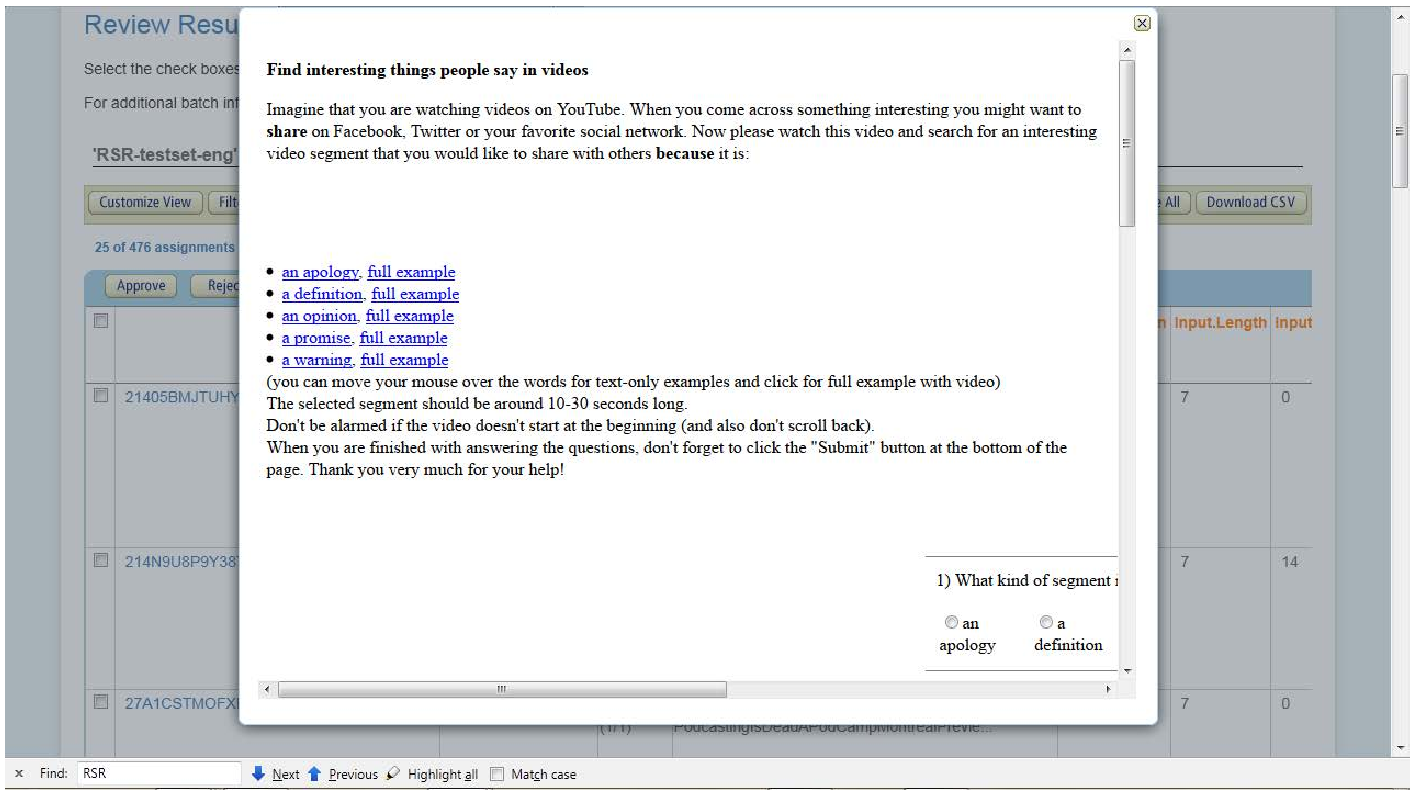 Figure: The requester's view to verify worker findings, bridging the gap between raw data collection and quality control.
Key findings from the experiment:
- Flexible Incentives: Giving workers the option to choose their own bonus based on work quality led to honest self-assessment.
- Creative Input: Crowd workers are capable of meaningful creative work (like writing search queries), not just repetitive clicking.
- Human Factors: Disclosing that the work supports non-profit university research increased worker empathy and engagement.
Critical Insight: Beyond Simple Labeling
The paper argues that we have only scratched the surface. While early work focused on transcribing audio, we are moving toward Affective Annotation (labeling emotions in video) and Social Data Analysis.
However, the transition to external platforms introduces technical dependencies—bandwidth issues, browser compatibility, and video playback errors can lead to "noisy" data that isn't the worker's fault.
Final Takeaway
Crowdsourcing is a sophisticated engineering discipline. Success requires more than just money; it requires User-Centered Design applied to the tasks themselves. For the future of HLT (Human Language Technologies), the ability to "program" a crowd is as important as the ability to program a neural network.
Limitations & Open Questions
- Ethical Compensation: What constitutes a "fair" micro-payment in a globalized emerging economy?
- Complexity Ceiling: At what point does a task become too specialized for a general crowd (e.g., medical imaging or legal summaries)?
- Automation: Can LLMs eventually replace the "Worker" in these workflows, or will "Human-in-the-loop" always be the Gold Standard?