
IDEAS: Mapping Intruder Trails through Emotional Ant Colonies
IDEAS: intrusion detection based on emotional ants for sensors
This paper introduces IDEAS (Intrusion Detection based on Emotional Ants for Sensors), a bio-inspired framework utilizing an Emotional Ant Colony System to secure wireless sensor networks (WSNs). By simulating pheromone-based foraging behavior integrated with "emotional" state templates, the system identifies suspicious traffic patterns and maps intruder trails with high coordination.
TL;DR
The IDEAS framework re-imagines sensor network security by deploying "Emotional Ants"—autonomous agents that mimic nature's foraging behavior to sniff out intrusions. Unlike static firewalls, these agents use pheromone trails to mark suspicious paths, providing a self-organizing "first line of defense" that can actually visualize an attacker's movement across a network.
Background Positioning
While traditional IDS often rely on heavy centralized computation, the IDEAS approach (Intrusion Detection based on Emotional Ants for Sensors) sits at the intersection of Swarm Intelligence and Distributed Security. It addresses the volatility of Wireless Sensor Networks (WSNs) by treating detection as a coordination problem rather than a simple classification task.
The Problem: Why Firewalls Aren't Enough
Sensor networks operate in open, often hostile environments with severe resource constraints. Traditional defenses like encryption are high-cost and prone to "insider attacks" where a compromised node bypasses authentications. Furthermore, these methods often fail to answer a critical forensic question: Where exactly did the intruder go?
The authors argue that we need a mechanism that is:
- Decentralized: No single point of failure.
- Adaptive: Able to handle uncertain or incomplete environmental data.
- Trace-oriented: Capable of keeping a physical/logical record of the intrusion path.
Methodology: The "Emotional" Twist on ACO
The core of IDEAS is an adaptation of the Ant Colony System (ACS). In a standard ACS, ants find the shortest path to food via pheromones. In IDEAS, "food" is replaced by "attack signatures."
1. Mathematical Pheromone Dynamics
The system uses two levels of updates. A Local Update Rule makes visited edges less attractive to encourage exploration: A Global Update Rule reinforces the paths that match known attack scenarios, allowing the "colony" to converge on a suspicious trail.
2. The Emotional Agent Template
What makes these ants "emotional"? The agents utilize Emotion Templates representing states like "affinity" or "dejection." These states adjust the Conflict Tendency of an agent. If an intruder object matches an attack rule (e.g., high data rate on a specific port), the ant's affinity for that path increases, effectively "screaming" to other ants via pheromone spikes.
(Note: Refer to the paper's description of Agent Templates and Rule Bases for the conceptual flow.)
Experimental Results: Sniffing Out the Suspects
The authors simulated a sensor network where suspicious behavior was defined by specific parameters:
- Source/Dest IP matching high-risk subnets.
- Unusual Data Rates: e.g., an originator sending 43.2 MB/Sec.
- TCP Protocol Violations.
Key Findings
As shown in the performance tables, different "Agents" or "Fused Agents" were assigned to monitor specific features (IP, Port, Duration).
| Agent Type | Pheromone Value | Decision |
|---|---|---|
| Agent A | Positive | High Attack Probability |
| Agent B | Optimum | "Deadly" Attack Likely |
| Fused Agents | 2.3 | Severe Multiple Node Attack |
By analyzing the final "Tendency" (where values > 0.5 indicate high alert), the network administrator can visualize the attack trail based on where pheromone concentration is highest.
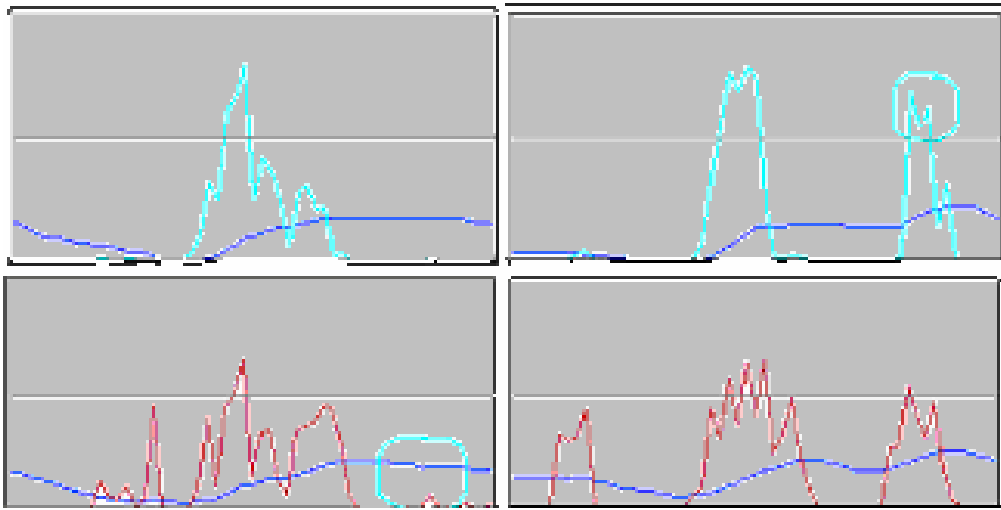 Figure: Simulation showing the distortion in transmit/receive signals (circled) which the ants identify as potential intrusion points.
Critical Insight & Conclusion
The true value of IDEAS lies in its Self-Organizational Principle. Instead of a central server checking every packet, the "Emotional Ants" provide a probabilistic, low-overhead layer that matures over time.
Limitations
- Rule Dependency: The system still relies on a "Basis of Rules" provided by administrators to initialize the ants' knowledge.
- Cold Start: Initial pheromone levels must be carefully tuned () to prevent early false positives.
Future Outlook
The integration of this "biological" layer with heavy-duty machine learning (like Support Vector Machines or Decision Trees) could create a hybrid IDS that is both fast (swarm-based) and deep (AI-based). As sensors move toward the Edge Computing era, such low-footprint, collaborative intelligence will be essential.