
Beyond Literacy: Decoding the "Man in the Street" Mobile Banking Experience in Mali
Investigating Mobile Banking in Mali: HCI Experience of ‘Man in the Street’
2019-01-01
Summary
Problem
Method
Results
Takeaways
Abstract
This study, "Investigating Mobile Banking in Mali," presents a comprehensive HCI investigation into the adoption and usage of mobile banking services among a diverse demographic in Bamako, Mali. By moving beyond the traditional research focus on low-literacy or marginalized groups, the authors provide a holistic view of the "man in the street" user experience, achieving a detailed understanding of the sociocultural drivers of financial technology adoption.
## TL;DR
While most research on mobile banking in developing nations focuses on the "unbanked" or "illiterate," this study shifts the lens to the general population of Mali. It reveals a fascinating paradox: while users are tech-savvy enough for WhatsApp and YouTube, they almost entirely shun mobile banking apps in favor of USSD due to poor UI consistency. Furthermore, it uncovers how social hierarchies dictate transaction delegation, suggesting that "User Experience" in Mali is a communal, rather than individual, endeavor.
## The Research Gap: Escaping the "Marginalized Group" Bias
For years, the HCI4D (Human-Computer Interaction for Development) community has focused on specific segments: the poor, the rural, and the non-literate. While noble, this focus has left a void in our understanding of the general urban population—the "man in the street."
The authors argue that by only looking at the extremes, we miss the broader evolution of digital ecosystems. In Mali, where the literacy rate is roughly 33%, the digital reality is nuanced. People navigate complex social structures and use high-end smartphones, yet their financial tools remain tethered to legacy interfaces.
## Methodology: A Multi-Layered Approach
The study utilized a structured, face-to-face questionnaire approach in Bamako and Ségou.
- **Breadth**: 77 participants from over 20 neighborhoods and 30 different professions.
- **Depth**: The researchers didn't just ask "if" people used the service, but "how" they communicated around it and "who" they performed transactions for.
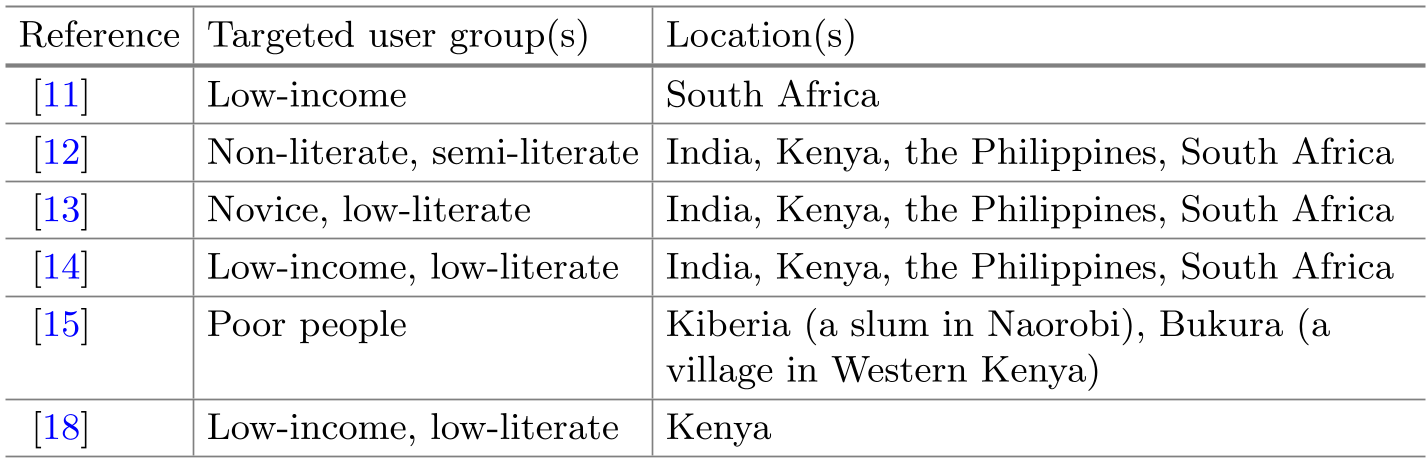
*Table 1: Most prior work focuses exclusively on low-income or low-literacy groups.*
## Core Insights: The Usability-Utility Paradox
### 1. The App Rejection
Despite 81% of respondents owning smartphones and being active on WhatsApp (75%) and YouTube (66%), only **13% used the mobile banking app**. The reason? An expert evaluation found major usability flaws. Users preferred the reliability of USSD (text-based menus) and physical kiosks over a frustrating app interface.
### 2. Social Delegation and Hierarchy
One of the most profound findings is that financial transactions are not solitary. 39% of participants charged others to send/receive money on their behalf.
- **Cultural Logic**: Parents ask children, and employers ask employees to handle the tech.
- **Design Implication**: Current systems assume a 1-to-1 relationship between the user and the device. In Mali, the "user" is often a social unit.
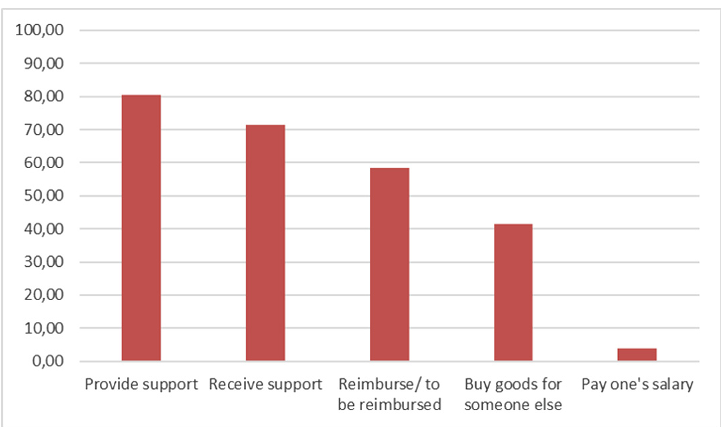
*Figure 2: Distribution of money transfers across social circles, highlighting the heavy reliance on immediate and extended family.*
### 3. The Communication Gap
Mobile banking in Mali lacks an integrated notification or confirmation system that fits the local workflow. 92% of users have to make a separate phone call before and after a transfer to verify details. The service "works," but it exists in a silo, forcing users to bridge the gap with expensive standard calls.
## Critical Analysis: Why This Matters for the Future
The most striking takeaway is the **high satisfaction (99%)** despite **low usability**. This proves that in high-stakes environments like financial services, **Utility is King**. Users will tolerate a broken interface if the service provides a vital social and economic lifeline.
However, the study warns that "satisfaction" should not breed "complacency" among designers. The low adoption of mobile apps represents a missed opportunity for more secure, feature-rich financial inclusion.
### Key Recommendations:
* **Support for Delegated Authority**: Implement features that allow "sub-accounts" or "trusted proxies" to reflect Malian social hierarchies.
* **Integrated Messaging**: Build transaction-status communication directly into the app (e.g., auto-generated SMS or WhatsApp alerts) to save users the cost of voice calls.
* **Context-Aware Adaptation**: Instead of designing "for the illiterate," systems should adapt to the user's current context, offering audio-visual cues or simplified flows based on detected proficiency.
## Conclusion
This paper serves as a vital reminder that the "developing world" is not a monolith of low-literacy users. It is a vibrant, smartphone-carrying population that is currently being underserved by poorly designed official applications. By designing for the "man in the street," HCI researchers can create tools that are not just functional, but culturally resonant.