
Beyond the Golden Cross: High-Frequency Parameter Adaptation for Forex Alpha
The Investment Strategy Based on the Difference of Moving Averages with Parameters Adapted by Machine Learning
The paper proposes an adaptive investment strategy based on the difference of Moving Averages (dMA). By modernizing traditional technical analysis with a machine learning-based parameter optimization and extra filtering (StopLoss and first derivatives), the authors achieve significant profitability on the EURUSD 1h pair.
TL;DR
This research revitalizes the classic Moving Average (MA) strategy by treating it as a dynamic Machine Learning problem. By introducing high-frequency parameter re-optimization and directional filters (dMA derivatives), the authors transformed a historically "leaky" strategy into a robust engine capable of generating over 15,000 pips on EURUSD 1h data, even after accounting for broker spreads.
Background Positioning
In the world of quantitative finance, Moving Averages are often dismissed as "retail-tier" indicators. However, this paper argues that the weakness lies not in the indicator itself, but in the static nature of its parameters. The authors position their work as a bridge between traditional technical analysis and modern adaptive machine learning, proving that "simple" models with "fast" adaptation can outperform complex black-box architectures.
The Core Friction: The "Spread" Problem
Most academic trading papers ignore transaction costs (spreads). The authors demonstrate that a basic crossover strategy (MA1) might look profitable on paper, but collapses instantly when a realistic 1.6-pip spread is applied. This illustrates the "Predictive Gap"—where a model identifies a trend but the cost of capture exceeds the alpha.
Methodology: The MA4 Evolution
The authors evolve their strategy through four iterations, culminating in MA4.
1. The "Inwards" Hypothesis
Contrary to typical trend-following (where you buy when the fast MA crosses above the slow MA), the authors test an "inwards" rule: assuming the price will revert when the gap becomes too wide.
2. The dMA Derivative Filter
To prevent "catching falling knives," they introduce the first derivative of the difference of moving averages (). A position is only opened if the gap is wide and the rate of change indicates the gap is starting to close.
3. Machine Learning Optimization
The system optimizes a six-dimensional hyperspace:
- : Slow and Fast MA windows.
- : Buffers for the dMA gap.
- : Dynamic Stop-Loss calculated per candle.
- : The holding period (number of candles before closing).
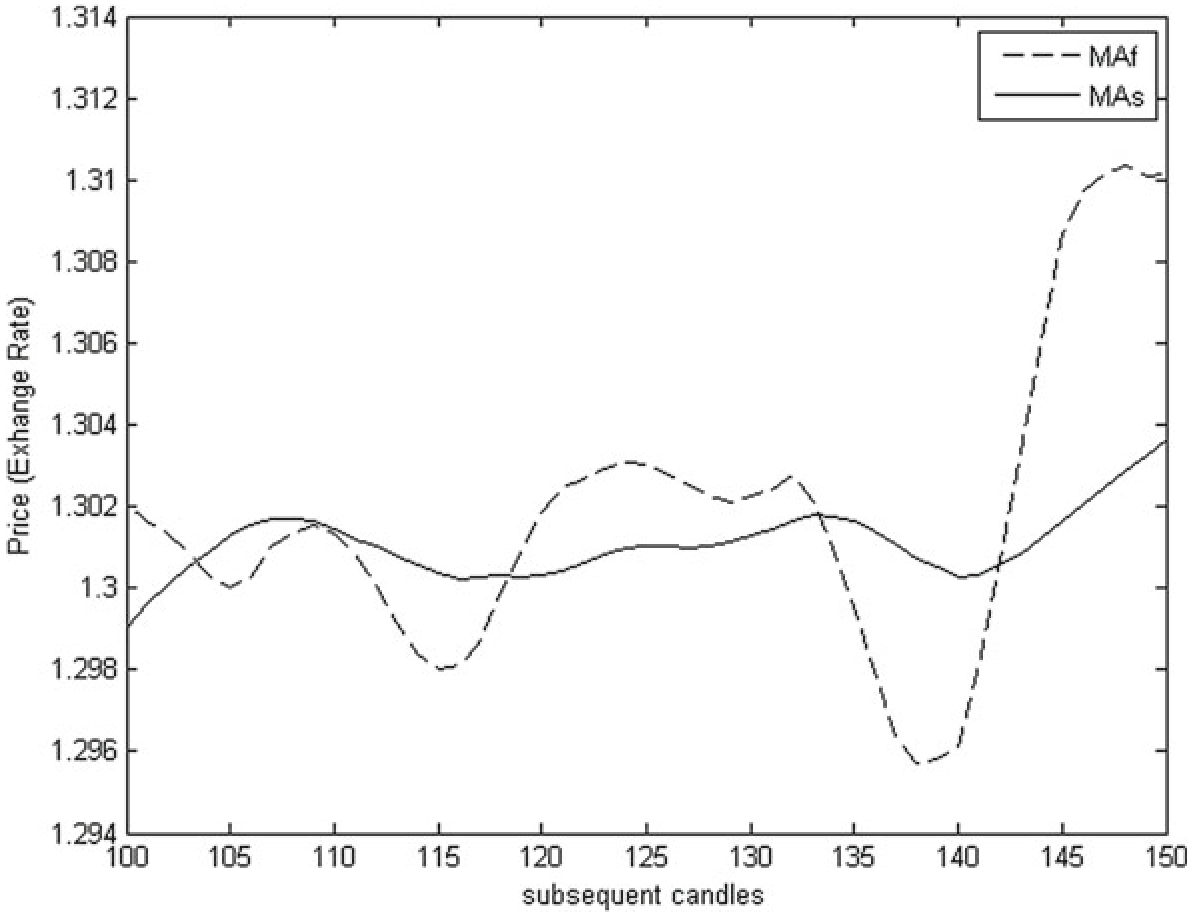 Figure 1: Illustration of the Moving Average intersections and signal generation.
Experimental Breakthrough: The Power of Short Windows
The most striking discovery in this paper is the volatility of optimal parameters. The authors found that the "best" parameters change drastically every few hours.
When they used a long-term "learned" parameter set, the results were mediocre. However, when they shifted to a very short-term adaptation cycle (learning on 5-8 candles and testing on 1-2 candles), the profit curve shifted from linear to exponential.
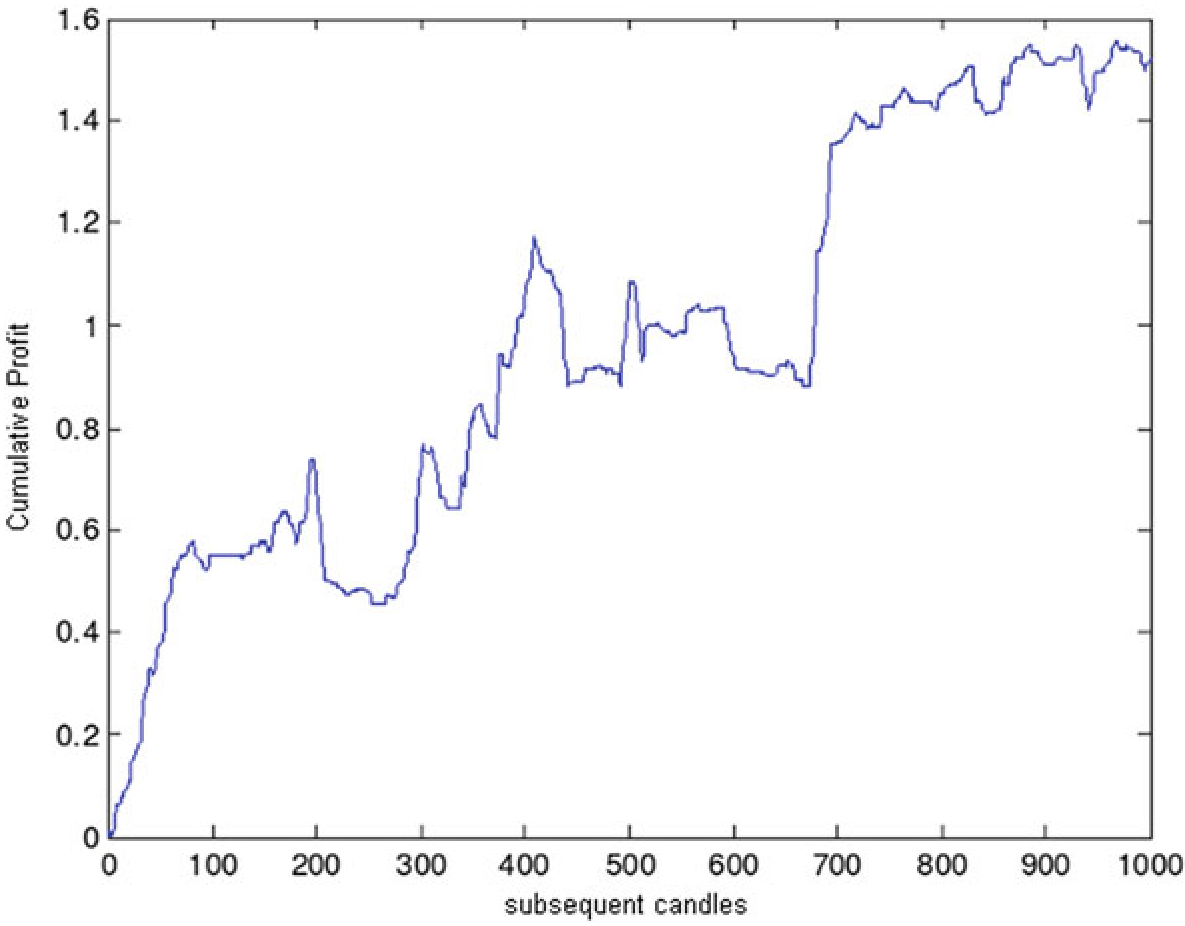 Figure 2: The cumulative profit trajectory using the MA4 adaptation (R=8/2 ratio). Note the consistent upward trend despite market noise.
Key Metrics:
- Profit per candle: Up to 15 pips.
- Calmar Ratio: ~5.0 (High risk-adjusted return).
- Max Drawdown: Approximately 20% of total profit.
Critical Insights & Future Outlook
The paper's "Simple yet Effective" mantra is its greatest strength. While the industry chases LLMs for sentiment analysis, this work reminds us that latency in parameter adaptation is a bigger bottleneck than model complexity.
Limitations: The strategy’s reliance on extreme short-term adaptation suggests it may be sensitive to execution latency (slippage). In a real-world HFT environment, the seconds it takes to re-optimize might erode the advantage.
Future Work: Integrating these adaptive dMA filters into State-Space Models (SSMs) or using Reinforcement Learning to navigate the 6-parameter hyperspace more efficiently than a grid search could be the next frontier for this research.
Conclusion
This study proves that even "obsolete" indicators like Moving Averages can become SOTA tools if wrapped in a machine learning framework that respects the market's non-stationarity. The secret sauce isn't a better indicator; it's a faster learning loop.