
iOLAP: Bridging the Gap Between Database OLAP and the Unstructured Web
iOLAP: A Framework for Analyzing the Internet, Social Networks, and Other Networked Data
This paper introduces iOLAP, a systematic framework for analyzing high-dimensional networked data (Internet, social networks, citations) using a Polyadic Factor Model. By representing data as a multi-dimensional "networked data cube" and employing Non-negative Tensor Factorization (NTF), the framework enables OLAP-style operations like roll-up and drill-down to uncover latent structures across People, Relation, Content, and Time dimensions.
TL;DR
The paper introduces iOLAP, a framework that applies the multidimensional analysis rigor of traditional Business Intelligence (OLAP) to the messy, linked world of the Internet. By using a Polyadic Factor Model (based on Tensor Factorization), it treats People, Relations, Content, and Time as inter-dependent dimensions. It achieves superior personalization in recommendations and deep exploratory insights into social communities while maintaining linear scalability.
Background: Beyond the Search Box
For decades, we have interacted with the web primarily through search engines. However, search engines are designed for retrieval—finding a needle in a haystack. They follow a power-law distribution, favoring dominant sites and ignoring the "long tail" where grassroots sentiments and niche wisdom reside.
The authors argue that just as databases evolved from simple SQL queries to OLAP (Online Analytical Processing) for business intelligence, the Internet needs an Internet OLAP to visualize distributions, summarize trends, and analyze high-order relationships across heterogeneous data.
The Core Innovation: Polyadic Factorization
The biggest challenge in "Internet OLAP" is that networked data is multi-modal. A single event involves a person (People), a link (Relation), a message (Content), and a timestamp (Time).
Why pairwise isn't enough
Most prior works used a "two-step" approach:
- Analyze People vs. Content.
- Analyze People vs. Relations.
- Try to glue the results together.
This misses the joint effect. For instance, a specific topic might only be discussed by a specific group of friends during a specific week. iOLAP solves this by using Polyadic Factorization, which models all dimensions simultaneously.
Mathematical Intuition
The framework utilizes a non-negative version of the Tucker Decomposition. It decomposes a large, sparse data tensor into a smaller "core tensor" and factor matrices () for each dimension.

The core tensor is the "brain" of the model—it captures how the latent groups in one dimension correlate with groups in others.
Scalability through "Lazy Computation"
Tensor operations are notoriously expensive (). To make iOLAP practical for millions of records, the authors developed an optimization that:
- Exploits Sparseness: Only computes values for non-zero entries.
- Ordered Computation: Reuses matrix products to minimize redundant floating-point operations. The result is an algorithm that is linear with respect to the number of records, making it feasible for massive datasets like CiteSeer.
Experimental Insights: Blogs and Citations
The authors applied iOLAP to two distinct domains:
1. The Blogosphere
By "rolling up" the core tensor, iOLAP identified that different blog groups might share a topic (e.g., Politics), but with different nuances (e.g., one group focusing specifically on terrorism).
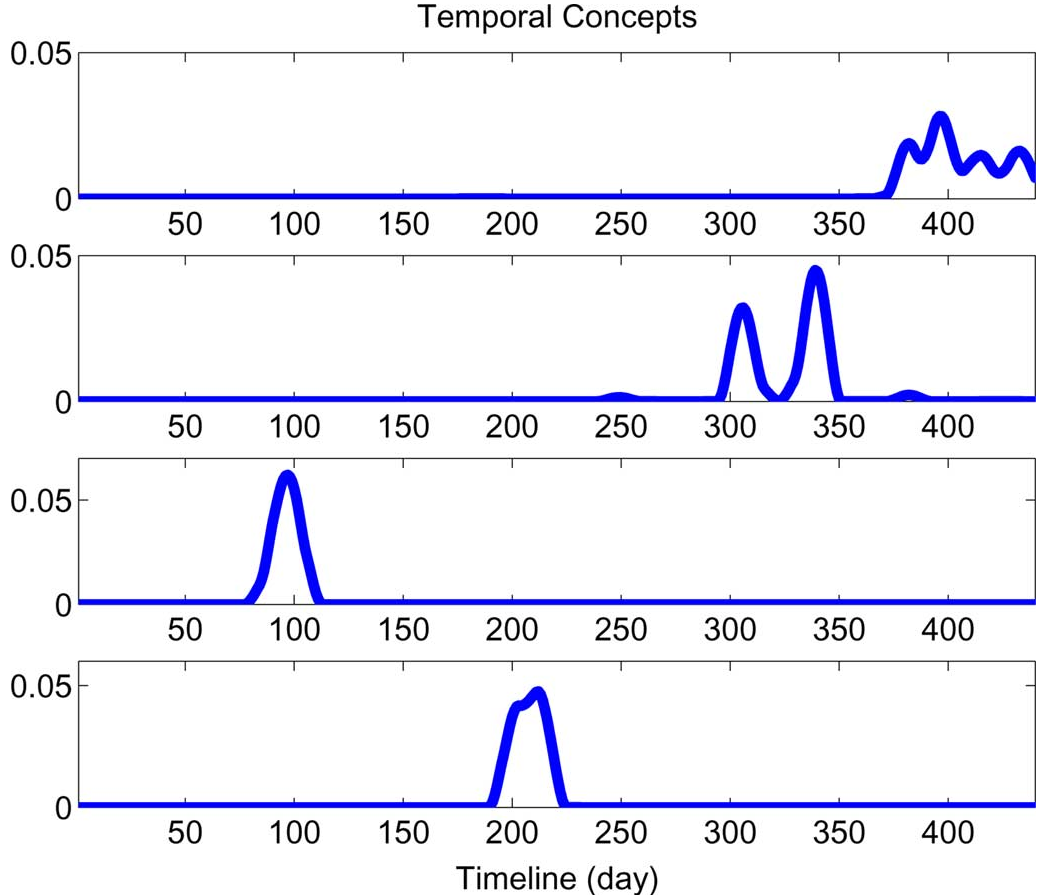 Figure: Time dimension factors showing temporal patterns of blog activity.
2. Personalized Recommendation (CiteSeer)
Standard recommendations suggest "popular" papers. iOLAP allows for triple-conditional recommendation: .
The results were striking: iOLAP outperformed popularity-based baselines significantly.
| Method | Top-1 NDCG | Top-10 NDCG |
|---|---|---|
| Popularity Baseline | 0.025 | 0.076 |
| iOLAP (Factor_KL_10) | 0.038 | 0.120 |
Critical Insight & Conclusion
The true power of iOLAP lies in its interpretability. Unlike black-box deep learning models, the factor matrices and core tensors provide a readable map of how communities, topics, and time intersect.
Limitations: The current framework captures the intensity of communities but doesn't easily track the structural evolution (e.g., when one community splits into two).
Future Work: The authors envision expanding this to automated summarization and more complex OLAP operations to provide a full "Business Intelligence" suite for the decentralized web.