
IoT Lab: Unifying the Crowd and Devices for Smart City Risk Management
Internet of Things, Crowdsourcing and Systemic Risk Management for Smart Cities and Nations: Initial insight from IoT Lab European Research project
This paper introduces IoT Lab, a multi-disciplinary European research platform that integrates heterogeneous Internet of Things (IoT) testbeds with crowdsourcing and crowd-sensing. It achieves a unified infrastructure through IPv6-based virtualization and provides a "Testbed as a Service" (TBaaS) for smart city systemic risk management.
TL;DR
The IoT Lab project represents a significant shift in urban research, moving from technical experimentation to a holistic, user-centric paradigm. By leveraging IPv6 as a universal integrator, it merges disparate IoT testbeds with the power of citizen crowdsourcing to provide a real-time, low-uncertainty data stream for smart city governance and systemic risk mitigation.
The "Uncertainty" Problem in Smart Cities
According to the ISO 31000 standard, risk is defined as the "effect of uncertainty on objectives." For smart cities, this uncertainty stems from a lack of high-fidelity, real-time data. Traditional statistics are often delayed and fail to capture the "human element"—the perception and satisfaction of the citizens living within the tech ecosystem.
Existing IoT research has been plagued by fragmentation:
- Protocol Silos: ZigBee, KNX, and Bluetooth devices often cannot communicate across a unified network.
- End-user Exclusion: Most testbeds focus on technical QoS rather than user acceptance.
- Geographic Fragmentation: Research labs are isolated, preventing large-scale, pervasive experiments.
Methodology: The Triple Integration Model
The authors solve these issues by introducing a three-layered integration architecture that allows research to "leak" out of the lab and into the real world.
1. Heterogeneous Testbed Integration (The Network)
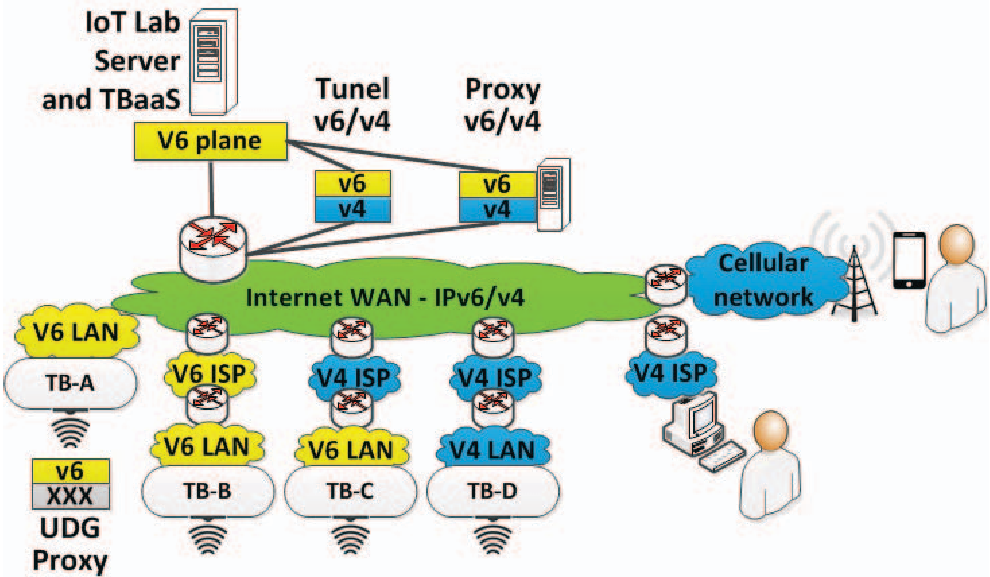
The backbone of IoT Lab is IPv6. By assigning a unique, scalable address to every mote—even those using legacy non-IP protocols—the project overcomes the limitations of IPv4 and NAT.
- The UDG Proxy: Acts as a bridge, mapping IPv6 addresses to legacy devices (ZigBee, internal IPv4).
- v6 in v4 Tunneling: Ensures connectivity even when local ISPs do not support native IPv6.
2. Crowdsourcing and Sensing (The Human Layer)
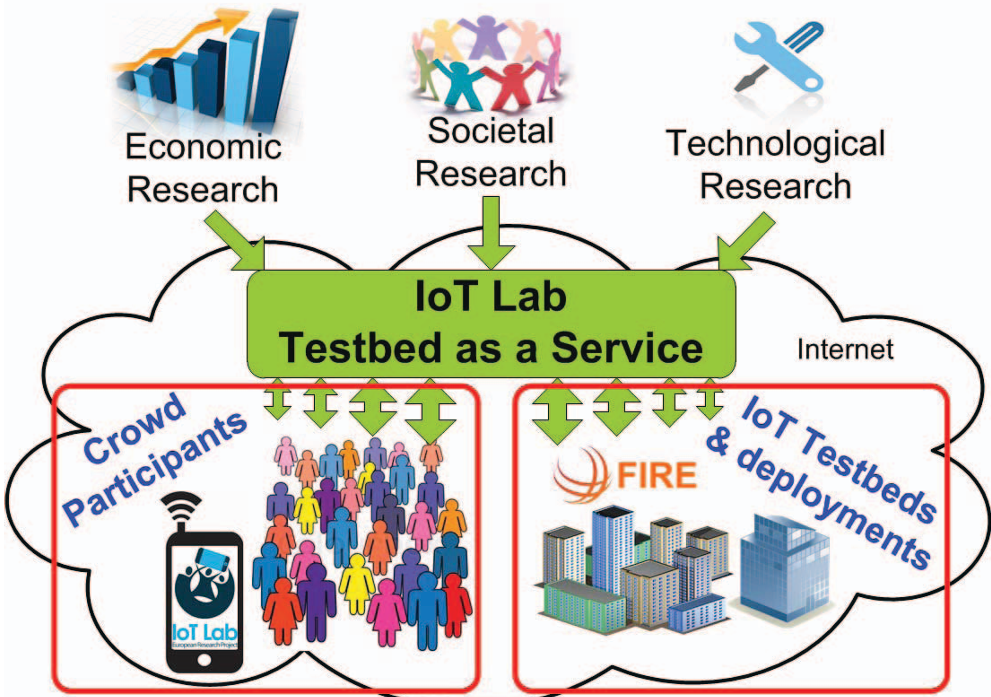
Unlike traditional sensor networks, IoT Lab utilizes the "Human as a Sensor" via a dedicated Android application. This provides:
- Direct Feedback: Surveys on urban "smartness."
- Active Sensing: Access to smartphone GPS, accelerometers, and environmental sensors.
3. Testbed as a Service (The Management)
By virtualizing hardware through the Slice-based Facility Architecture (SFA), researchers can reserve global resources remotely, just as they would reserve a virtual machine in the cloud.
Transforming Risk Management
The core insight of the paper is that IoT + Crowdsourcing = Systemic Risk Reduction. By improving the quality, granularity, and timeliness of information, public administrations can:
- Detect "abnormal data peaks" (e.g., environmental hazards) instantly.
- Align investments with citizen-perceived priorities.
- Ensure Privacy by Design, mitigating legal and reputational risks through built-in anonymity.
Experimental Validation
The project demonstrated that citizens want to be involved. In European surveys, 81% of the participants demanded that their opinions be included in city performance metrics. This led to the methodology being adopted in the ITU Bahamas Declaration, signaling a global shift toward inclusive, data-driven urban governance.
Critical Insight & Conclusion
IoT Lab’s greatest contribution isn't just the IPv6 tunneling; it is the Crowd-driven Research Model. By allowing the public to suggest and rank research topics, the project ensures that technological development serves societal needs rather than just academic curiosity.
However, the transition to such a pervasive system is not without peril. Cybersecurity and Data Privacy remain the primary hurdles. As the authors suggest, independent auditing (like Europrivacy) will be essential for the market and societal acceptance of these ubiquitous sensing environments.