
IoT for Dementia Care: A Smart Wearable System for Nighttime Position Monitoring
2674_Internet of Things (IoT) for Healthcare Application Wearable Sleep Body Position Monitoring System Using IoT Platform.
This paper presents an IoT-based wearable monitoring system specifically designed for dementia patients, utilizing an Arduino UNO and MySignals HW platform to track sleep body positions. The system automates nighttime assistance through integrated sensors, audio-visual prompts, and an emergency alert mechanism via the Ubidots platform.
TL;DR
Researchers have developed an integrated IoT wearable system that doesn't just watch but acts. By combining an Arduino-based sensing platform with cloud-based logic, the system monitors the sleep positions of dementia patients, provides immediate audio-visual guidance if they wake up, and alerts caregivers if a prolonged wakefulness state is detected.
Background & Motivation: The Nighttime Challenge in Dementia
Dementia isn't just about memory loss; it profoundly disrupts the circadian rhythm. Patients often experience "sundowning" or nighttime confusion, leading them to wander in the dark, which significantly increases the risk of falls. For caregivers, the need for constant vigilance leads to chronic sleep deprivation.
Existing solutions generally fall into two categories:
- Clinical Polysomnography: Highly accurate but extremely expensive and uncomfortable for home use.
- Passive Pressure Mats: Simple but lack scalability and the ability to provide active feedback to the patient.
The authors identified a gap: active assistance. They sought to build a system that senses a problem and intervenes before an accident occurs.
Methodology: The "Sense-Think-Act" Framework
The system architecture (shown below) follows a classic IoT feedback loop:
- Sensing: A triple-axis accelerometer (part of the MySignals HW Kit) classifies five distinct positions: Supine, Prone, Left/Right lateral, and Sitting/Standing.
- Processing: An Arduino UNO processes the raw acceleration data.
- Connectivity: The ESP8266 module transmits data to the Ubidots cloud platform via TCP.
- Acting: If the "Sitting/Standing" state is detected at night:
- LEDs provide essential lighting to prevent falls.
- Speakers play audio reminders ("It’s nighttime, please go to sleep").
- Cloud Triggers initiate a voice call to the caregiver if the state persists for >20 minutes.
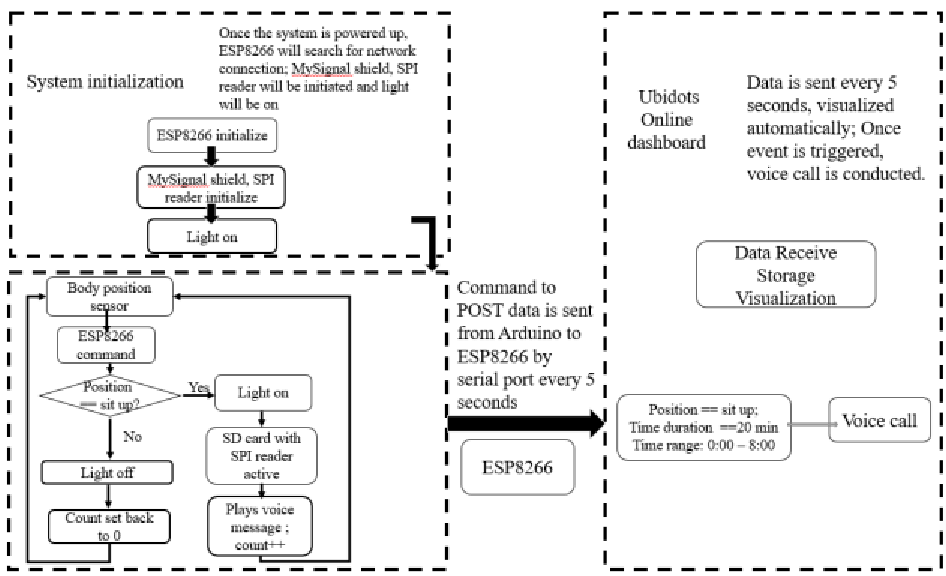 Figure 1: Integrated system design showing the flow from sensors to cloud-based alerts.
Experimental Results: Precision in Monitoring
The authors conducted simulation runs to validate the system's reliability. The device demonstrated a 100% connection success rate with minimal latency (data updates every 5-6 seconds).
The most impressive aspect of the results is the granularity of the data visualization. As shown in the dashboard below, the system can clearly distinguish between different sleep phases:
- Deep Sleep: Characterized by stagnant position values (2-3 changes per hour).
- Light Sleep/Wakefulness: Characterized by rapid fluctuations in the position index (up to 9 changes per hour).
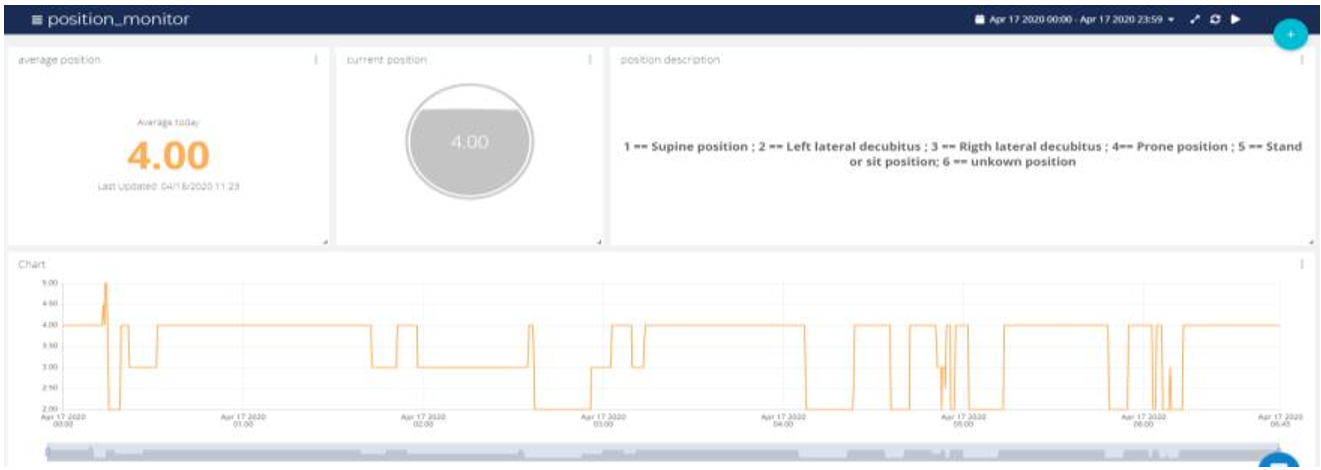 Figure 2: Ubidots dashboard displaying real-time position tracking and historical sleep patterns.
Critical Analysis & Future Outlook
The strength of this work lies in its holistic approach. It addresses the patient's immediate need (light and guidance) and the caregiver's need (remote alerts and historical data).
Limitations:
- Hardware Form Factor: The current prototype uses a wired connection between the sensor and the core, which might be uncomfortable for a sleeping patient.
- Heuristic Logic: The system relies on fixed thresholds (e.g., 20 minutes) rather than personalized machine learning models.
The Road Ahead: The authors plan to transition from simple position tracking to Sleep Pattern Recognition. By applying ML techniques to larger biometric datasets, future versions could predict a "wandering episode" before it happens, moving from reactive to proactive care.
Takeaway
This paper is a vital proof-of-concept for Active IoT in Healthcare. It proves that using off-the-shelf components like Arduino and ESP8266, researchers can build sophisticated medical interventions that were once reserved for high-end clinical settings.