
PPHMP: Revolutionizing Remote Diagnosis through IoT and Ensemble Learning
IoT Based Intelligent Computer-Aided Diagnosis and Decision Making System for Health Care
The paper introduces the Pandemic Patient Health Monitoring Platform (PPHMP), an IoT and Cloud-based system designed for remote patient monitoring and intelligent diagnosis. By utilizing AdaBoost and other machine learning classifiers on the UCI heart disease dataset, the system achieves a state-of-the-art accuracy of 93.54% in predicting health status.
TL;DR
The Pandemic Patient Health Monitoring Platform (PPHMP) is a decentralized healthcare solution that bridges the gap between remote patients and providers. By integrating IoT sensors, Cloud computing, and a high-performance AdaBoost classifier, the system identifies critical health conditions (specifically heart disease) with a remarkable 93.54% accuracy, providing a robust alternative to in-person clinical visits.
Problem & Motivation: The Pandemic Bottleneck
The COVID-19 era exposed a fatal flaw in global healthcare: the over-reliance on physical proximity. This "proximity-dependency" leads to:
- Viral Contagion: Increased exposure risks for medical staff.
- Resource Exhaustion: Overcrowded hospitals struggling with "surge" capacity.
- Diagnosis Delays: Remote patients often lack access to continuous monitoring tools.
The authors' insight was to move beyond simple data collection. They realized that for a remote system to be trusted by physicians, it must not only transmit data but also provide intelligent decision support that matches or exceeds human diagnostic accuracy.
Methodology: The Three-Tier Intelligent Core
The PPHMP architecture is designed for scalability and intelligence. It comprises three vertical layers:
- Patient Data Storage (PDS): Captures both longitudinal e-Health records and real-time sensory data (ECG, Heart Rate, Temperature).
- Health Data Allocating Policy (HDAP): Manages authorized sharing and regulatory compliance.
- Cloud Middleware (CM): The "brain" of the system, managing Virtual Machines and service scheduling to process data in an energy-efficient manner.
Architectural Breakdown
The system utilizes Raspberry Pi 3 and Arduino at the edge to collect data, which is then pushed to a MYSQL cloud backend.
 Figure 1: The PPHM Architecture integrating sensors, personal servers, and cloud resources.
To handle the "curse of dimensionality" in medical data, the authors applied Rank Correlation Coefficient (RCC) and PCA/LDA for feature reduction, ensuring that the classifiers (KNN, SVM, Random Forest, AdaBoost) operate on the most discriminative features.
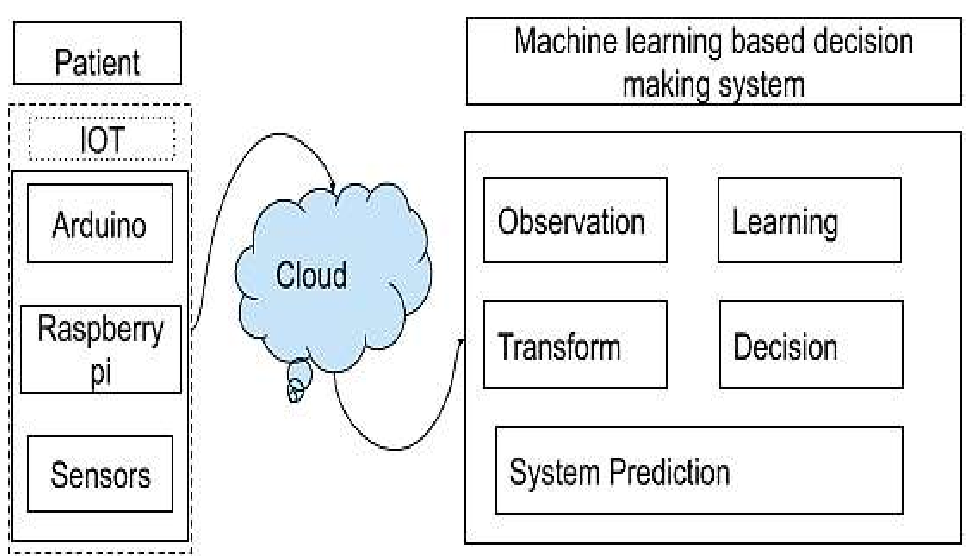 Figure 2: The decision-making pipeline from ECG acquisition to classification.
Experiments & Results: Setting a New Benchmark
The researchers validated their approach using the UCI Cleveland Heart Disease dataset. While many models were tested, AdaBoost emerged as the clear winner.
- The SOTA Leap: The proposed system achieved 93.54% accuracy.
- Comparison: This significantly outperforms previous methodologies which hovered between 85% and 89% accuracy on the same dataset.
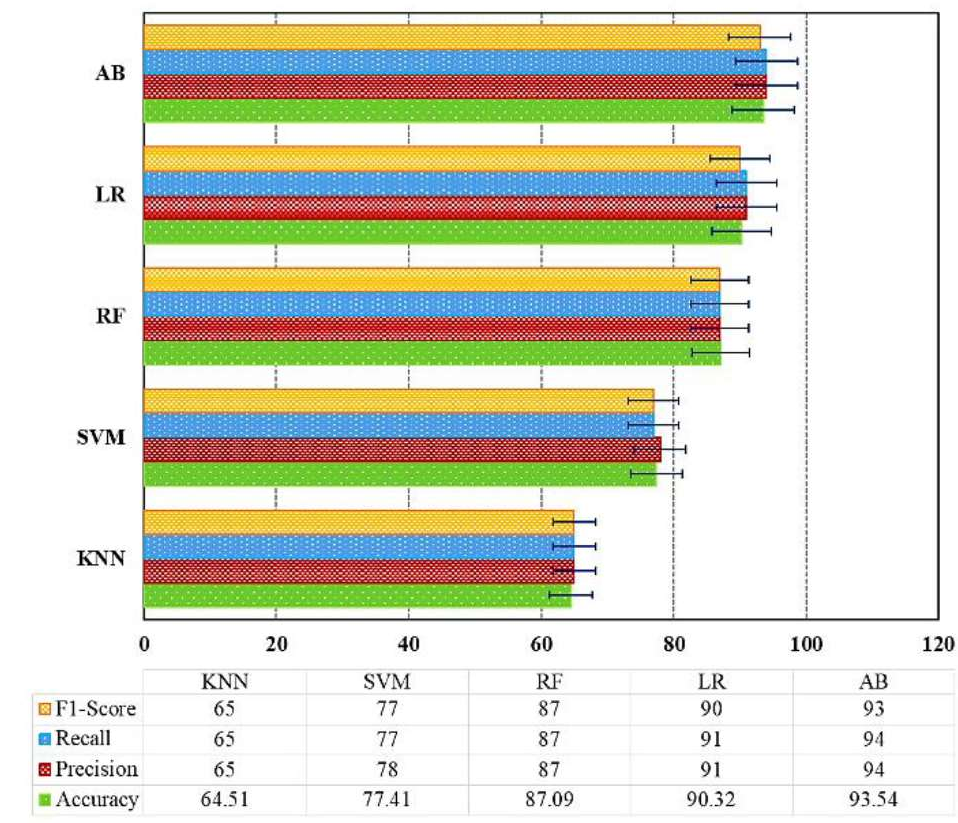 Figure 3: Comparative metrics for various ML classifiers. AdaBoost consistently leads in Precision, Recall, and Accuracy.
The success of AdaBoost here can be attributed to its ability to focus on "hard-to-classify" instances, effectively boosting the performance of weak learners to create a strong diagnostic ensemble.
Critical Analysis & Conclusion
Takeaway
PPHMP proves that the Internet of Things is no longer just about "connectivity"—it is about automated intelligence. By offloading the initial diagnostic filtering to an AI-Cloud system, healthcare providers can focus on high-risk patients, reducing both costs and mortality rates.
Limitations & Future Work
While the 93.54% accuracy is impressive, the study relies on the Cleveland database, which is a curated dataset.
- Future Work: Testing the system with "noisy" real-world sensor data from wearable devices (like smartwatches) would be the next step to prove its clinical robustness.
- Scalability: Integrating 5G/6G technology could further reduce the latency in the Cloud Middleware, enabling real-time stroke or heart attack alerts.
In conclusion, this work serves as an essential blueprint for a Cyber-Physical Healthcare System that is resilient to pandemics and accessible to the world.