
DeepNetPrint: Inferring IoT Behavioral Fingerprints with Meta-Learning
Iot Network Behavioral Fingerprint Inference With Limited Network Traces For Cyber Investigation
This paper introduces DeepNetPrint, a novel meta-learning framework for IoT device identification using limited network traces. By combining a ConvLSTM Autoencoder with a One-Class Prototypical Network, the model achieves SOTA-level accuracy (81%) in fingerprinting devices using only a single packet sample for inference.
TL;DR
As Industry 4.0 scales, identifying rogue IoT devices from sparse network traffic is a major forensic challenge. DeepNetPrint addresses this by using a One-Class Time Series Meta-learner. It requires only a tiny sample of network traces to identify a device, achieving 81% accuracy even on devices the model has never seen before, matching the performance of data-hungry supervised models.
Background: The Forensic Needle in a Haystack
In cyber investigations, identifying a "rogue" device (like a hijacked drone or a malicious sensor) often relies on Network Behavioral Fingerprinting. However, current AI-based solutions face two major roadblocks:
- Data Scarcity: Investigators often only have access to a handful of intercepted packets.
- Generalization Gap: Supervised models fail when encountering a new IoT device brand or model not present in the training set.
DeepNetPrint's core intuition is that network traffic is essentially a spatio-temporal language. By learning the "syntax" of how devices communicate, we can "learn to learn" device identities with minimal examples (Few-Shot Learning).
Methodology: The DeepNetPrint Architecture
The system follows a modular "Deep Learning + Meta-Learning" pipeline.
1. ConvLSTM Autoencoder (The Feature Extractor)
Instead of manual feature engineering (like counting ports or bytes), the authors use a ConvLSTM Autoencoder.
- Why ConvLSTM? It captures both the sequential nature of traffic (LSTM) and the spatial relationships within packet structures (Convolution).
- Character-based Embeddings: The model processes raw CSV extracts of network traces, treating conversational dialogues between devices as raw input.
2. One-Class Prototypical Network (The Classifier)
Standard Prototypical Networks compare a query against multiple class means (prototypes). DeepNetPrint adapts this for cyber investigation by:
- Defining a Target Class (the device of interest).
- Defining a Null Class (a "silent" origin point in the embedding space).
- Distance Metric: It calculates the Euclidean distance of a query packet to these prototypes to determine a match.
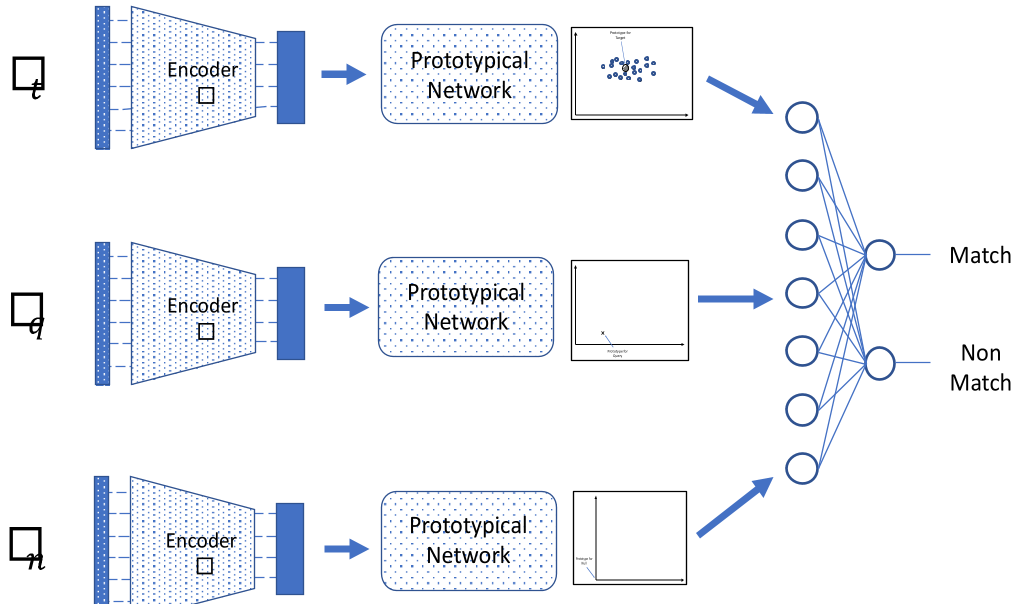 Figure 1: The DeepNetPrint architecture showing the flow from raw traces to similarity measurement.
Experiments and Results
The model was tested using the IoT Sentinel dataset, encompassing 23 distinct IoT devices.
- Zero-Shot Success: The model was trained on only 12 devices but tested on all 23. It achieved 80% accuracy on the 11 unseen devices, proving its ability to generalize to new hardware.
- Efficiency: Unlike prior work requiring thousands of packets, DeepNetPrint uses a sequence of just 20 samples to form a prototype.
- Benchmark Performance:
- DeepNetPrint: 81% Accuracy
- SysID: 82% Accuracy (Requires full supervision)
- IoT Sentinel: 79% Accuracy
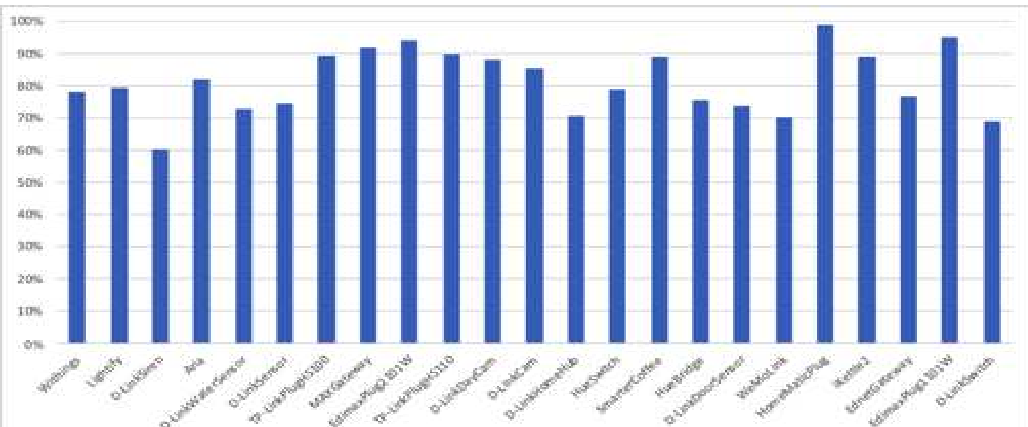 Figure 2: Accuracy performance across different IoT device categories.
Critical Insight: Why One-Class?
In a real-world investigation, you (the investigator) usually know what you are looking for (e.g., "Find the D-Link Camera"). You don't necessarily have labeled data for every other device on the network. By formulating the problem as a One-Class similarity task rather than a multi-class classification task, DeepNetPrint mirrors the actual workflow of a forensic expert, making it a highly practical tool.
Conclusion and Limitations
DeepNetPrint represents a significant shift from "static" signatures to "dynamic" meta-learning in network security.
Limitations: The model currently relies on the "Information" field of PCAPs, which might be obfuscated by advanced encryption or protocol mimicking. Future Work: Expanding this architecture to other time-series forensics, such as power consumption patterns or system logs, could unify behavioral fingerprinting across the IoT ecosystem.