
Intelligent Maternity Care: Bridging the Rural Health Gap with IoT and SVM
Prediction of the mortality rate and framework for remote monitoring of pregnant women based on IoT
This paper proposes an IoT-based framework for the remote monitoring of pregnant women in rural areas, integrating machine learning to predict neonatal mortality risks. By analyzing a dataset of 10,000 cases, the authors identify key risk factors like maternal age and pregnancy intervals, demonstrating that a Two-Class SVM model achieves a superior AUC of 96.6% in mortality prediction.
TL;DR
To combat the high maternal and infant mortality rates in remote regions, researchers have developed an IoT-enabled "contactless machine" capable of comprehensive vital sign monitoring. By applying machine learning to a dataset of 10,000 pregnant women, the study demonstrates that a Two-Class Support Vector Machine (SVM) can predict mortality risks with an AUC of 96.6%, providing a life-saving tool for early clinical intervention.
Problem & Motivation: The "Rural Penalty" in Maternal Health
In many developing nations, the distance to urban healthcare centers often proves fatal. Statistics from the WHO highlight a grim reality: nearly 830 women die daily from pregnancy complications, with 99% of these deaths occurring in rural areas.
The root cause isn't just a lack of equipment, but a lack of timely data. Current rural health systems rely on manual, infrequent check-ups. While some IoT devices exist, they are typically limited to single-parameter monitoring (e.g., just blood pressure or just temperature). There is a critical need for an integrated system that monitors the tri-trimester health cycle holistically and uses predictive analytics to alert gynaecologists before a crisis occurs.
Methodology: The IoT Contactless Machine
The authors propose a dual-layered approach combining custom hardware with cloud-based intelligence.
1. The Hardware Framework
The core of the system is an IoT-based machine equipped with a suite of sensors:
- CC3200 Microcontroller: Acts as the brain, featuring built-in Wi-Fi for cloud synchronization.
- Multi-Sensor Array: Includes TCRT1000 for pulse rate, DS1620 for temperature, and specialized belts for monitoring hypertension and fetal movement.
- Biometric Authentication: Ensures patient data integrity and tracks medical history accurately across multiple pregnancies.
2. The Machine Learning Pipeline
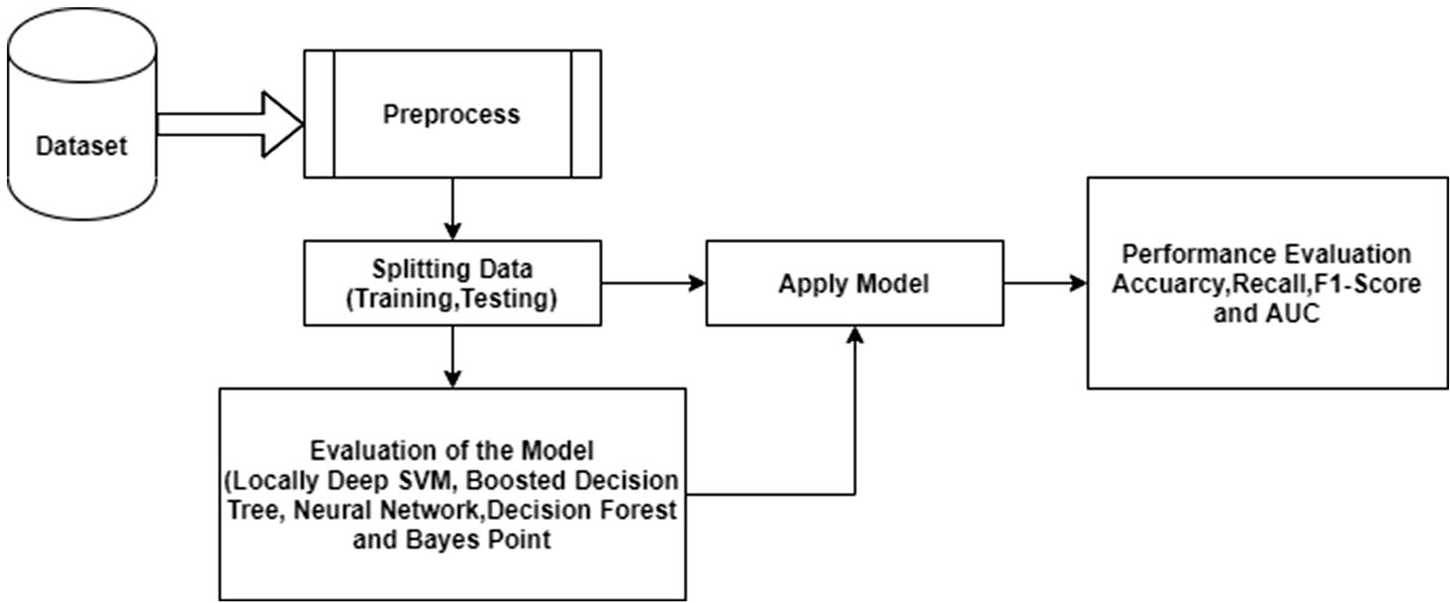
The authors utilized a massive dataset from the Bihar district in India (10,000 tuples, 200 attributes). The methodology followed a rigorous path:
- Preprocessing: Cleaning missing values via MATLAB.
- Splitting: A 70/30 train-test ratio was adopted to ensure model robustness.
- Classification: Testing eight different algorithms including Decision Jungles, Locally Deep SVMs, and Gradient Boosted Trees.

Experimental Results: SVM Takes the Lead
The study compared various classifiers on the Azure platform. The Two-Class SVM significantly outperformed other models in terms of the Area Under the Curve (AUC), which is critical for medical diagnostics where the cost of a "False Negative" is extremely high.
| Algorithm | Accuracy | Recall | F1-Score | AUC |
|---|---|---|---|---|
| Two Class SVM | 93.3% | 96.6% | 96.6% | 96.6% |
| Averaged Perceptron | 93.3% | 91.3% | 95.5% | 95.7% |
| Boosted Decision Tree | 80.0% | 87.0% | 87.0% | 90.7% |
| Bayes Point Machine | 83.3% | 99.9% | 90.2% | 69.6% |
Table: Comparative performance of mortality prediction algorithms.
Key Insights from Data Analysis:
- The 3-Year Gap: The data confirmed that birth intervals of less than three years significantly spike mortality rates.
- Age and Marriage Correlation: There is a clear non-linear relationship between marriage duration and pregnancy success, allowing the model to flag "high-risk" profiles based on simple demographic data.
Deep Insight: Beyond Just Monitoring
What distinguishes this work from standard "Telehealth" is the Trimester-Specific Monitoring logic. The framework doesn't just treat the patient as a static set of variables; it adapts its monitoring focus based on the pregnancy stage (e.g., focusing on Nuchal Translucency in Trimester 1 vs. Glucose Screening in Trimester 2).
By storing this data in a centralized cloud, the system creates a "Digital Twin" of the patient’s pregnancy, enabling doctors to provide prescriptions and guidance remotely via a mobile app. This removes the "Technical Knowledge" barrier for rural patients—they simply use the machine as directed, and the AI handles the complexity.
Conclusion and Future Outlook
The integration of IoT and SVM-based classification offers a viable path to eradicating preventable pregnancy complications in developing regions.
- Current Success: High prediction accuracy (96.6% AUC) and a holistic hardware design.
- Limitations: The system requires a stable (though minimal) internet connection and a local technician for initial setup.
- Future Work: Moving toward Deep Learning and Healthcare 5.0, where 5G connectivity could allow for real-time remote ultrasound guidance by urban experts.
This framework represents a shift from "reactive" medicine to "proactive" remote care, potentially saving thousands of lives by turning data into a diagnostic shield.