
AI: The Guardian of the Internet of Medical Things (IoMT)
IoT Security in Healthcare using AI: A Survey
This paper provides a comprehensive survey (2014-2019) on the integration of Artificial Intelligence (AI) to secure Internet of Things (IoT) ecosystems within the healthcare sector, specifically focusing on the Internet of Medical Things (IoMT). It categorizes security issues and evaluates how Machine Learning (ML) and Deep Learning (DL) algorithms like SVM and CNN are utilized to protect sensitive patient data.
TL;DR
This survey investigates the critical intersection of IoT security and Artificial Intelligence in the healthcare sector. It analyzes how AI methods are moving from "optional enhancements" to "mandatory safeguards" for protecting patient privacy and ensuring the reliability of life-critical medical devices.
Problem & Motivation: The Fragility of Digital Health
The rapid digital transformation in healthcare—moving from manual records to real-time monitoring via Internet of Medical Things (IoMT)—has opened a Pandora's box of security vulnerabilities. Unlike general IT infrastructure, a breach in a healthcare IoT device (like a pacemaker or insulin pump) can have immediate, life-threatening consequences.
The authors argue that traditional cryptographic methods are often too computationally expensive for resource-constrained IoT sensors. Furthermore, the sheer volume and heterogeneity of medical "Big Data" make manual threat detection impossible, necessitating the Inductive Bias provided by AI to identify subtle attack patterns in real-time.
Methodology: Mapping the AI-Security Landscape
The survey categorizes the literature into three main analytical silos:
- Fundamental IoT Security: Issues surrounding Physical and Information security (Confidentiality, Integrity, Availability).
- AI-Assisted Security Services: Leveraging algorithms like Support Vector Machines (SVM) and Naive Bayes for anomaly detection and watermarking.
- The Converged Frontier: Deep Learning applications (CNNs, DQNs) specifically architected for healthcare SDN (Software Defined Networks).
Core Framework Categorization
The paper highlights the shift from simple encryption to intelligent frameworks. For example, the MSCryptoNet utilizes multi-key homomorphic encryption to allow deep learning models to perform predictions on encrypted data without ever "seeing" the raw patient information.
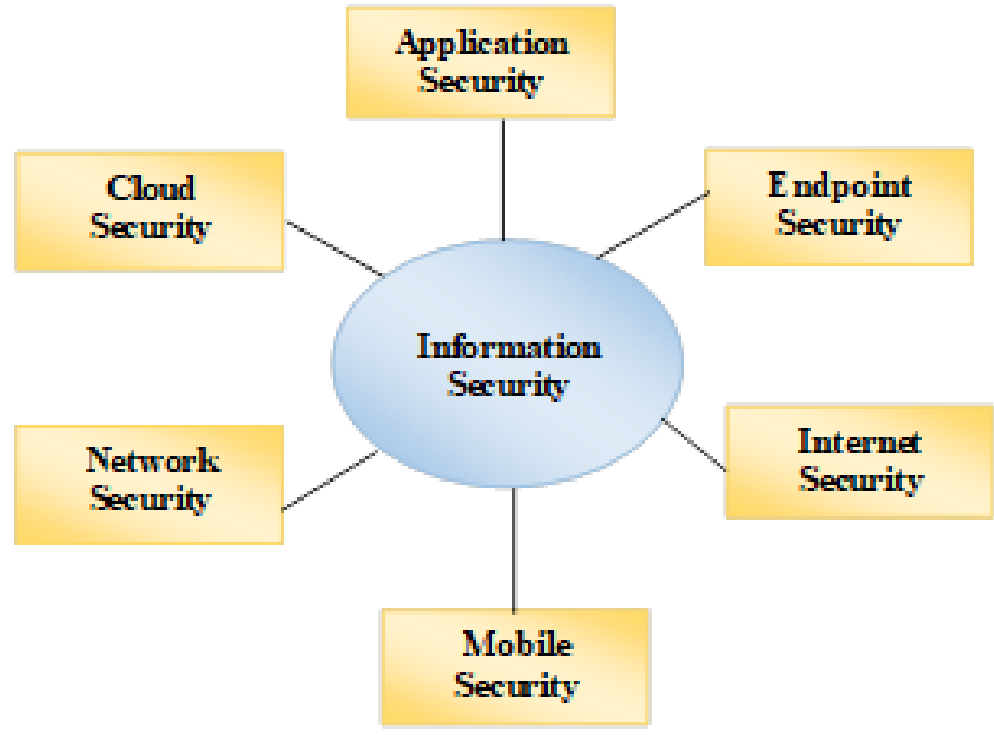 Fig 1: The taxonomy of Information Security analyzed in the healthcare context.
Key Findings & SOTA Benchmarks
The analysis reveals several high-performing models that set the benchmark for AI in healthcare security:
- HealthGuard: An ML security framework that uses Artificial Neural Networks (ANN) and Random Forest to detect malicious activities with 91% accuracy.
- Deep CNN for Biometrics: Achieving 97.2% accuracy in identifying users via ECG signals, outperforming traditional biometric methods.
- Deep Q-Learning (DQN): Effectively used to reduce malware attacks while maintaining high data reliability in high-traffic healthcare environments.
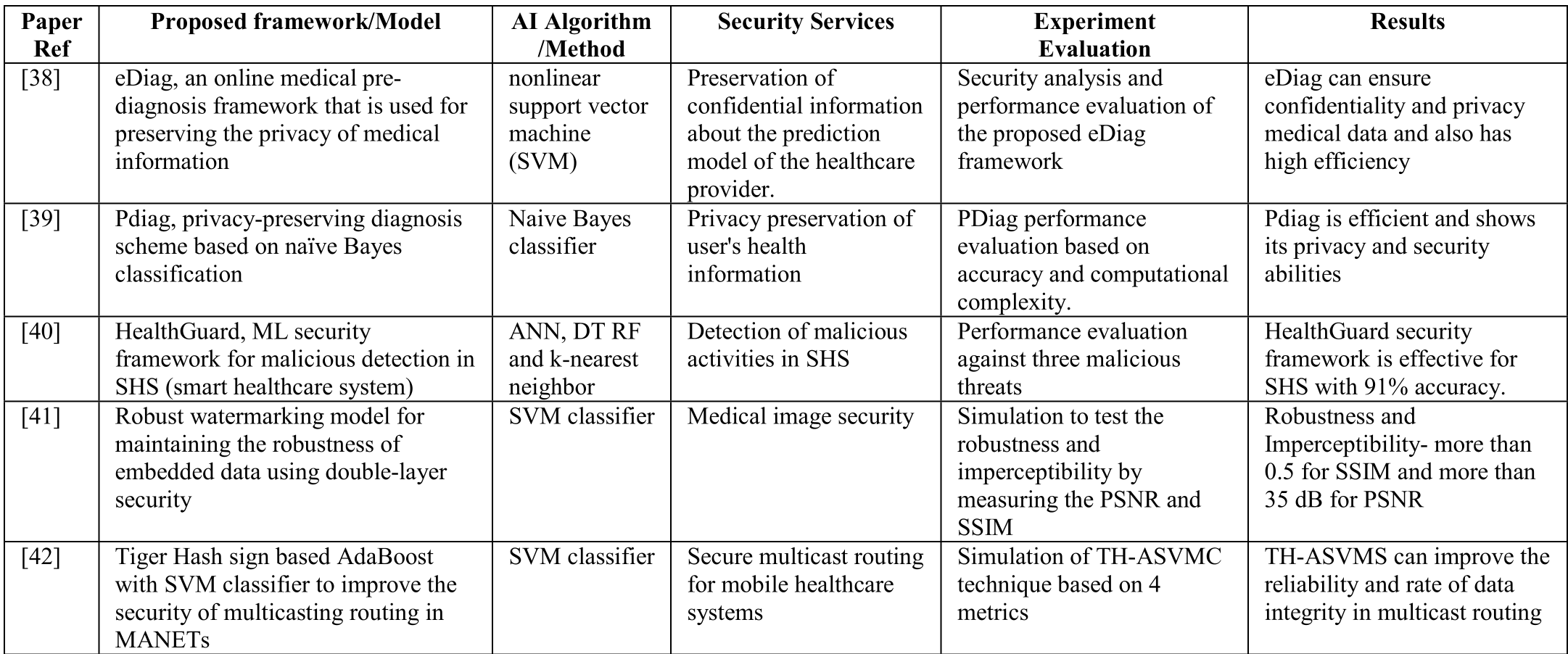 Table: Comparison of AI methods (SVM, Naive Bayes, ANN) across various security services.
Critical Insights & Future Outlook
While the adoption of AI is promising, the survey identifies a "verification gap." A majority of the researchers fail to report the standardized percentage of effectiveness for their frameworks, making it difficult to perform a true SOTA comparison.
Takeaways for Practitioners:
- Privacy-Preserving Computation: Homomorphic encryption and differential privacy are becoming the standard for healthcare AI to comply with regulations like GDPR.
- Architecture Shift: There is a noticeable trend moving away from decentralized IoT security towards Fog and Cloud-centric architectures to handle the heavy lifting of AI training.
- The Unexplored Niche: The survey explicitly points out a lack of in-depth comparative studies across different AI methods for specific healthcare use cases, marking a clear trail for future PhD-level research.
Conclusion
The marriage of AI and IoT in healthcare is no longer just about optimizing patient outcomes—it is about defending them. As we move towards 2026, the focus must shift from "if" AI can secure these networks to "how" we can make these AI models robust against adversarial attacks themselves.