
IPv6-Enabled Locators: Redefining Personalized Smart Marketing via IoT
The Implementation of IPv6-Enabled Locators for Location-Based Smart Marketing Service
This paper introduces a novel Location-Based Service (LBS) architecture specifically for smart marketing, utilizing IPv6-enabled locators built on the Octopus II platform and Contiki OS. By leveraging unique IPv6 addresses for user identification and zone-based localization, the system enables real-time, personalized advertisement delivery through Google Cloud Messaging (GCM).
TL;DR
This research presents a functional infrastructure for Location-Based Smart Marketing that moves away from traditional tracking to an IPv6-driven sensing model. By equipping users with Octopus II sensors running the Contiki OS, the system identifies physical location and user identity through a single IPv6 address, delivering ultra-targeted ads via Google Cloud Messaging (GCM) as users navigate different retail zones.
The "Why": Beyond GPS and IPv4
While Location-Based Services (LBS) are ubiquitous, indoor retail environments remain a challenge for GPS due to signal attenuation. Furthermore, the explosion of IoT devices requires a massive address space and unique identification that IPv4 cannot sustain. The authors identified that to make "Smart Marketing" truly smart, the system needs to know who is where without complex multi-step handshakes.
By utilizing IPv6, each locator (carried by the user) becomes a uniquely addressable entity on the global network, allowing the backend to map spatial coordinates to specific demographic profiles instantly.
Methodology: The IoT Backbone
The architecture is comprised of three pillars:
- IPv6-enabled Locators: Built on the Octopus II platform (similar to Tmote Sky). It uses Contiki OS, a lightweight multitasking system designed for memory-constrained devices, and the uIP library to handle the TCP/IPv6 stack.
- Smart Marketing System: A Java-based management interface that bridges the gap between raw sensor data and user databases.
- Mobile Application: An Android-based interface that receives push notifications via GCM based on "Events" triggered when a user enters a new zone.
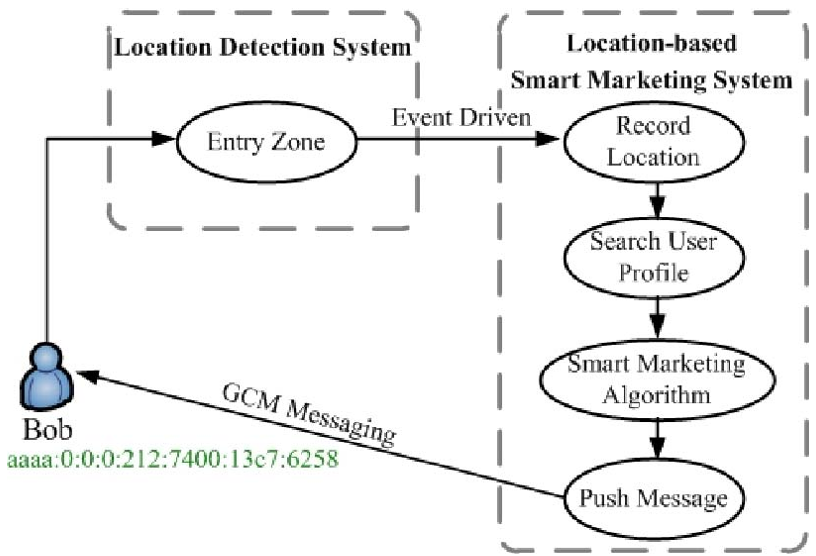 Figure 1: The IPv6 locating management system bridging locators and the marketing backend.
The Event-Driven Logic
When a user moves from "Zone A" to "Zone B," the IPv6 locator triggers a location update. The system performs a Profile Match:
- Identity Check: Maps IPv6 Username.
- Context Check: Current Zone Available Ads.
- Demographic Filter: Age/Gender Relevant Products.
Experiments and Results
The authors demonstrated the system's efficacy through a real-world retail simulation. A user named "Bob" was tracked moving through two distinct zones.
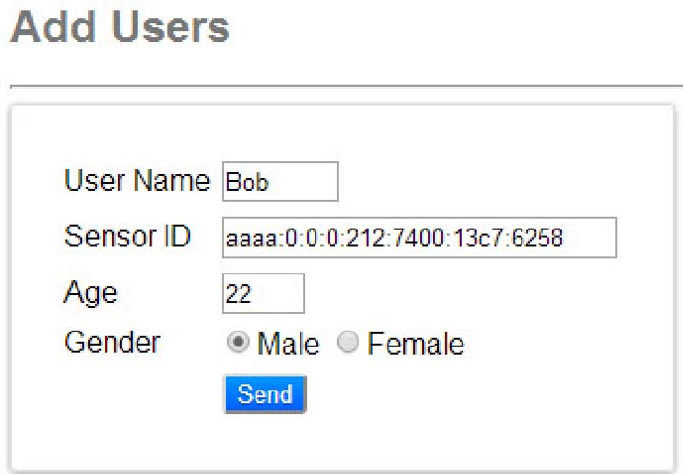 Figure 3: Overall system workflow from registration to localized ad delivery.
Key Findings:
- Zone Sensitivity: The system successfully updated Bob's location as he transitioned from the hardware accessory zone to the cosmetic zone.
- Personalization Precision: When in the cosmetic zone, the system filtered out female-targeted products and pushed "men's facial foam" based on Bob's registered gender profile.
- Reliability: The use of GCM ensured that even if the mobile app was in the background, the time-sensitive marketing data reached the user immediately.
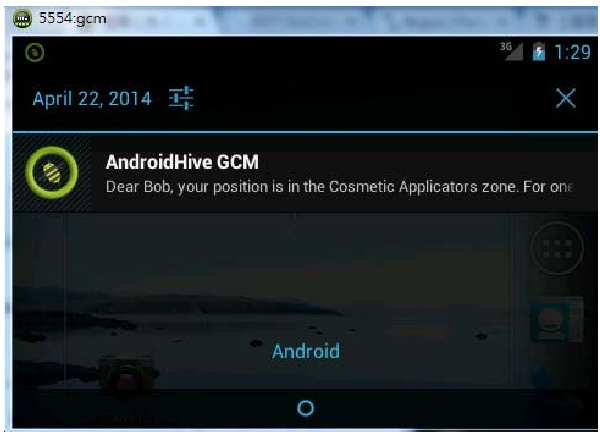 Figure 8: Real-time notification received as the user enters a specific retail zone.
Critical Insights
The true value of this work is not just in "pushing ads," but in the seamless integration of networking protocols and marketing logic. By treating a locator as an IPv6 node, the researchers reduce the overhead of proprietary tracking systems.
Limitations & Future Outlook:
- Hardware Form Factor: Currently, users carry a sensor device (Octopus II). Future iterations should target the integration of these IPv6 stacks directly into smartphones or wearable BLE-to-IPv6 gateways.
- Privacy: While the paper focuses on utility, the persistent tracking of an IPv6 address raises privacy concerns that need addressing through temporary address extensions (Privacy Extensions for IPv6).
Conclusion
This study successfully bridges the gap between low-power wireless sensor networks (WSN) and consumer-facing applications. The use of IPv6-enabled locators provides a scalable, standardized way to handle identity and location, proving that the future of retail lies at the intersection of the Network Layer and personalized User Experience.