
Beyond the Extremist Label: Analyzing the Digital Lives of ISIS Supporters on Twitter
"I like ISIS, but I want to watch Chris Nolan's new movie": Exploring ISIS Supporters on Twitter
The paper introduces a search and analysis system designed to explore 123 million tweets from 57,000 Arabic-speaking users classified as ISIS supporters or opponents. Using a high-accuracy classification method (98%) based on naming conventions (e.g., "Islamic State" vs. "Daesh"), the authors demonstrate that ISIS supporters lead multifaceted digital lives, spending 80% of their time discussing general topics like movies and jokes.
TL;DR
This study challenges the "monolithic" view of extremists by analyzing 123 million tweets from 57k users. It reveals that ISIS supporters are not 24/7 propaganda machines; instead, they spend 80% of their time tweeting about movies (like Christopher Nolan films), nature, and jokes. The authors developed a high-accuracy classification system and a comparative search engine to visualize how these users' perspectives shift over time.
Background Positioning
In the landscape of social computing and counter-terrorism, this work serves as an essential empirical bridge. Published during the height of ISIS's global visibility (2015), it moves beyond static profiling to offer a dynamic, data-driven look at the antecedents and multidimensionality of radicalized individuals.
Problem & Motivation: The Myth of the "Isolated Extremist"
Common public perception often frames supporters of violent groups as uneducated or socially disconnected. However, psychological research suggests they are often more educated and psychologically resilient than average. The researchers at the Qatar Computing Research Institute aimed to solve a critical data gap: How does an extremist's daily digital life look when they aren't talking about "the cause"?
The challenge lay in identifying these users at scale and distinguishing their genuine support from news reporting or general commentary.
Methodology: The "Full Name" vs. "Acronym" Proxy
The core insight of the study is purely linguistic. In the Arab world:
- Pro-ISIS users almost exclusively use the group's full name (ad-Dawlah al-Islamiyah).
- Anti-ISIS users use the abbreviated acronym (Daesh), which the group considers derogatory.
Using this 70% threshold rule, the team achieved a staggering 98% classification accuracy.
System Architecture
The researchers built a specialized search engine using Solr, featuring:
- Arabic Normalization: Tools to handle the complexities of "social" Arabic (e.g., word elongation and emojis).
- Comparative UI: A split-screen interface showing Pro-ISIS vs. Anti-ISIS content side-by-side.
- Temporal Analytics: A timeline feature to see how a user’s opinion on an entity (like the "Free Syrian Army") mutated from support to betrayal over a two-year period.
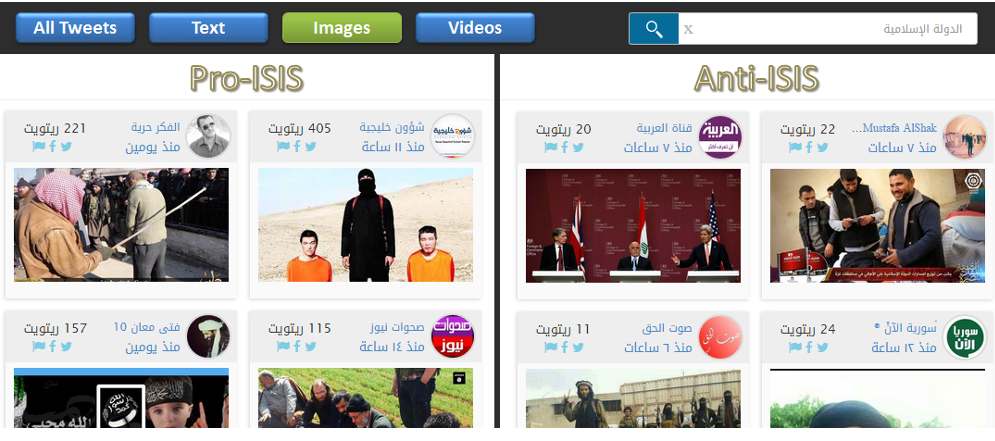 Figure 1: The comparative search interface showing parallel perspectives on specific queries.
Experiments & Results: The "80/20" Rule of Radicalization
The most striking result wasn't about the violence, but the mundanity:
- Engagement Levels: Pro-ISIS users dedicate only 20% of their tweets to the group. The other 80% covers religion, politics, and even pop culture (e.g., "I want to watch Chris Nolan's new movie").
- Data Scale: The system successfully indexed 123 million tweets, allowing for "time travel" to see what these users were like before the rise of the Islamic State.
- Linguistic Evolution: The data captured real-time shifts in loyalty as users navigated the "missteps of the Arab Spring."
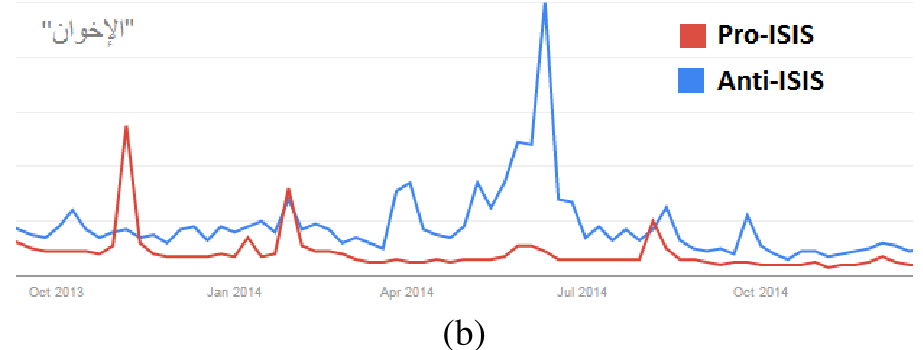 Figure 2: Plotting the popularity of query terms over time for both groups.
Critical Analysis & Conclusion
Takeaway
This paper proves that online radicalization is not an all-consuming identity but is often integrated into a standard digital lifestyle. This "banality of evil" in a digital context suggests that counter-messaging should perhaps target these "mundane" windows of interest rather than just arguing against extremist ideology.
Limitations
As a 2015 study, it relies on Twitter’s then-open API and less stringent moderation policies. Today’s extremist groups use much more sophisticated obfuscation, making simple linguistic proxies like the "full name rule" less effective as platforms increase bans.
Future Perspectives
The methodology—comparing "insider" vs. "outsider" language—is a powerful framework that could be applied to modern political polarization or the spread of misinformation in non-extremist contexts.