
The IT Artifact as the Service: Bridging User Satisfaction and Long-Term Retention
Understanding the role of an IT artifact in online service continuance: An extended perspective of user satisfaction
This paper proposes an integrated research model to explain online service continuance by combining the user satisfaction and technology acceptance (TAM) perspectives. Tested via a field survey of Social Network Service (SNS) users, the study reveals that website information and system satisfaction significantly drive continuance intentions through the mediators of perceived usefulness and perceived enjoyment.
TL;DR
In the hyper-competitive landscape of online services, retaining a user is often more valuable than acquiring a new one. This paper bridges the gap between User Satisfaction (how much you like the website) and Continuance Intention (whether you will stay). By analyzing Social Network Service (SNS) users, the authors prove that your satisfaction with the "technical" system and the "content" information are the primary fuels for perceived usefulness and enjoyment, ultimately deciding the service's fate.
Background: Beyond the First Click
Most IT research focuses on acceptance—why people start using a tool. However, for online services like social networks or e-banking, the real challenge is continuance. The authors argue that we cannot understand long-term behavior without looking at the IT Artifact itself: the man-made website. They combine two major academic schools of thought:
- User Satisfaction Literature: Focused on the quality of the system and information (The Object).
- Technology Acceptance Model (TAM): Focused on usefulness and ease of use (The Behavior).
The Core Insight: The System is the Service
The researchers posited that in the world of online services, the interface isn't just a "pipe"—it is the product. If the system is slow or the information is stale, users don't just dislike the website; they stop finding the service useful or fun.
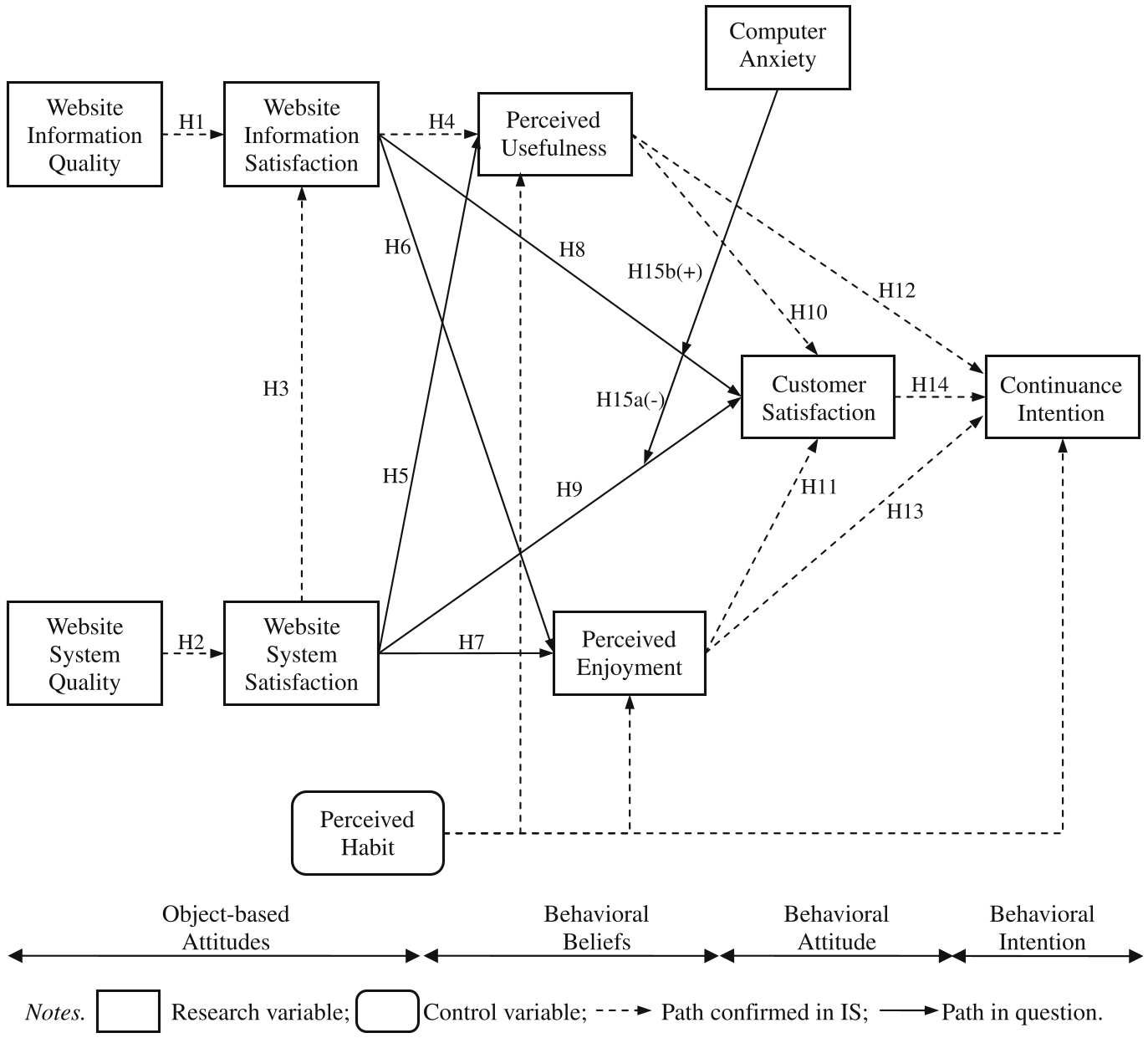
The Integrated Model
The study proposed a hierarchical flow:
- Quality (Information/System) Object Satisfaction Behavioral Beliefs (Usefulness/Enjoyment) Continuance.
Methodology and Results
The authors surveyed 254 active users of Cyworld (a dominant South Korean SNS). Using PLS-SEM (Partial Least Squares Structural Equation Modeling), they validated several critical hypotheses:
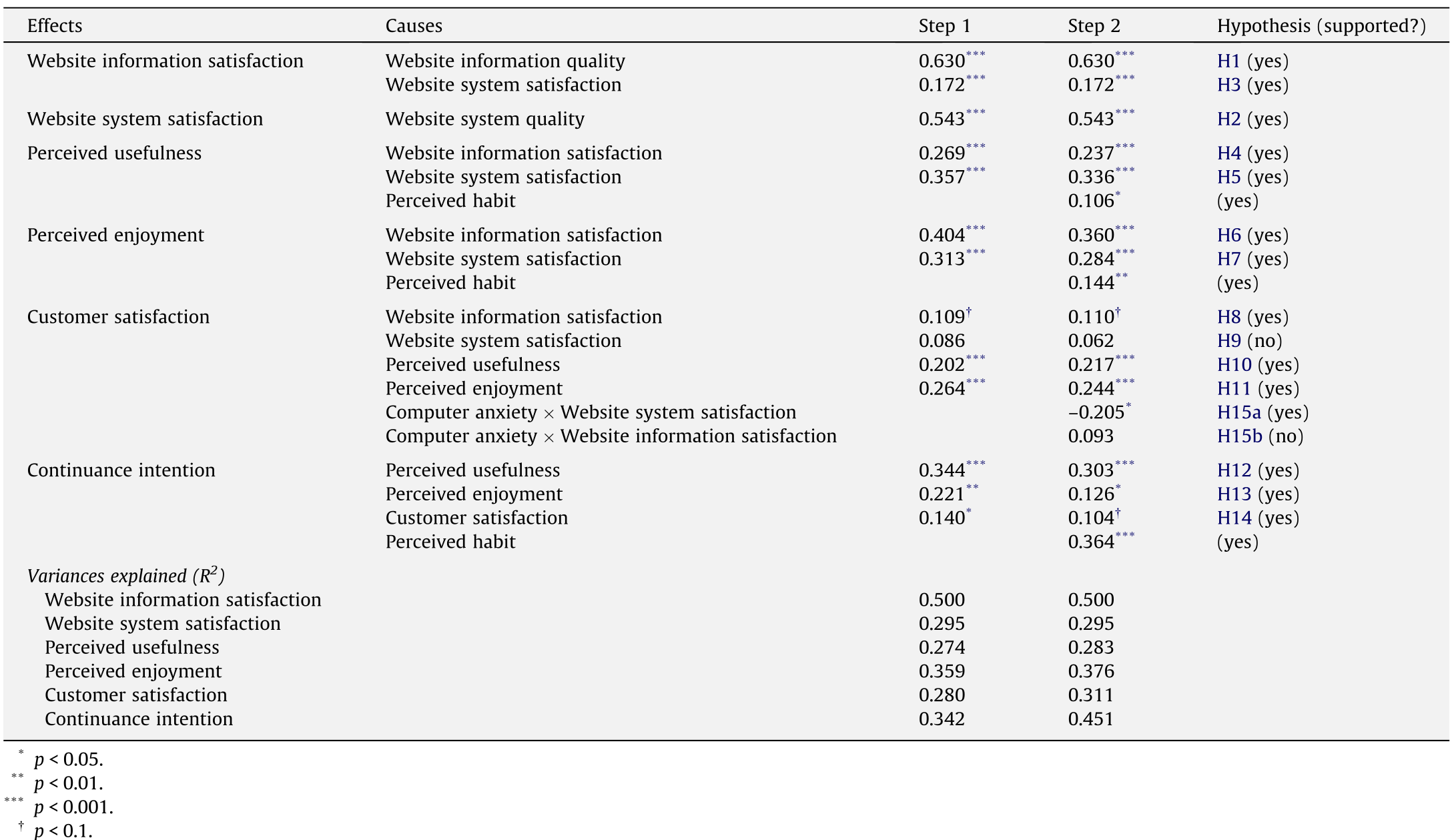
- System Satisfaction Usefulness: Unlike traditional workplace tools, in SNS, if the system (search, navigation, speed) works well, users perceive the service as more "useful" for managing their social lives ().
- Information Satisfaction Enjoyment: High-quality content (profiles, photos) directly drives the "fun" factor ().
- The Habit Factor: For heavy users, "Habit" becomes the strongest predictor of staying, actually weakening the impact of conscious satisfaction.
Performance Data Summary
The following table highlights the path coefficients and their significance:
The "Anxiety" Factor
A fascinating discovery was the role of Computer Anxiety. For users with high anxiety, even a high-performing system doesn't necessarily translate into high satisfaction. Their fear of making mistakes or losing data acts as a "noise" that disrupts the positive impact of a good IT artifact.
Critical Analysis & Conclusion
Takeaways for Tech Leaders
- System Maturity is a Myth: Managers often stop investing in the "system" once it's stable. This paper suggests that because the system is the service, continuous evolution is mandatory for retention.
- Hedonic vs. Utilitarian: Even for "fun" apps (SNS), usefulness matters. Cyworld succeeded because it balanced being a "toy" (enjoyment) with being a "tool" (usefulness for social management).
- Targeting Non-Habitual Users: Since habitual users stay by reflex, marketing and UX improvements should focus on non-habitual users who are more "rational" and sensitive to system quality.
Limitations
The study is cross-sectional (a snapshot in time) and focused on one culture (South Korea). Future research should explore "social" variables like network density and "betweenness" to see how peer pressure influences the decision to stay.
Conclusion: This work reaffirms that the IT artifact is the heart of the online service experience. By managing both the technical system and the information it delivers, firms can transform a one-time visitor into a lifelong user.