
Smart Governance: How Dubai RTA Leverages AI and Big Data for Future Infrastructure
IT Governance Framework and Smart Services Integration for Future Development of Dubai Infrastructure Utilizing AI and Big Data, Its Reflection on the Citizens Standard of Living
This paper explores the integration of IT Governance, Artificial Intelligence (AI), and Big Data within the Dubai Roads and Transport Authority (RTA) to advance smart city infrastructure. It establishes a comprehensive framework to enhance service delivery efficiency and improve the standard of living for citizens.
TL;DR
Dubai's Roads and Transport Authority (RTA) is redefining urban mobility not just through hardware, but through a sophisticated IT Governance Framework. By integrating AI and Big Data, the RTA has transitioned from traditional transport management to a "Data-Smart" governance model that prioritizes citizen well-being and long-term sustainability alongside operational efficiency.
Problem & Motivation: The "Governance Gap" in Smart Cities
Why do many smart city initiatives fail despite massive investment? The paper identifies a critical "Governance Gap." Prior works often focus on the implementation of technology (the "What") without establishing the governance required to oversee it (the "How").
The authors argue that the complexity of smart cities—characterized by novel technologies like IoT and AI—makes traditional financial ROI metrics obsolete. Investors and governments need a new lens that captures Social Responsibility and Environmental Value, addressing the risks of cost overruns and fragmented service delivery.
Methodology: The Six-Pillar Governance Framework
The core of the RTA’s success lies in its rigorous technological governance structure. This isn't just a management chart; it's a strategic engine designed to align every byte of data with the city's economic and social goals.
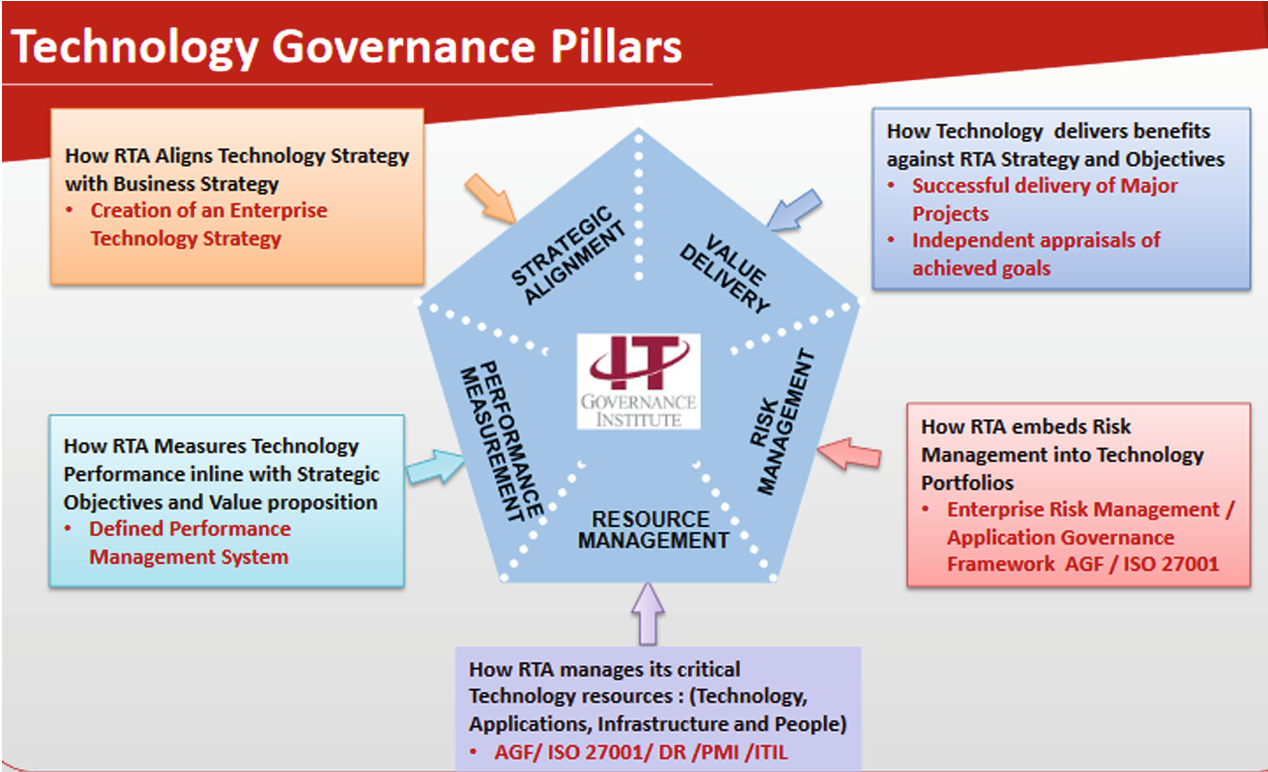
The RTA Technology Governance Pillars:
- Strategic Alignment: Ensuring tech serves the Dubai Urban Development Plan.
- Benefit Realization: Delivering major projects with measurable community impact.
- Risk Management: Using technology to mitigate site-specific and cybersecurity risks.
- Resource Management: Efficiently allocating human and ICT capital.
- Performance Measurement: Tracking success against strategic KPIs.
- Essential Success Factors: Institutionalizing innovation.
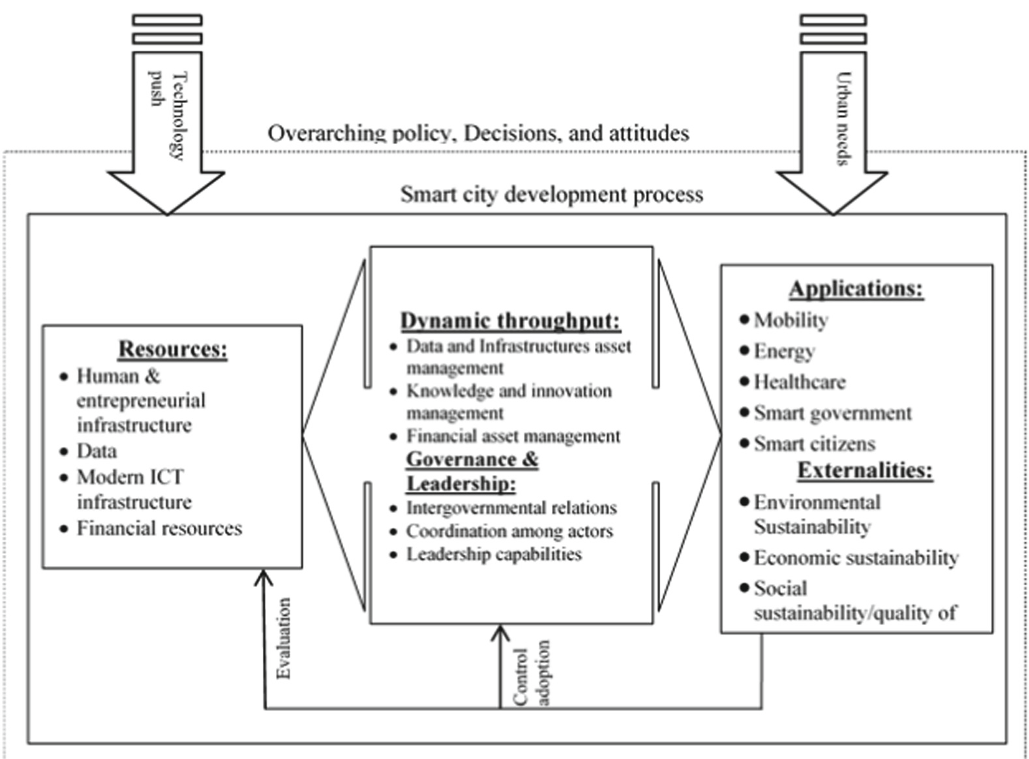
The IO Model of Smart City Development
The research adopts an Input-Output (IO) model, where "Throughput" (Governance and Leadership) acts as the catalyst that transforms "Inputs" (ICT Infrastructure, Data, Finance) into "Outcomes" (Improved Standard of Living).
How AI and Big Data Transform Public Service
The paper highlights a shift toward Algorithmic Government. By processing massive datasets—from social media patterns to IoT sensor data—the RTA can move from reactive management to Predictive Analytics.
- Behavioral Insights: Understanding how citizens use transport to anticipate demand.
- Inclusivity: Big Data allows the government to identify the needs of marginalized groups (e.g., elderly parking requirements), making policy design more democratic and less technocratic.
- Efficiency: AI-based advisors and automated systems reduce the operational cost and human error in traffic monitoring.
Critical Perspective: Risks and ROI
The authors do not ignore the "New Gold" risks. The ubiquity of mobile interaction in smart cities introduces significant security vulnerabilities. They advocate for:
- Privacy-Preserving Authentication (PPA): Cryptographic approaches to secure mobile services.
- Fog Computing: Mitigating cloud-based data interception.
Beyond Financials: The paper concludes that the ROI of smart infrastructure must be "multi-pronged." The intangible benefits—reduced traffic stress, cleaner air, and inclusive parking—are what truly attract long-term global investment to Dubai.
Conclusion: A Blueprint for Future Cities
The Dubai RTA case study proves that IT Governance is the most crucial predictor of organizational value in the smart city era. By focusing on Data-Smart Governance, cities can ensure that technology actually serves the people rather than just existing as a "high-tech veneer."
Key Takeaway: For future infrastructure, the "Smart" in Smart City refers to the governance framework as much as the technology itself.