
Crisis Response 2.0: Bridging the Gap Between Social Media Noise and Emergency Management
14046_An Iterative Information Retrieval Approach from Social Media in Crisis Situations.
The paper proposes an "Intelligent Information Retrieval Framework" for social media during crises, specifically designed for Emergency Management Services (EMS). It combines a Query Generator based on Conditional Neural Turing Machines and a Topic Discovery component powered by deep learning to dynamically match social media streams with the evolving information needs of first responders.
TL;DR
Despite the wealth of real-time data on social media during disasters, Emergency Management Services (EMS) often ignore it due to overwhelming noise. This paper introduces an intelligent framework that uses Conditional Neural Turing Machines (CNTM) and Deep Learning to act as an automated "filter," identifying and retrieving only the specific data points—like casualty locations or evacuation status—that responders actually need at specific stages of a crisis.
The Problem: Information Overload vs. Situational Awareness
During events like the Nepal earthquake or Typhoon Hagupit, social media becomes a lifeline. However, for a professional firefighter or police officer, a feed of 10,000 tweets is a distraction, not a tool.
Current SOTA (State Of The Art) tools like AIDR or CrisisTracker are primarily "data-driven." They tell you what is being said, but they don't understand what a responder needs to know next. The authors identify three pillars of EMS skepticism:
- Lack of confidence: Crowdsourced data feels random.
- Content Quality: Slang, typos, and abbreviations hinder automated processing.
- Inefficiency: Tools don't adapt to the iterative nature of a crisis (e.g., first you need the fire's location, then the number of trapped residents).
Methodology: A "Brain" for Crisis Data
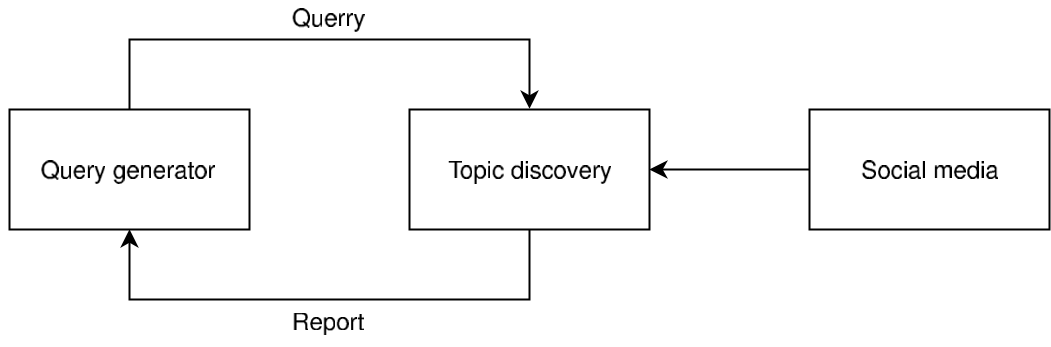
The proposed framework consists of two core modules that create an iterative loop of information retrieval.
1. The Topic Discovery Component (The "Eyes")
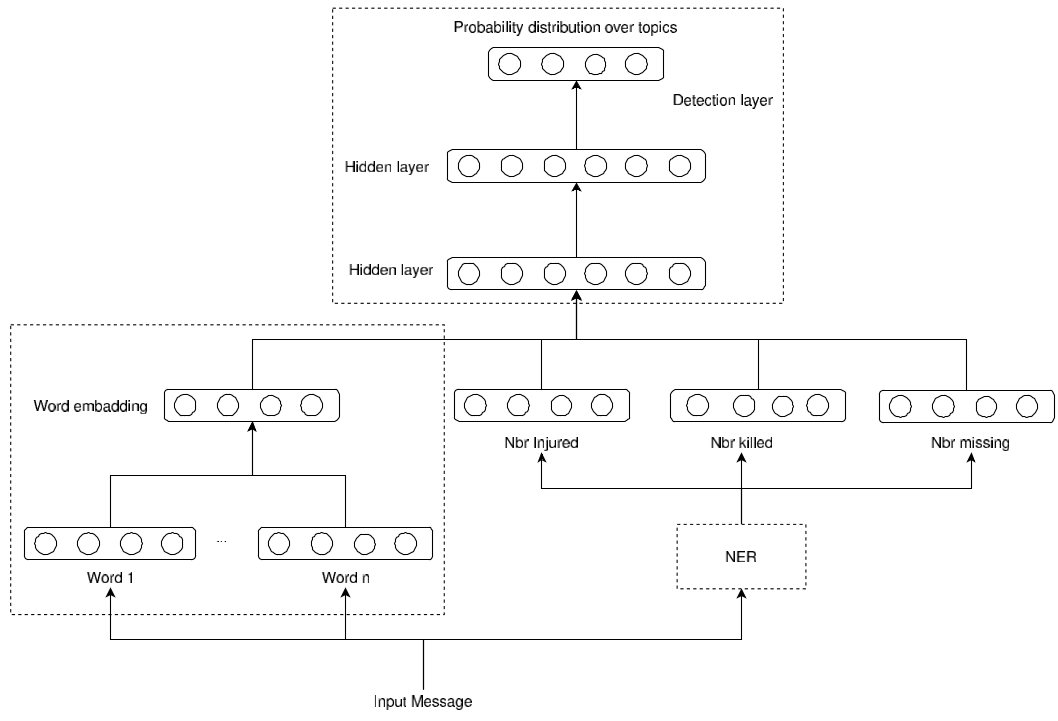
This module classifies incoming messages. To handle the "messy" nature of social media text, the authors used a specialized Denoising Autoencoder to create word embeddings. This allows the model to map non-standard spellings (e.g., "h3lp") to their standard forms ("help") in a high-dimensional vector space. Combined with Maximum Entropy NER, it extracts metadata like the number of injured or specific locations.
2. The Query Generator (The "Brain")
This is the most innovative part of the paper. Using a Conditional Neural Turing Machine (CNTM), the authors model a crisis as a state transition graph.
- Logic: If the system detects a "Fire Event," the CNTM predicts that the next logical information needed is "Location" and "Magnitude."
- Feedback Loop: Once those are found, it triggers a new query for "Evacuation Status."
Experimental Results: Proving the Value
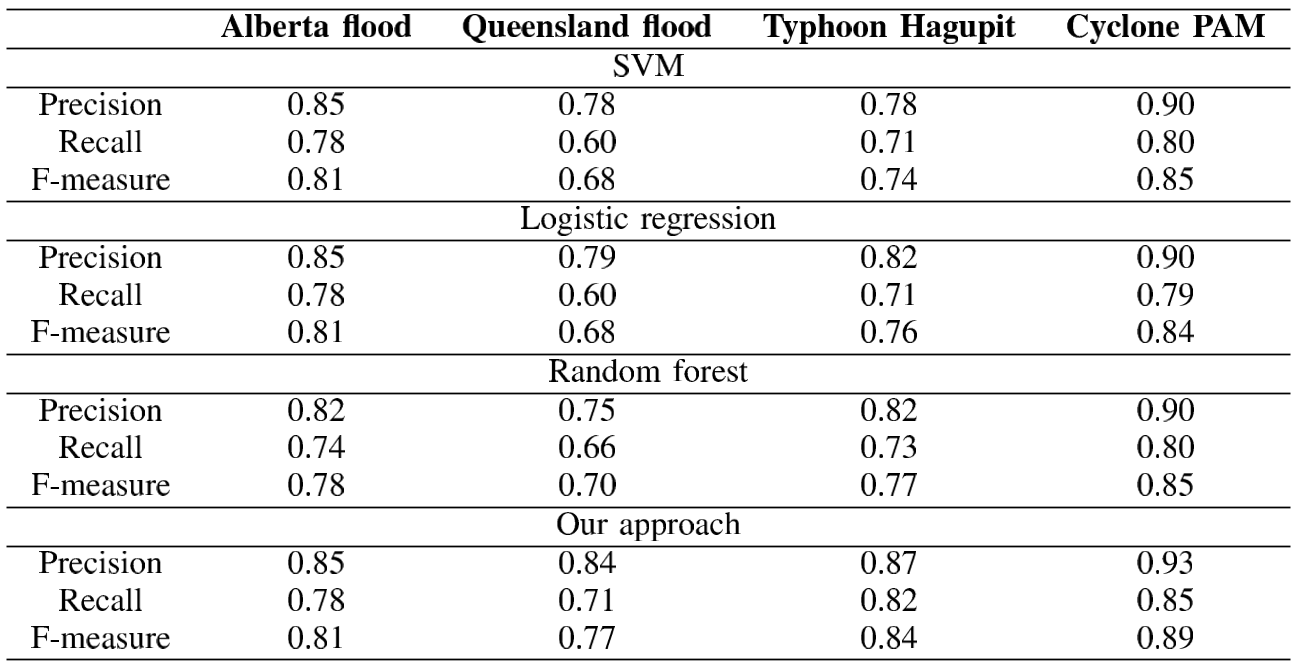
The framework was tested against several baselines (SVM, Logistic Regression) using historical disaster data.
Performance Gains
The neural approach significantly outperformed classical ML models. For Typhoon Hagupit, the F-measure improved from 0.74 (SVM) to 0.84 (Proposed Approach). The custom word embedding outperformed standard Word2Vec and GloVe by roughly 3-5%, proving that crisis-specific language requires crisis-specific training.
Expert Validation
To ensure "real-world" applicability, the authors conducted a survey with 11 experts from the Red Cross, police, and academia. The experts agreed with the framework's retrieval choices in 75.3% of cases. While the system occasionally suffered from low "recall" (missing some relevant tweets), its "precision" was high, meaning the information it did provide was highly trustworthy.
Critical Analysis & Conclusion
Takeaway
The shift from "let's classify all tweets" to "let's find the specific answer to the responder's current question" is a major step forward. By using CNTMs to represent the workflow of emergency response, this paper moves AI closer to being a practical teammate in disaster zones.
Limitations
- The "Missing" Problem: The NER component struggled to identify "missing persons" because people describe them in highly varied ways (e.g., "lost," "haven't seen," "kidnapped") compared to "killed" or "injured."
- Dependency on Graph Design: The CNTM relies on a well-designed transition graph of crisis stages. Creating these graphs for every possible type of disaster (chemical spills, cyber-attacks, etc.) remains a manual bottleneck.
Future Outlook
As Large Language Models (LLMs) continue to evolve, the reasoning capabilities of the Query Generator could be further enhanced, allowing for even more fluid and natural interactions between EMS personnel and the wealth of data hidden in the social media storm.