
Navigating Multi-Granularity: A Strategic Review of Fuzzy Linguistic Decision Making
Information Technology and Quantitative Management (ITQM 2015) On multi-granular fuzzy linguistic modelling in decision making
This paper provides a comprehensive analysis of Multi-Granular Fuzzy Linguistic Modelling (FLM) for Group Decision Making (GDM). It categorizes and evaluates six distinct methodologies that allow experts with varying knowledge levels to express preferences using linguistic term sets of different granularities.
Executive Summary
TL;DR: In the world of Group Decision Making (GDM), experts don't always speak the same "scale." This paper reviews the evolution of Multi-Granular Fuzzy Linguistic Modelling (FLM)—a framework that allows different experts to use their own preferred linguistic scales (from "Low/High" to "Poor/Fair/Good/Excellent") and then mathematically unifies them to find a consensus.
Background: This work serves as a critical survey and taxonomic guide in the field of Computing with Words (CWW). It positions various methodologies—ranging from classical membership functions to modern symbolic 2-tuples—within a comparative framework to guide researchers in selecting the right tool for complex human-computer interaction scenarios.
The Pain Point: The "Communication Gap" in Expertise
When a panel of experts evaluates a set of alternatives, a central conflict arises: Granularity of Knowledge. A senior engineer might need a 9-point scale to express nuanced technical preferences, while a business executive might prefer a simple 3-point scale.
If we force everyone onto the same scale, we lose information or introduce "false precision." Traditional GDM methods often failed because they:
- Cruelly converted words to raw numbers, losing the "fuzzy" intent.
- Produced "average" results that didn't map back to any real-world words.
Methodology: Six Paths to Linguistic Harmony
The paper decomposes multi-granular modeling into six major technical schools of thought.
1. The Traditionalists (Fuzzy Membership Functions)
These methods map words to Trapezoidal Fuzzy Numbers (TFNs). While mathematically robust, they often yield results that are impossible to explain back to humans (e.g., "The consensus is a trapezoid with coordinates [0.2, 0.4, 0.5, 0.7]").
2. The Unifiers (Basic LTS)
Everything is translated into a single "BLTS" (Basic Linguistic Term Set). The paper notes a critical trade-off: smaller BLTS = less complexity but higher information loss.
3. The 2-Tuple Model (The Industry Gold Standard)
The 2-tuple representation is highlighted as a breakthrough. It stores a linguistic term and a "symbolic translation" (the distance from the label). This allows for continuous computation without losing the linguistic connection.
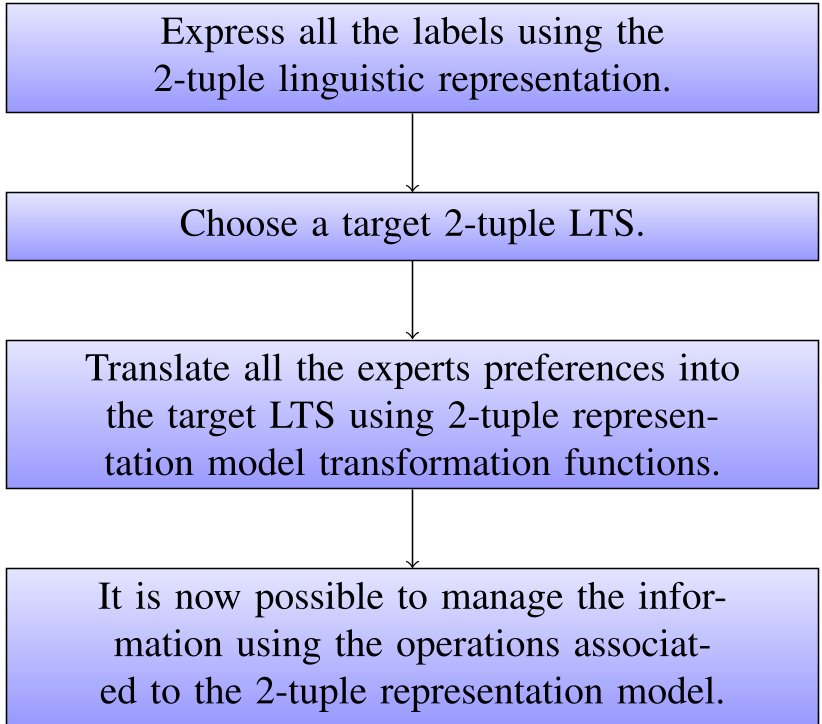 Figure: The hierarchy used to transform different granularities into a target 2-tuple scale.
4. Hierarchical Trees & Qualitative Spaces
These methods offer more flexibility for "unbalanced" scales (e.g., when you have more words for "Positive" than "Negative").
Experimental Insights & Comparisons
The paper’s ultimate value lies in its comparative matrix. It evaluates techniques based on Data Loss, Complexity, and Interpretability.
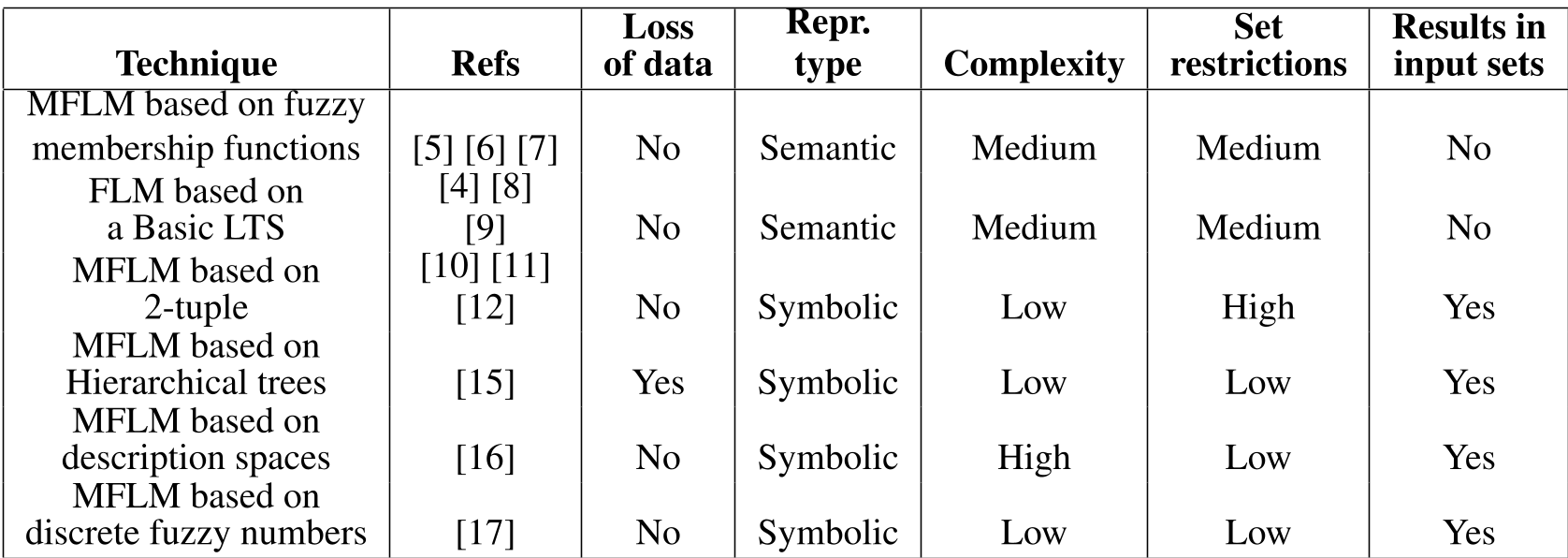
- Key Insight: 2-tuple and Hierarchical models are praised for their low complexity and ability to retain results in the input linguistic sets.
- Complexity vs. Accuracy: Methods like Discrete Fuzzy Numbers offer extreme flexibility but increase the cognitive load on experts, who must provide degrees of membership for every word.
Critical Analysis: Where do we go from here?
The paper concludes that interpretability is the final frontier. A decision model is useless if the experts cannot understand the consensus it produces.
Limitations: The review notes that "Unbalanced LTS" (where scales are skewed) remains a difficult problem. Most models still assume a somewhat symmetric distribution of words, which rarely happens in real-world sentiment.
Future Outlook: As AI systems (like LLMs) increasingly act as "experts" in decision-making loops, multi-granular FLM will be essential to align human qualitative feedback with machine quantitative metrics.
Main Takeaway: When designing a decision system, prioritize the 2-tuple model for a balance of mathematical accuracy and human readability.