
Jamura: Bridging the Gap Between Chatbots and the Web of Things (WoT)
Jamura: A Conversational Smart Home Assistant Built on Telegram and Google Dialogflow
The paper introduces "Jamura," a DIY conversational smart home assistant that leverages Telegram and Google Dialogflow to provide a natural language interface for IoT device management. The system integrates a Raspberry Pi-based local server with distributed ESP8266 nodes to facilitate smart monitoring, intruder detection, and unified control of heterogeneous home appliances.
TL;DR
"Jamura" is a smart home assistant that replaces clunky device-specific apps with an intuitive chat interface. By combining a Raspberry Pi, ESP8266 microcontrollers, and Google's Dialogflow, the researchers created a system capable of monitoring "house health" (temperature, humidity, soil moisture) and identifying intruders via Telegram—all through natural language.
Context & Motivation
As our homes become populated with "smart" gadgets, the interface problem grows. We are currently stuck in an app-centric world where every bulb and fan requires a different icon on our screens. The researchers behind Jamura argue that the Web of Things (WoT) paradigm—which treats hardware as programmable web resources—is the key to a unified interface. Their goal? A DIY system that is easy to implement yet powerful enough to perform predictive analytics and intruder detection.
Methodology: The Architecture of Intelligence
The system is built on a robust four-layer Web of Things architecture:
- Access Layer: Turns hardware into "WebThings" using RESTful APIs and JSON.
- Discovery Layer: Ensures the local server can identify and talk to non-IP based clients.
- Share Layer: Utilizes third-party APIs (Google Vision, Dialogflow) to share data across the internet.
- Compose Layer: The User Interface where Telegram and Google Assistant meet the user.
System Architecture
The heart of Jamura is a Raspberry Pi serving as the Local Server, which aggregates data from "Local Clients" (WeMos D1 Mini nodes).
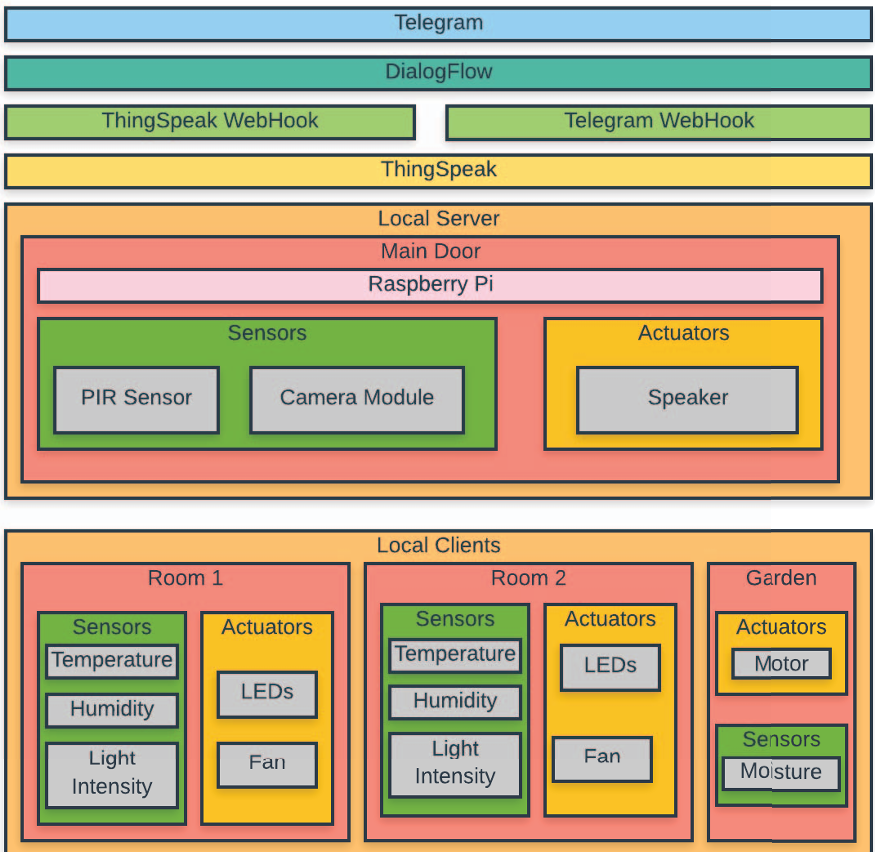
The logic flow is elegant: a user asks a question via Telegram; Dialogflow parses the Intent (e.g., "What is the temperature?"); a Webhook pushes this request to the local server; the server queries the specific sensor and returns a JSON response that is translated back into human speech.
Experimental Setup
The authors deployed Jamura across several "zones":
- Living Areas: Monitoring temperature, humidity, and lighting.
- Garden: Using soil moisture sensors and relay-controlled pumps to automate watering.
- Security: A PIR sensor and camera module at the main door. When motion is detected, the Google Vision API analyzes the image to confirm if a human is present before alerting the owner via Telegram.
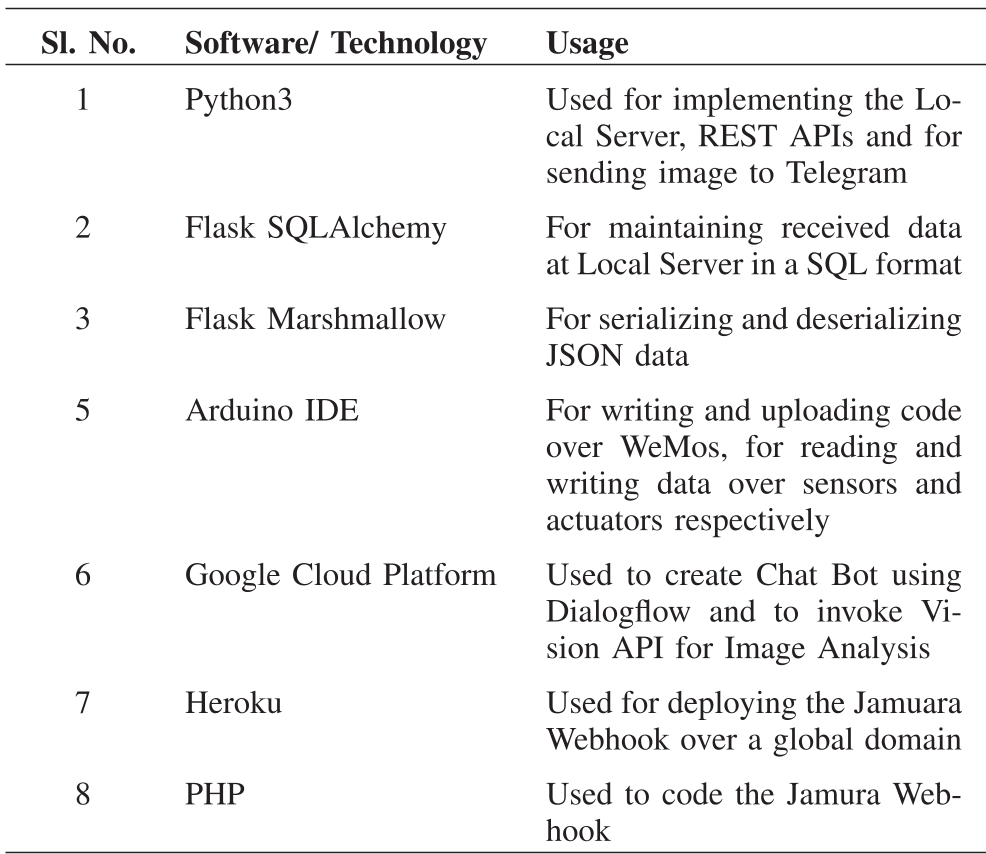
Performance Insights
In a smart home, latency is the enemy of usability. The authors performed an ablation-style analysis on response times for various intents:
- Low Latency: Basic intents like "Who are you?" or "Welcome" (processed entirely within Dialogflow) responded in 0.04s - 0.08s.
- High Latency: Complex queries like "Which rooms?" requiring a round-trip to the Local Server and cloud-to-local communication saw a jump to 7.42s.
 (Note: Users should refer to Table V in the paper for the full intent-response breakdown)
Takeaways & Future Work
Jamura demonstrates that the "Social Web of Things" is no longer a futuristic concept—it's buildable today with off-the-shelf components. While the current system relies on a "restricted set of queries," the authors highlight that future iterations will incorporate Machine Learning optimization to handle more complex, unscripted user interactions and predictive maintenance for the home.
For developers and researchers, Jamura provides a blueprint for moving away from siloed IoT apps toward a unified, conversational ecosystem.