
Beyond the Screen: How Japanese Families "Show and Narrate" Across the Pacific
Japanese Family via Webcam: An Ethnographic Study of Cross-Spatial Interactions
This ethnographic study investigates how geographically dispersed Japanese families maintain relationships using webcams. It introduces the "show-and-narrate" activity as a core mechanism for cross-spatial interaction, achieving SOTA-level insights into multimodal socialization between children in the US and grandparents in Japan.
TL;DR
This study moves beyond viewing webcams as simple video phones, instead treating them as "cultural products" that redefine family intimacy. By analyzing Japanese families separated by the Pacific, the research identifies a unique "show-and-narrate" activity—a structured sequence where physical objects and performances are presented to distant kin to bridge the gap between "virtual" and "real" spaces.
Back to the Physical: The Motivation
In the digital age, we often think of "online" as a separate realm. However, for Japanese families living in the US, the webcam is deeply anchored in their physical domestic environment. The author, Chiho Sunakawa, noticed a gap in linguistic anthropology: we talk a lot about what people say, but not enough about how the computer, the camera, and the room layout dictate the conversation.
The motivation was to understand how these families reconcile local differences and maintain emotional attachment through a lens that demands both seeing (miru) and being seen (miseru).
Methodology: The "Show-and-Narrate" Framework
The core of the paper is the "show-and-narrate" activity. Think of it as a digital "Show and Tell" that serves a deep social purpose. It consists of three moving parts:
- Showing: An embodied focal point (a toy, a song, or a gesture).
- Narrating: Verbal description provided by the child or a "scaffolding" parent.
- Responding: The audience's (grandparents') validation.
The "On-Stage" Performance
One of the most fascinating findings is the use of desu/masu (polite) forms. Usually, Japanese parents speak to their children in "plain" or casual forms. However, during webcam sessions, mothers often switch to polite forms.
Why? Because the webcam creates a "public stage." Utilizing polite forms indexes a "soto" (outside/public) context, signaling to the child that this interaction is a formal performance for the grandparents—a ritual of showing growth and education.
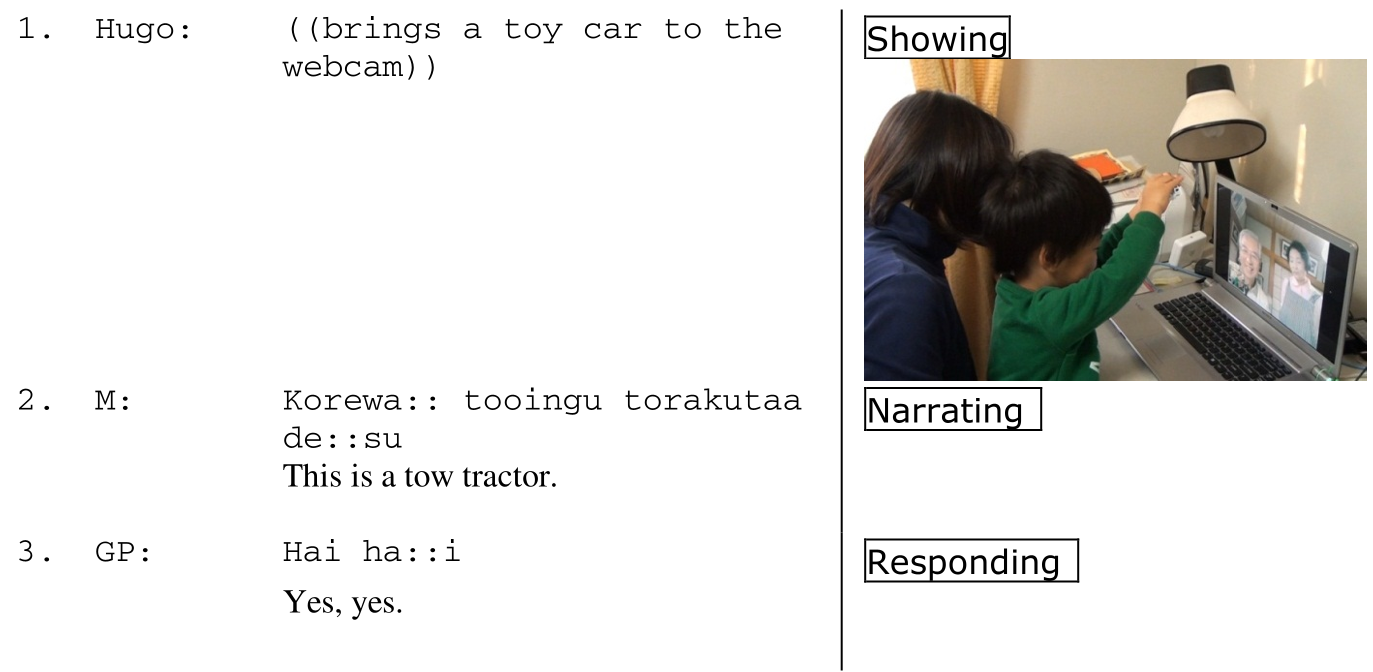 Example of a mother using polite forms to "stage" the introduction of a toy.
Socializing the Next Generation
The paper highlights how children are not just "chatting"; they are being socialized into technological habitus. Parents must teach children to distinguish between:
- The Webcam lens (where the grandparents "are").
- The Self-image on screen (which is just a reflection).
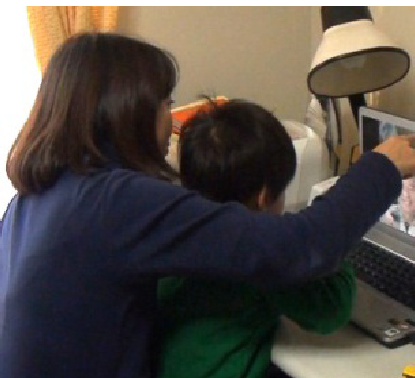 A mother literally "highlighting" the webcam to guide the child's gesture into the camera's field of view.
Key Results: Performance and Presence
The interaction isn't just about objects; it's about performance. In the "Sota" case study, the parents created an "on-stage" space on the sofa where Sota would list his American friends' names in English.
- The Adult Role: The mother would "echo" Sota's English with a clearer accent, essentially acting as a translator/promoter of the child's progress to the grandparents.
- The Result: The grandparents "see" the child growing up in a foreign culture, validating their role as kin even from thousands of miles away.
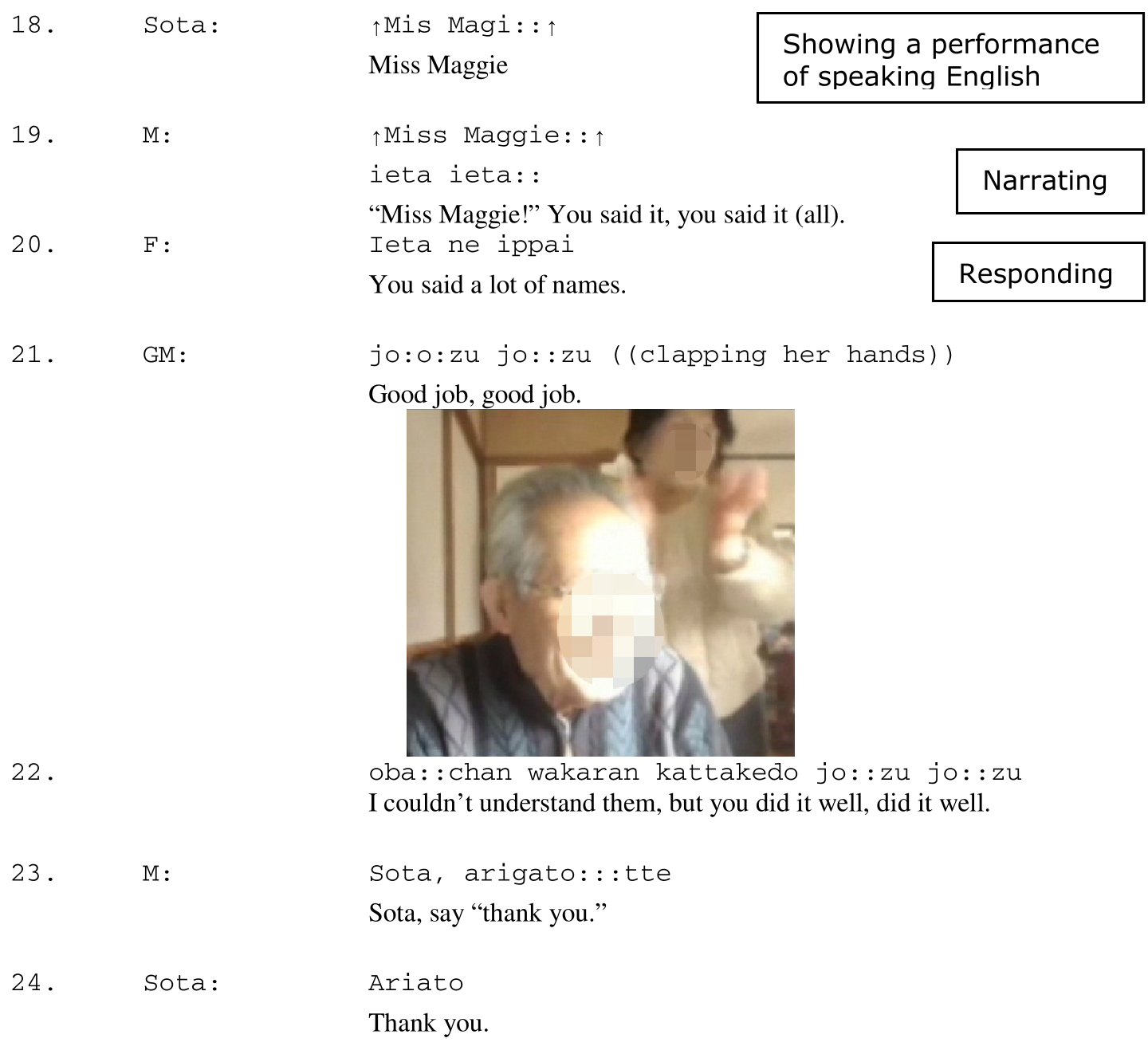 Analysis of rhythmic repetition and prosody used to "perform" English proficiency.
Critical Insight: The "Mediated Habitus"
Sunakawa’s work proves that "multimodality" in 2026 isn't just about gaze and gesture; it’s about how we incorporate the machine into our social identity.
Takeaway for Researchers:
- Technology is not transparent: The webcam’s affordances (where it is placed, what it can see) change the very nature of family roles.
- Cultural Tradition via Innovation: Traditional values (like respecting grandparents) are not lost in the digital transition; they are simply "re-staged."
Limitations: The study is small-scale (two primary families). Future research could explore how these dynamics change as children become "digital natives" who no longer need parental scaffolding to navigate the webcam "stage."
Conclusion
The webcam acts as a bridge not just between San Francisco and Tokyo, but between the "Inside" (Uchi) of the home and the "Outside" (Soto) of the mediated world. By "showing and narrating," these families ensure that even when physical presence is impossible, the "face" of the family remains visible and vibrant.