
JALs: Bridging the Gap Between Social Networking and Java Programming
Java Assist Learning System for Assisted Learning on Facebook
This paper introduces the Java Assist Learning System (JALs), a Facebook-embedded application designed to facilitate peer-assisted programming education. By integrating an automatic code verification mechanism and a social-linkage help system, it enables students to receive immediate coding assistance from proficient peers within a familiar social network environment.
TL;DR
The Java Assist Learning System (JALs) is a specialized application that embeds a programming environment directly into Facebook. By utilizing social API integrations, it creates a "Peer-Tutor" ecosystem where students get instant code verification and prioritized help from classmates who have already mastered the task. The result? Higher engagement, reduced frustration, and demonstrably better exam scores.
Background: The Social Coordinate of Learning
In the landscape of 2011-2012 (when this research was conducted), Facebook was the uncontested center of digital life for college students. While traditional Learning Management Systems (LMS) felt like a chore, Facebook was an addiction. The authors of this paper didn't just build a compiler; they built a Social Learning Intervention that meets students where they already spend their time.
Problem & Motivation: The "Frustration Gap"
Programming is a high-friction subject. A single semicolon error can stop a student for hours.
- The Teacher Bottleneck: Instructors cannot be available 24/7.
- The Peer Delay: Asking a friend via a separate chat app often leads to "out of context" help.
- The Social Anxiety: Some students are too shy to raise their hands in class but are comfortable interacting in a digital, social environment.
The authors hypothesized that by combining Automatic Verification with a Social Help Mechanism, they could turn passive scroll time into active learning time.
Methodology: How JALs Works
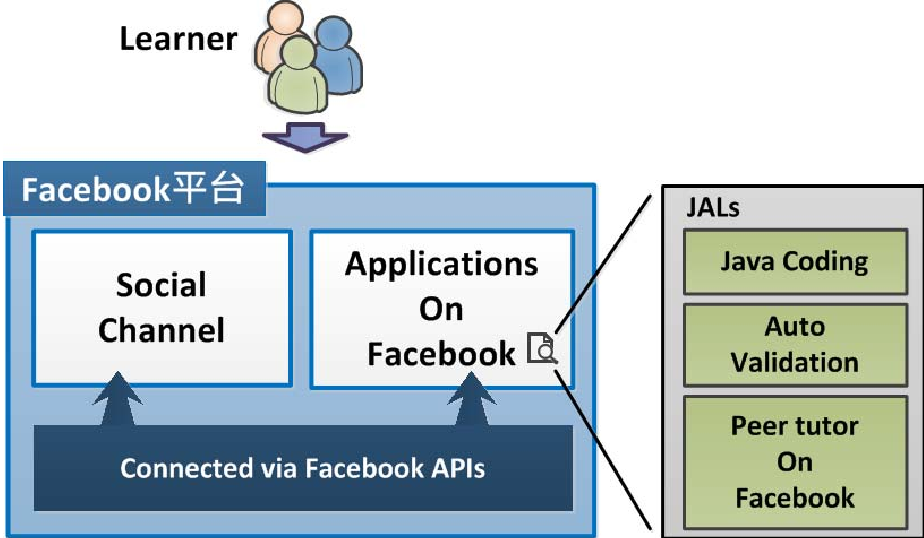
The architecture of JALs is built on three pillars: the Social Channel, the Coding Environment, and the Smart Help Logic.
1. Architecture Overview
The system hooks into the Facebook API to handle authentication and social graphs.
2. The Prioritized Help Logic
When a student clicks "Ask for Help," the system doesn't just blast a random message. It uses a specific ranking algorithm to find the best tutor:
- Priority 1: Peers who have already correctly solved this specific problem.
- Priority 2: Peers with the highest overall correctness rate in the course.
- Priority 3: The Course Assistant (as a fallback).
This ensures that the "Tutor" is someone with high competence in the immediate domain, maximizing the chance of a correct and swift answer.
Experiments & Results: Does it Actually Work?
The study involved 55 students over a semester covering core Java concepts (Arrays, Recursion, Classes).
Quantitative Success
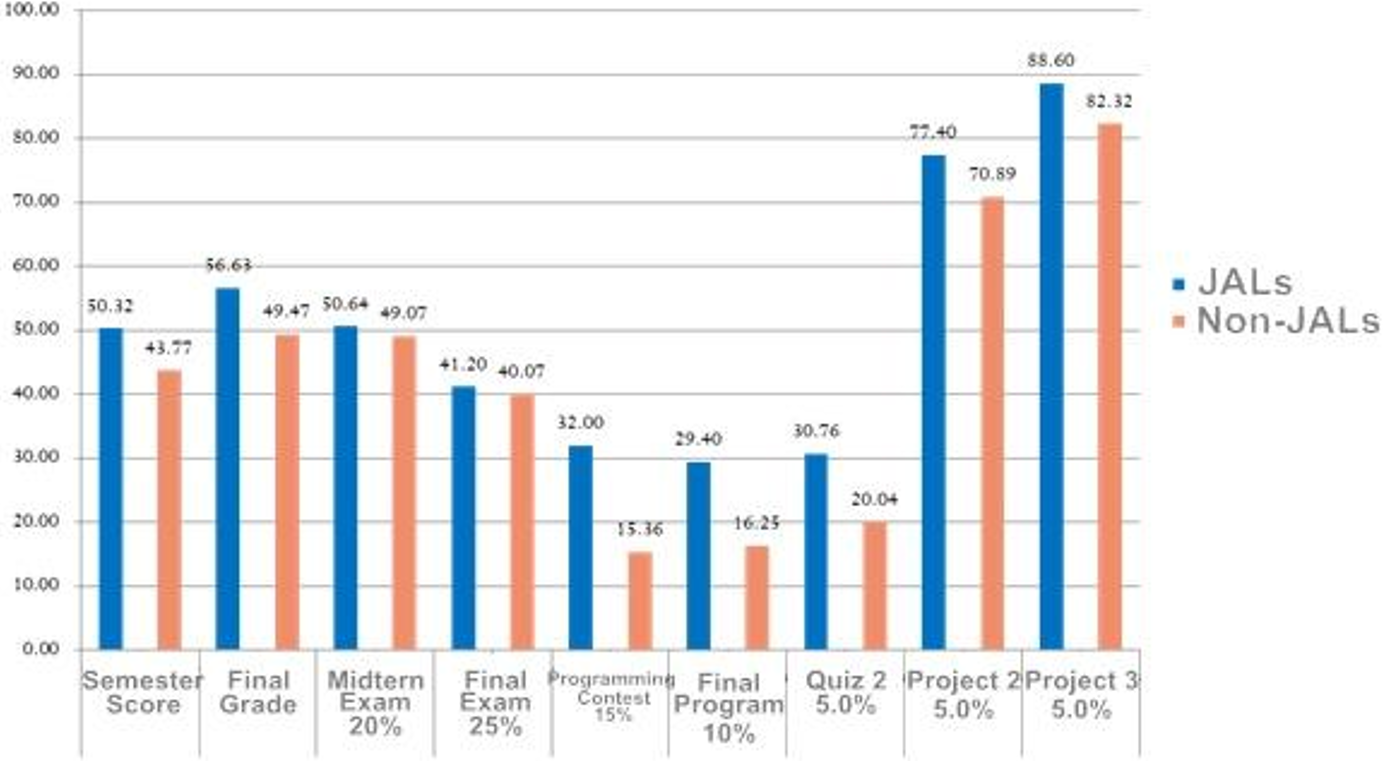
Students who used the JALs system showed a marked improvement over those who did not. As shown in the figure below, the JALs-enabled group achieved higher scores across various programming tasks.
Qualitative Feedback
The questionnaire revealed two distinct factors (analyzed via SPSS):
- Opinion on Social Learning: 80% felt Facebook-assisted learning was helpful.
- System Usability: While users loved the "novelty," some faced technical friction due to differences between the Linux-based backend and their Windows-based local environments.
Critical Analysis & Conclusion
Takeaways
JALs proves that Social Capital (Facebook friends) can be converted into Cultural Capital (programming knowledge). The "Interactive Reminding" function of a social app is a powerful tool to pull students back into the learning loop.
Limitations & Future Outlook
- Platform Dependency: The system's reliance on the Facebook API makes it vulnerable to platform policy changes (which the authors noted during the study).
- Privacy Concerns: The study found students are still hesitant to grant "Inbox Access" to educational apps, a precursor to the modern privacy-first web.
- The LLM Upgrade: In today's context, the "Ask for Help" mechanism would likely be supplemented by an AI Agent, though the Peer Tutor model still holds unique value for social accountability and mutual learning.
In summary, JALs was a visionary attempt to turn "Distraction Platforms" into "Instruction Platforms." It reminds us that for effective learning, the interface between people is just as important as the interface between code and compiler.