
Job Candidate Rank: Leveraging Sentiment Analysis to Optimize Recruitment
Job Candidate Rank Approach Using Machine Learning Techniques
The paper proposes the "Job Candidate Rank Approach," a sentiment analysis-based system designed to rank job candidates by analyzing interviewer feedback. Using a combination of WordNet expansion and Naïve Bayes/SVM classifiers, the model achieves a peak classification accuracy of 93%.
TL;DR
The "Job Candidate Rank Approach" is a machine learning framework that transforms qualitative interviewer feedback into quantitative hiring decisions. By utilizing WordNet expansion and Bernoulli Naïve Bayes, the system achieves a 93% accuracy in classifying candidate suitability, effectively reducing the manual workload for HR departments in the post-pandemic digital hiring landscape.
Problem & Motivation: Beyond the Resume
Modern recruitment is no longer a search for information but a battle against data overload. While many tools exist to match a CV to a job description, the actual interview remains a subjective "black box."
The authors identify a critical gap: HR managers struggle to synthesize diverse interviewer sentiments into a standardized rank. Traditional keyword matching is too rigid, failing to capture the nuances of human opinion (e.g., "sociable" vs. "easy-going"). The motivation behind this work is to build a bridge between subjective human observation and objective algorithmic ranking.
Methodology: Semantic Enrichment & Machine Learning
The proposed model follows a sophisticated NLP pipeline that prioritizes semantic depth over raw frequency.
1. The Pipeline
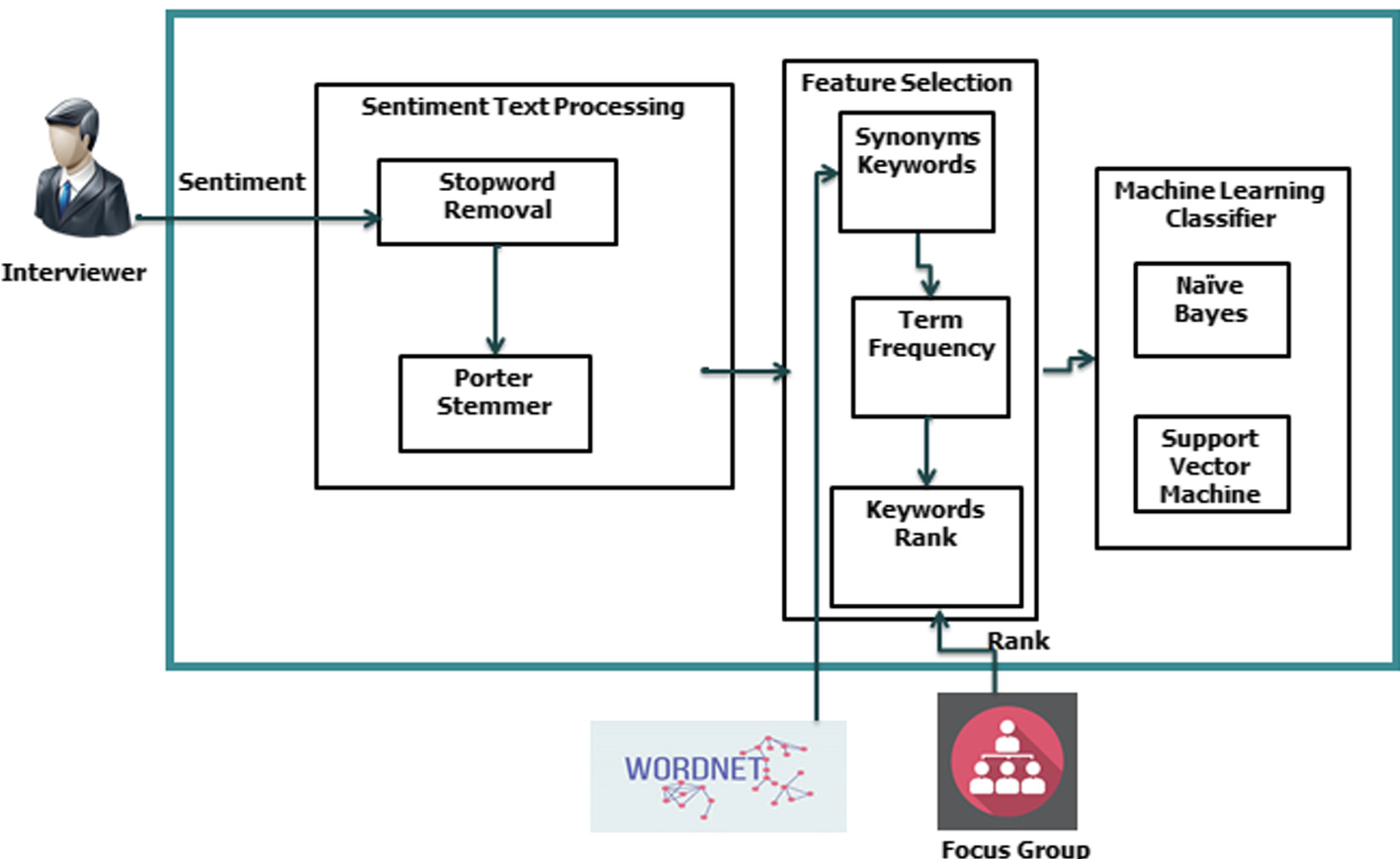
The architecture is divided into three primary phases:
- Processing: Standard NLP techniques (parsing, stop-word removal, and Porter Stemming).
- Feature Expansion: Unlike basic models that only look at words present in the text, this approach uses WordNet to identify synonyms. For example, if an interviewer calls a candidate "smart," the model also considers related concepts like "wise" or "intelligent."
- Ranking: A focus group of linguistics experts assigns importance weights to these features, ensuring the domain-specific nuances of "recruitment language" are captured.
2. Model Architecture
Experiments & Results: The Power of Synonyms
The study utilized a dataset of 1,500 interviewer sentiments (1,050 accepted, 450 rejected). The researchers compared two main algorithms: Naïve Bayes (NB) and Support Vector Machines (SVM).
Key Findings:
- Bernoulli vs. Multinomial: Bernoulli NB (which tracks word presence) outperformed Multinomial NB (which tracks frequency), suggesting that in short interview comments, the occurrence of a trait matters more than how many times the word is repeated.
- The "WordNet" Boost: Moving from simple Document Frequency to WordNet-expanded features increased the accuracy of the Bernoulli NB model from 85% to 93%.
- Kernel Selection: In SVM tests, the Linear Kernel significantly outperformed the RBF (Radial Basis Function) Kernel, proving that sentiment features in this domain are generally linearly separable.
Performance Comparison Table

Critical Analysis & Conclusion: Academic Insight
The core strength of this paper lies in its Inductive Bias—the assumption that interviewer feedback is rich in synonyms that carry similar hiring weights. By using WordNet, the authors effectively address the "sparsity" problem in short-text classification.
Limitations:
- Dataset Scale: 1,500 samples is a solid start but small for deep learning applications.
- Feature Scope: The model focuses on text. However, interviewers' sentiments are often influenced by non-verbal cues which are lost in text-only analysis.
Future Outlook: The logical next step for this research is the transition from Static Lexicons (WordNet) to Contextual Embeddings (BERT/Transformer-based). While WordNet handles synonyms well, it struggles with polysemy (words with multiple meanings depending on context). Nevertheless, this paper provides a robust, high-accuracy baseline for AI-driven HR decision-making.
Takeaway: Effective AI in HR isn't just about "counting words"; it's about understanding the semantic intent behind an interviewer's praise or criticism.