
The Weakness of Ties: Why More LinkedIn Contacts Might Be Killing Your Career Prospects
Getting a Job via Career-Oriented Social Networking Sites: The Weakness of Ties
The paper investigates job search success on Career-oriented Social Networking Sites (CSNS) like LinkedIn and XING. By integrating the "Number of Contacts" as a construct into the UTAUT2 model, the researcher discovered a counter-intuitive negative relationship between network size and job offer success, while significantly boosting the model's predictive variance from 19.0% to 80.5%.
TL;DR
In a world obsessed with networking, we often assume that a 500+ connection count is a badge of professional success. However, research by Ricardo Buettner reveals a startling reality: there is a substantial negative relationship between the number of contacts you have on career sites and your success in getting job offers. By refining the standard UTAUT2 model, this study explains 80.5% of the variance in job search success, proving that "contact collecting" is a failing strategy.
Problem & Motivation: The "More is Better" Fallacy
Most networking theories, such as Metcalfe's Law, suggest that the value of a network increases exponentially with the number of members. On a macro level, this makes sense for platform owners. But for the individual user, the "micro" reality is different.
Prior work in the offline world showed positive correlations between network centrality and career success. However, recruiters in the digital age have begun to view "super-connectors" with skepticism, often seeing a massive contact list as "noisy" or non-strategic information. Buettner's motivation was to bridge this gap: does a high contact count actually help you get hired, or is it just an "illusion of community"?
Methodology: Supercharging UTAUT2
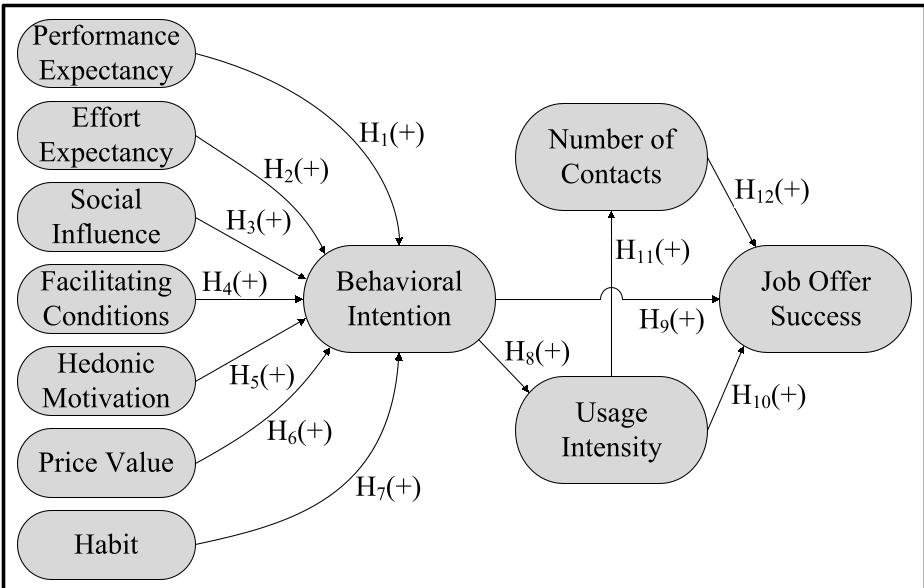
The author utilized the Unified Theory of Acceptance and Use of Technology (UTAUT2) but added a critical twist. Instead of just looking at why people use a site, the model was extended to track the outcome—Job Offer Success.
The Research Model
The study analyzed:
- Antecedents of Intent: What makes you want to use XING or LinkedIn for a job search? (Performance, Effort, Facilitating Conditions, Habit, etc.)
- Usage Intensity: How often do you actually apply and interact?
- The Network Metric: The actual number of direct contacts.
- The Success Metric: Frequency of job offers received from the network or headhunters.
Key Insights: Habit and Knowledge are King
The Structural Equation Modeling (SEM) yielded several "Academic Bombshells":
- Habit over Rationality: Unlike offline job searching, which is a complex, conscious task, CSNS usage becomes habitual. Users who integrate job-seeking into their daily digital routine are more likely to stay active.
- Facilitating Conditions: Having the specific knowledge of how to navigate the system is the strongest driver of usage intention. If you don't understand the platform's features, you won't use it, no matter how much you need a job.
Experimental Results: The "Contact" Paradox
The most shocking result is found in the path analysis between "Number of Contacts" and "Job Offer Success."
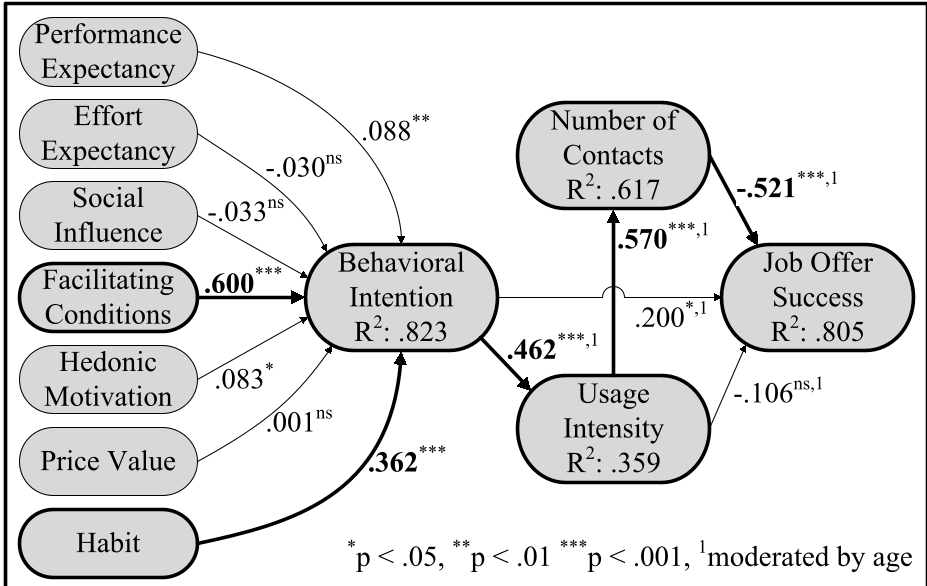
As shown in the SEM results, the path coefficient from Number of Contacts (NC) to Job Offer Success (JS) is -0.521. This means that as the contact pool grows, the likelihood of receiving a job offer significantly decreases.
Why does this happen?
- Trust Deficit: Recruiters and headhunters often distrust profiles that appear to be "contact collectors."
- Tie Dilution: Having thousands of contacts often means having zero meaningful "weak ties" that can actually advocate for you.
- The Noise Effect: Usage Intensity leads to more contacts, but if that intensity is spent on "collecting" rather than "connecting," the signal-to-noise ratio collapses.
Critical Analysis & Conclusion
Takeaway for Professionals
Stop the mindless clicking of "Connect." This research validates the professional "gut instinct" that a massive network is often a shallow one. Success in the digital job market comes from Facilitating Conditions (knowing how to use the tool effectively) and Habit, but not from sheer volume.
Limitations
The study relies on self-reported contact counts and "perceived" job offer success, which can be subject to retrospective bias. Furthermore, it treats all contacts as equal, whereas future research should distinguish between a "contact" and a "connection."
Future Outlook
This work challenges the very value proposition of CSNS platforms. If having more members makes the individuals within that network less successful at finding jobs, platforms may need to pivot their algorithms to favor tie strength and engagement quality over network growth.