
Job Recommendation Synergy: Combining Factorization Machines and Topic Modeling
Job recommendation based on factorization machine and topic modelling
This paper presents a prize-winning solution for the RecSys Challenge 2016, focused on job recommendation for the XING social network. The authors developed a hybrid ensemble combining Factorization Machines (FM), Item-based Collaborative Filtering, and LSI-based Topic Modeling, achieving 7th place on the final leaderboard.
TL;DR
The RecSys Challenge 2016 presented a massive task: predicting job interactions for millions of users on the XING platform. This paper details the 7th-place solution, which leverages a sophisticated ensemble of Factorization Machines (FM), Item-based Collaborative Filtering, and LSI Topic Modeling. By bridging the gap between user behavior (collaborative) and profile context (content-based), the authors addressed the persistent "Cold Start" problem in job matching.
Problem & Motivation: The Sparsity Wall
In the world of job recommendations, the "Cold Start" problem isn't just an edge case—it's the norm. The authors observed that:
- 47.1% of target users had fewer than three historical interactions.
- 57.6% of items were equally sparse.
Standard Collaborative Filtering (CF) breaks down here because there isn't enough signal to build a user-item relationship matrix. Furthermore, job seekers' preferences are highly tied to specific metadata: job roles, career levels, and industries. The motivation was to build a system that could "hallucinate" preferences for new users by looking at the content of their profiles and the items they were shown (impressions).
Methodology: The Hybrid Architecture
The researchers didn't rely on a single "silver bullet" model. Instead, they built a three-pronged defense against data sparsity:
1. Factorization Machines (FM)
FM was used to model interactions between categorical side features (like education, industry, and job tags). Unlike standard matrix factorization, FM can learn latent factors for features themselves, allowing it to predict interaction probabilities even for users with zero history, provided their profile features are known.
2. Item-based Collaborative Filtering
To capture the "users who liked this also liked that" intuition, they used Jaccard and Pearson similarity. This performed well for active users but struggled with the cold-start segment.
3. LSI Topic Modeling
By treating a user's history as a "document" of tags and titles, the authors applied Singular Value Decomposition (SVD) to map users and jobs into a shared semantic latent space. This allowed for text-based matching that transcended exact keyword overlaps.
4. The "Impressed" Insight
Perhaps the most impactful discovery was the "Impressed" model. The authors realized that users are most likely to interact with jobs they have already seen in their feed. Simply tracking which items were "impressed" (shown) to a user in the past provided a massive lift in predictive accuracy.
 Figure 1: Traditional approaches compared to the hybrid strategy.
Experiments & Results: The Power of Blending
The authors used a local validation set of 10,000 users to tune their ensemble. The results showed that while individual models were decent, the linear blend was where the magic happened.
| Model Component | Local Score Improvement |
|---|---|
| FM0 (Factorization Machine) | 76,995 |
| SIM0 (Item-Similarity) | 69,622 |
| Impressed (History-based) | 104,495 |
| Full Hybrid Blend | 132,505+ |
As the competition progressed, the addition of Topic Modeling (increasing factors from 50 to 100) and increasing the candidate pool from 30 to 150 items consistently pushed them up the leaderboard.
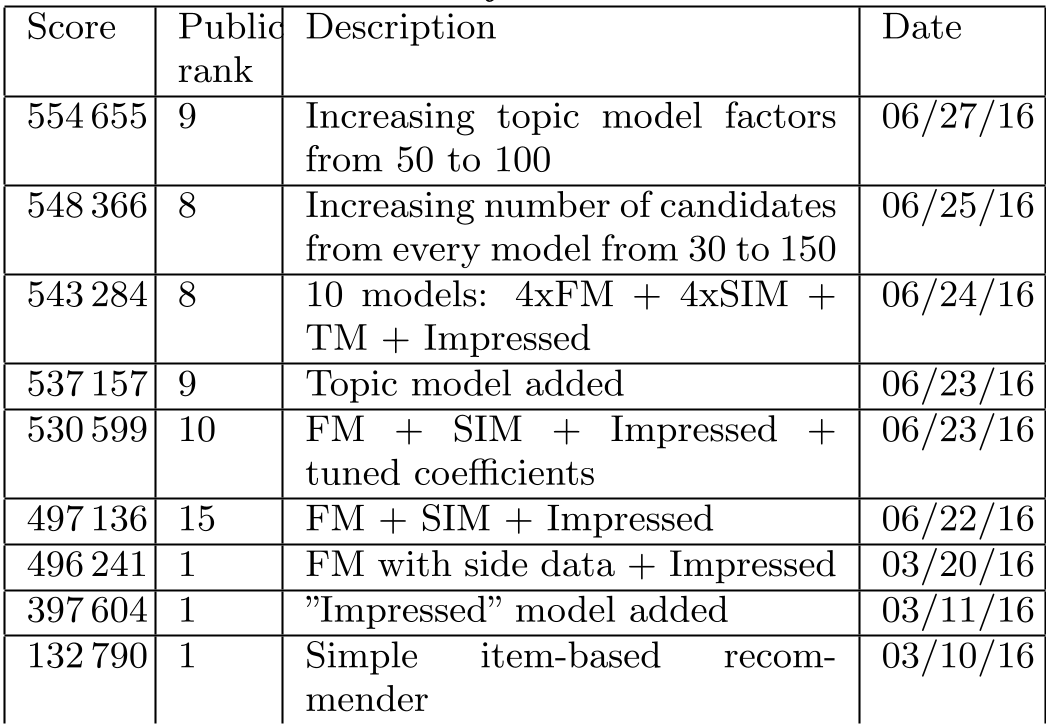 Table 3: Iterative improvements and ranking jumps during the challenge.
Critical Analysis & Conclusion
Takeaway
This paper serves as a masterclass in Feature Engineering vs. Model Complexity. While modern practitioners might jump straight to Deep Learning, this work shows that a well-tuned Factorization Machine combined with simple heuristics (like the "Impressed" feature) can outperform complex black-box models.
Limitations
The primary limitation is the reliance on linear blending coefficients, which were manually or semi-manually tuned. In a production environment with shifting data distributions, a "Meta-Learner" (stacking) approach might be more robust than static blending.
Final Thought
The scalability of these methods (dimensionality reduction and parallel SGD for FM) makes them highly applicable to modern large-scale systems. The lesson is clear: when data is sparse, let the content and the context (impressions) do the heavy lifting.